


US Tech Giants Form Alliance to Standardize AI Agents Amid China’s Expansion
Linux Foundation forms Agentic AI Foundation to standardize AI agents.
The Linux Foundation has established a new organization — the Agentic AI Foundation (AAIF). Its aim is to prevent the fragmentation of the AI agent sector into numerous incompatible, closed products.
The foundation will serve as a neutral environment for the development of open projects in the realm of digital assistants. Key contributions to the initiative’s launch were made by:
- Anthropic — provided the Model Context Protocol (MCP), a standard for connecting models to external data and tools;
- Block — opened the platform for digital assistants Goose;
- OpenAI — proposed the AGENTS.md solution, an instruction file for simplified setup of development tools in repositories.
The MCP ecosystem already encompasses more than 10,000 active public registries.
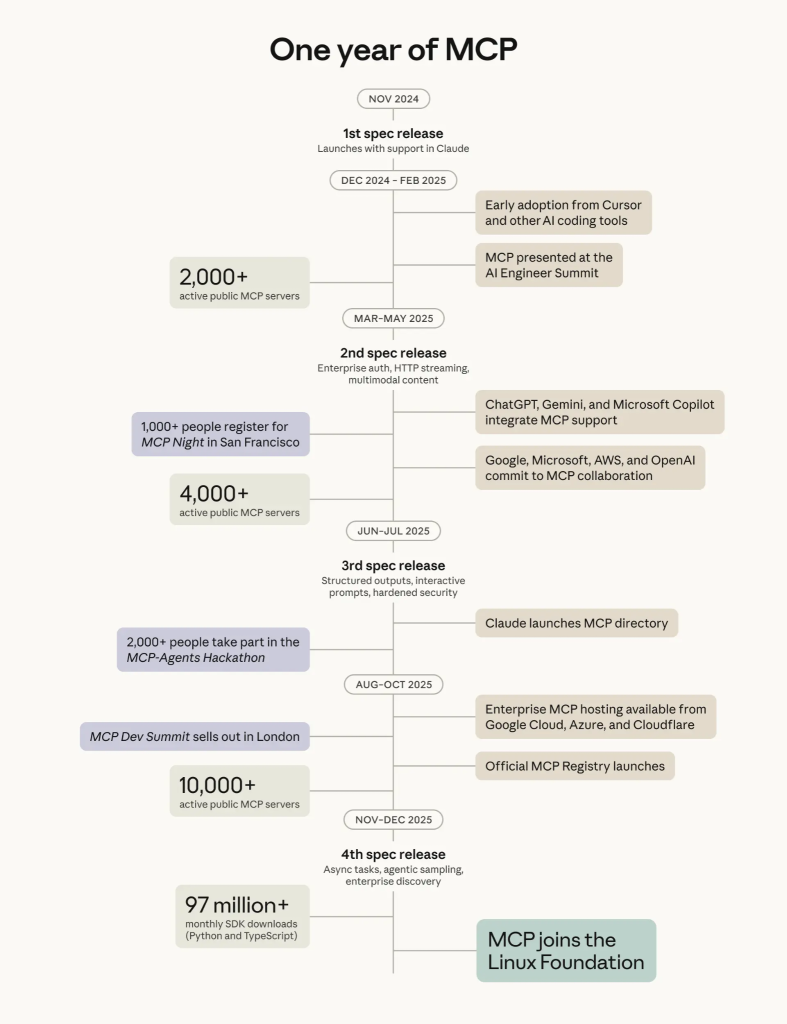
The tools are positioned as the foundational infrastructure in the era of AI agents.
Other members of AAIF include AWS, Bloomberg, Cloudflare, Google, Cisco, Datadog, Docker, IBM, Oracle, SAP, Snowflake, Twilio, Hugging Face, Uber, SUSE, and others.
OpenAI developer Nick Cooper noted that protocols are a “common language.” They allow different agents and systems to work together without the need to recreate integrations.
“We need several protocols for negotiation, communication, and collaboration. This will benefit people, and such openness and interaction are why there will never be a single host or company,” he said.
Linux Foundation Executive Director Jim Zemlin stated that the initiative aims to avoid “walled gardens” of proprietary stacks that block the connection of tools, management, and behavior of AI agents.
“By bringing these projects together under the AAIF, we can coordinate interaction, security models, and leading practices specifically for AI assistants,” he noted.
Competing with China
A study conducted by MIT in December 2025 showed that China leads in the number of global open-source AI downloads, accounting for 17.1%. The US figure stands at 15.8%.
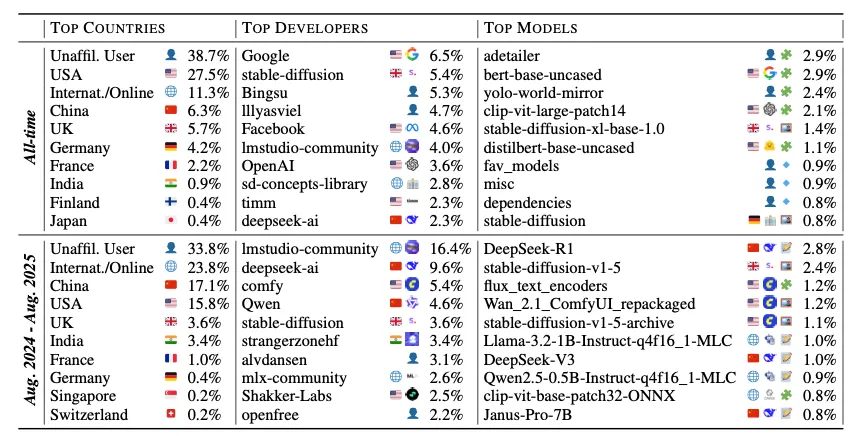
DeepSeek, Alibaba, and others have filled the market with high-performance models, while their American competitors have focused on closed APIs in pursuit of profit.
Chinese open-source neural networks create technological dependency: developers worldwide build their work on this infrastructure, reducing the influence of American suppliers.
Funding
The new organization is funded through a dedicated fund. Companies can contribute money via membership fees.
Zemlin emphasized that project roadmaps are set by technical steering committees. No group member has unilateral voting rights when choosing the direction of activities.
“An early indicator of success will be the development and adoption of common standards used by agents worldwide,” added the Linux Foundation Executive Director.
Cooper from OpenAI considers the “evolution of standards” a success — their systematic development and the regular emergence of new proposals.
The unification of rules saves developers time when creating customizable connectors. It also achieves more predictable agent behavior in codebases and simplified deployment in security-oriented ecosystems.
Back in November, Microsoft experts introduced an environment for testing AI agents and identified vulnerabilities inherent in modern digital assistants.
Рассылки ForkLog: держите руку на пульсе биткоин-индустрии!