



US Uncovers $2.5 Billion AI Chip Smuggling Scheme to China
US detains Super Micro co-founder for $2.5B AI chip smuggling to China.
US authorities have detained Yi-Xiang “Wally” Liao, co-founder of Super Micro Computer. He has been charged with smuggling AI chips to China worth $2.5 billion, according to a press release from the Department of Justice.
Other accused individuals include Rui-Zang “Steven” Chang, general manager of Super Micro’s Taiwan office (currently wanted), and third-party broker Ting-Wei “Willy” Sun (detained).
According to the investigation, the suspects misled inspectors, forged documents, and used complex transit shipping schemes involving an intermediary company to conceal the true destination of the AI chips.
“Such schemes generate billions of dollars in illegal profits and pose a direct threat to US national security,” stated Jay Clayton, prosecutor for the Southern District of New York.
Authorities claim that the accused and others conspired to systematically redirect servers from the American manufacturer with specific GPU to China without a license from the Department of Commerce. The scheme operated as follows:
- Liao and Chang instructed executives of a company in Southeast Asia to place orders with the US manufacturer for servers.
- The systems were assembled in the US, then shipped to facilities in Taiwan, and from there to the company involved in the case in other Southeast Asian countries.
- The firm then repackaged the servers in unmarked boxes to conceal their contents before shipping them to final destinations in China.
Between 2024 and 2025, the company purchased equipment worth $2.5 billion from the US manufacturer.
Authorities reported that the accused and their accomplices took extensive measures to conceal the scheme. They manufactured thousands of fake servers to deceive American compliance auditors.
Surveillance footage shows Sun personally overseeing the process of replacing serial number stickers, with employees using a hairdryer for the task.
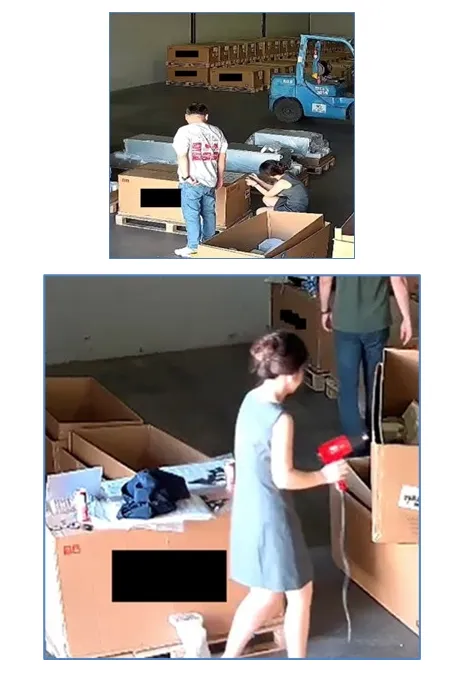
Liao, Chang, and Sun are charged with three counts of conspiracy to:
- violate the Export Control Reform Act (maximum penalty of 20 years imprisonment);
- smuggle goods from the US (up to five years);
- defraud the United States (up to five years).
Rumors of Smuggling
Reports of smuggling banned export chips have surfaced over the past few years.
In December 2024, media reported that the US Department of Commerce approached Nvidia to determine how the corporation’s products ended up in China.
In turn, the tech giant asked major distributors — Super Micro and Dell Technologies — to vet their clients in Southeast Asia.
At that time, five different participants in the smuggling scheme claimed they “managed to avoid detection during Super Micro’s inspections.”
In July 2025, it became known that chips worth about $1 billion were smuggled into China within just three months following the tightening of export controls by the Trump administration.
According to the Financial Times, the B200 became the most popular and accessible processor on the black market.
In December, new rumors of smuggling emerged. At that time, Nvidia developed technology to verify the location of its processors.
The feature was introduced privately and offered to clients as an option. The tool uses “confidential computing capabilities of graphics processors.”
The software is designed to “track the overall performance of the chip.” This is reportedly standard practice among companies that purchase processors in large batches for major data centers.
The location of semiconductors is determined by analyzing the latency in data exchange with Nvidia servers. The corporation plans to make the software open source so that third-party researchers can study it.
In December 2025, Trump authorized the sale of H200 AI chips to “approved clients” in China and other countries, provided the US receives 25% of the profits.
Рассылки ForkLog: держите руку на пульсе биткоин-индустрии!