



Validator Activity in Ethereum Drops 25% Following Fusaka Deployment
Validator activity in Ethereum drops 25% following Fusaka deployment.
Shortly after the deployment of Fusaka, a malfunction occurred in the popular consensus client Prysm, disabling a portion of Ethereum validators.
🚨 We have identified the issue and have a quick workaround. All nodes should disable Prysm to unnecessarily generate old states to process outdated attestation. To do this, simply add the following flag to your beacon node. This flag works with v7.0.0 and you do not need to…
— Prysm Ethereum Client (@prylabs) December 4, 2025
An error was discovered in client version v7.0.0, causing unnecessary generation of outdated blockchain states when processing old attestations.
As explained by lead developer Terence Tsao, the issue disrupted the proper functioning of nodes using this client. Experts provided a temporary solution to disable the problematic feature.
However, at epoch 411,448, key network metrics sharply declined. Only 75% of nodes were signing current block headers, and participation in consensus fell to 74.7%. Ethereum was on the brink of a full-scale failure, with less than nine percentage points remaining before a complete halt in block finalization.
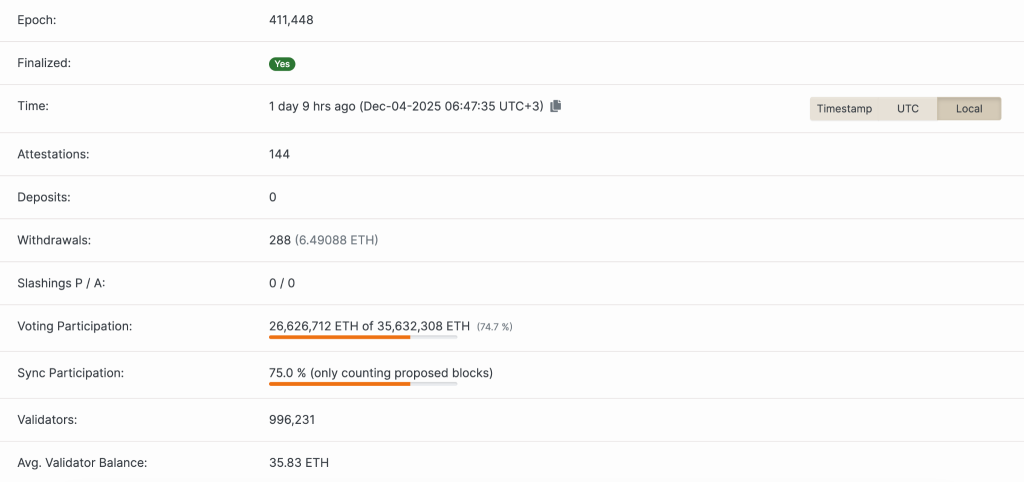
As of the current epoch (411,760), the network’s operation has normalized. Metrics have nearly returned to pre-crisis levels:
- consensus participation: ~99%;
- synchronization: ~97%.
Before the incident, these values consistently exceeded 99%.
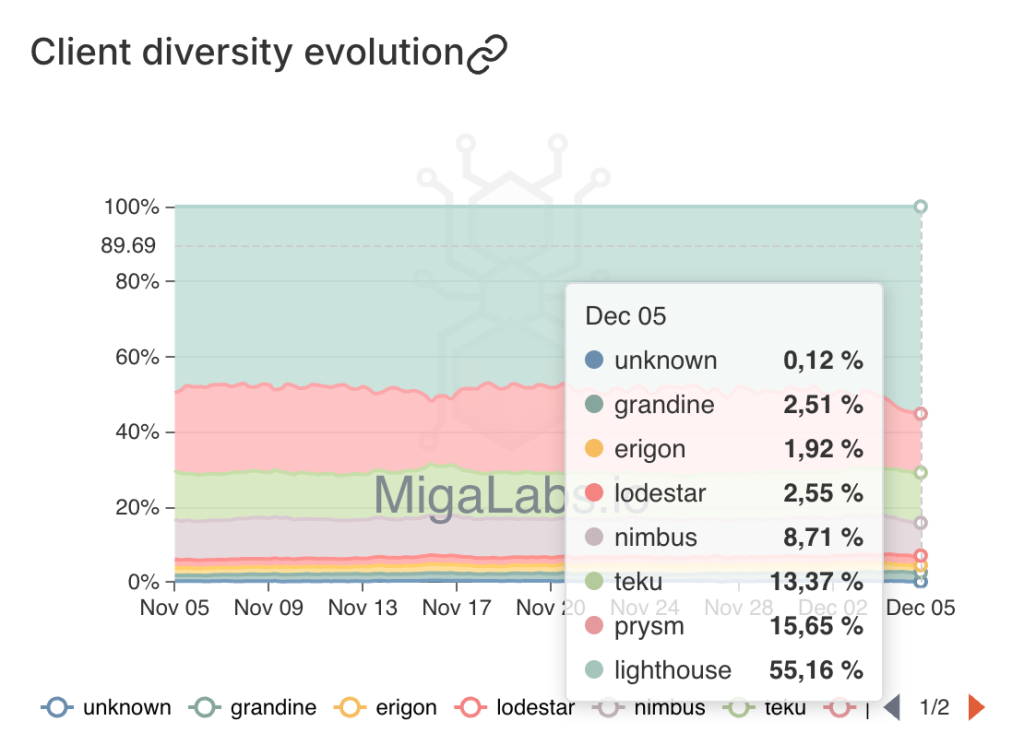
The drop in consensus participation roughly corresponds to the share of validators using the Prysm client. On December 3, it was estimated at 22.71%, now it stands at 15.65%.
Critical Threshold
According to Ethereum’s consensus rules, the network loses finalization if validator participation in voting falls below the critical mark—two-thirds of all staked ether.
In such a state, new blocks are created, but the chain ceases to be irreversibly confirmed, sharply increasing the risk of transaction history reorganization. Loss of finalization would trigger a cascading failure across the ecosystem. Potential consequences could include:
- freezing of fund withdrawals via L2 bridges and rollups;
- increased number of confirmations required for exchange deposits;
- a heightened risk and uncertainty mode across all financial activities on Ethereum.
This scenario is not hypothetical. In May 2023, Ethereum already experienced finalization failures—twice in one day. The cause then was data processing errors in the Prysm and Teku clients.
Insufficient Client Diversity
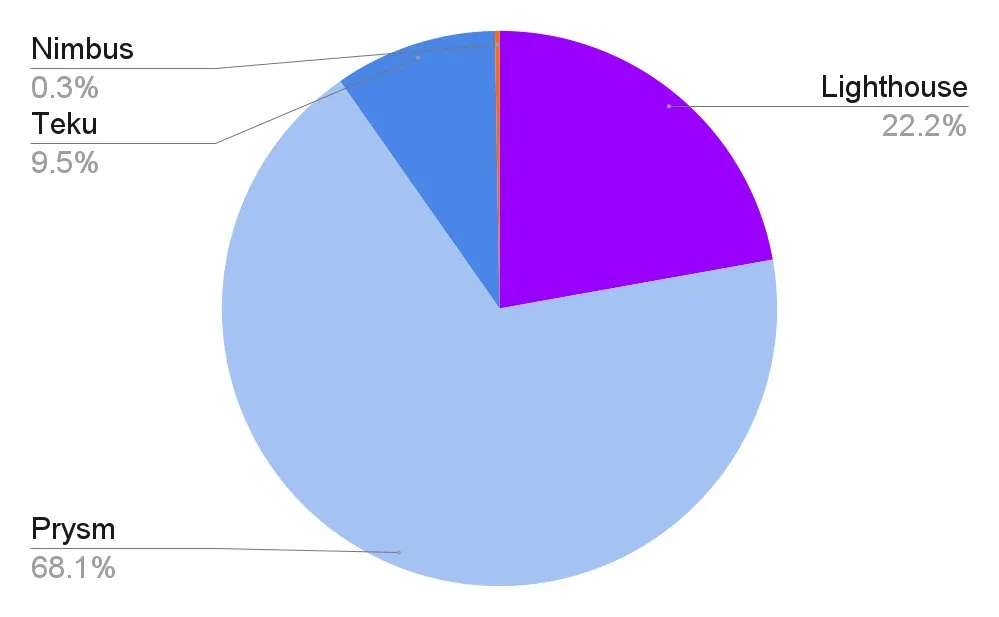
The current incident seemed relatively localized, but historically the risk was much higher. In autumn 2021, Prysm controlled over 66% of nodes—an error in it alone could have paralyzed the entire network.
By January 2022, its share was 68.1%, leaving the network in a vulnerable position.
Despite some progress, Ethereum remains far from a safe distribution of clients. A critical threshold is considered to be 33% for a single client. Currently, Lighthouse dominates with a 52.55% share.
“We avoided disaster by sheer luck. Had the error occurred in Lighthouse, the network could have lost finalization,” commented Ethereum expert Anthony Sassano.
Earlier in September, a failure occurred in the execution layer client Reth by Paradigm. The bug led to a halt in node synchronization using this software.
Рассылки ForkLog: держите руку на пульсе биткоин-индустрии!