




In the sixth part of his essay “Possible Futures of the Ethereum Protocol,” Vitalik Buterin explored blockchain improvements during the roadmap phase known as The Splurge, focusing largely on the Ethereum Virtual Machine (EVM).
Possible futures of the Ethereum protocol, part 6: The Splurgehttps://t.co/OabLldVCqj
— vitalik.eth (@VitalikButerin) October 29, 2024
“Today, the EVM is difficult to statically analyze, complicating the creation of highly efficient implementations, formal code verification, and the development of additional extensions over time. Moreover, the mechanism is extremely inefficient, making it challenging to implement many forms of advanced cryptography unless explicitly supported through precompilation,” noted the Ethereum co-founder, highlighting a major issue.
To address this, a key step will be the introduction of the EVM Object Format (EOF). This is a set of EIPs that will define a new version of the virtual machine with several features:
- separation between code and data;
- prohibition of dynamic jumps (only static ones will remain);
- no tracking of gas-related information by the code;
- a new subroutine mechanism.
Once EOF is implemented, further updates will be easier, which is why the upgrade is tentatively included in the upcoming hard fork Pectra, Buterin noted.
Another important task of The Splurge phase is the full implementation of account abstraction.


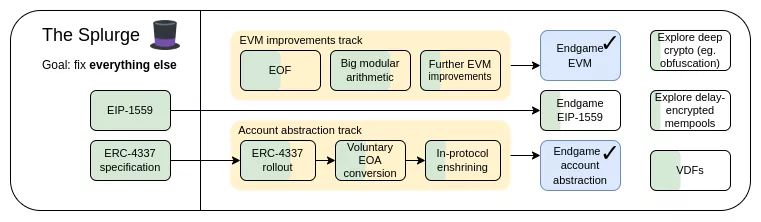
This will allow for transaction verification using not only ECDSA signatures but also arbitrary EVM code. User accounts will be able to initiate operations as smart contract wallets, not just as externally owned accounts (EOAs).
According to Buterin, implementing this option will enable several further improvements:
- transition to quantum-resistant cryptography;
- introduction of multi-signature and social recovery wallets;
- key segregation for high and low-cost operations;
- the ability for privacy protocols to operate without relays.
Another direction of The Splurge is a more efficient allocation of network bandwidth through the implementation of the “multidimensional gas” concept. This EIP-1559 improvement envisions different prices and limits for various computational resources.
In the long term, the Ethereum team will continue research in code obfuscation (deliberate hindrance of decompilation and modification) based on the ZK-SNARK protocol and homomorphic encryption, as well as quantum one-time signatures. These solutions will render the blockchain immune to a 51% attack, Buterin emphasized.
“If such primitives are made sufficiently efficient, most applications in the world can be decentralized. The main bottleneck will remain the verification of correct implementation,” he concluded.
In the previous part of the essay, the Ethereum co-founder examined solutions to the problems of blockchain bloat and increasing complexity.