




Ethereum co-founder Vitalik Buterin has highlighted the network’s bloating and increasing blockchain complexity over time as major issues, and has explored potential solutions.
Possible futures of the Ethereum protocol, part 5: the Purgehttps://t.co/ccGZDxgT6O
— vitalik.eth (@VitalikButerin) October 26, 2024
In the fifth part of the essay “Possible Futures of the Ethereum Protocol” titled The Purge, he pointed out two main “weak points” in this plan:
- Historical data — every completed transaction and account must be stored by all clients indefinitely and loaded during synchronization. As a result, this volume grows even if the network capacity remains unchanged;
- Protocol functions — it is much easier to add a new one than to remove an old one, leading to increased code complexity.
“For Ethereum to sustain itself in the long term, we need strong countermeasures against both these trends, reducing complexity and bloat over time. But we also need to preserve one of the key properties that make blockchains great: their permanence,” Buterin emphasized.
At the time of writing, a fully synchronized Ethereum node requires approximately 1.1 TB of disk space for the execution client and “several hundred gigabytes” more for the consensus client.
One natural solution Buterin considers is for each node to store only a small percentage of the data. This is linked to one of the main goals of The Purge phase — simplifying the launch of clients on users’ PCs.
As a result, a network of 100,000 nodes could be achieved, each containing a random set of 10% of historical information. Replicating these parts 10,000 times would be equivalent to full storage.


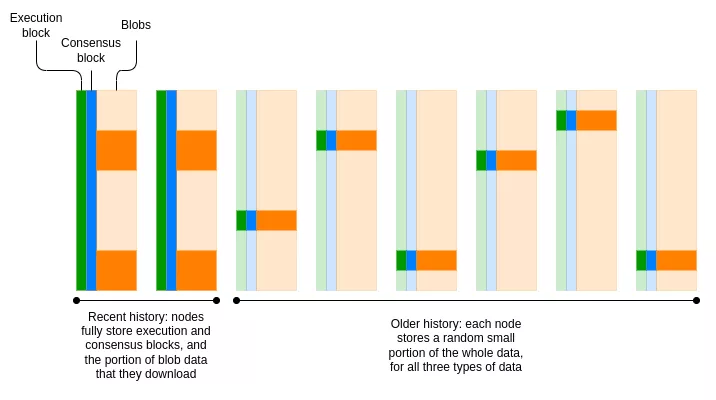
The expert noted that of the 1.1 TB of the execution client, ~800 GB is attributed to history, with the remainder being state data.
Reducing the volume of the latter can be achieved by implementing expiration dates for storage, as well as partial data availability with the option of full “resurrection” if necessary, Buterin believes.
Regarding protocol complexity, he noted that removing “unnecessary” functions will require a compromise in ensuring backward compatibility.
“There is no single solution that could reduce protocol complexity; the inherent nature of the problem is that there are many small fixes,” the programmer acknowledged.
Some improvements, such as removing old transaction types, permanently removing the Beacon Chain committee mechanism, or harmonizing data formats, are relatively easy to implement. Changes for other options, mostly “hardwired” into the EVM, will require more analysis and technical work, Buterin believes.
Earlier in the fourth part of the essay, the Ethereum co-founder explored ways to reduce network state data storage using Verkle trees and other technologies.