




Despite the collapse of TerraUSD (UST) and the market’s ‘multitude of imperfect’ stablecoins, the industry should not abandon projects in this category, said Ethereum founder Vitalik Buterin.
Two thought experiments to evaluate automated stablecoins:https://t.co/gqPKb42tL8
— vitalik.eth (@VitalikButerin) May 26, 2022
According to Buterin, the UST collapse drew increased attention to DeFi financial mechanisms and cryptographic models promising higher yields for users. He stressed that he welcomes this, but does not agree that all stablecoins are painted with the same brush.
“We don’t need boosterism or excessive pessimism toward stablecoins, but rather a return to principled thinking,” he wrote.
The Ethereum founder said that the resilience of a “stablecoin” can be assessed with two thought experiments.
In his view, the first question to answer is whether a stablecoin can safely “wind down” to zero for users. He explained that if activity on the project’s markets falls “almost to zero,” holders should be able to extract fair value from their investment.
Buterin cited UST as an example of an asset that fails this test. The reason: the stablecoin’s collateral structure tied to LUNA’s pricing. In his words, the latter must support its price and user demand, otherwise the project faces collapse.
“First the price of the collateral asset falls. Then the shock is transmitted to the stablecoin itself. The system tries to support demand for the stablecoin by issuing more collateral. Because trust in the system is low and buyers are few, the price of the collateral falls quickly. When the price of the latter is close to zero, the stablecoin collapses,” he explained.
Buterin stressed that such UST-like assets could pass the thought experiment if demand declines slowly. However, such a scenario is “extremely unlikely.”


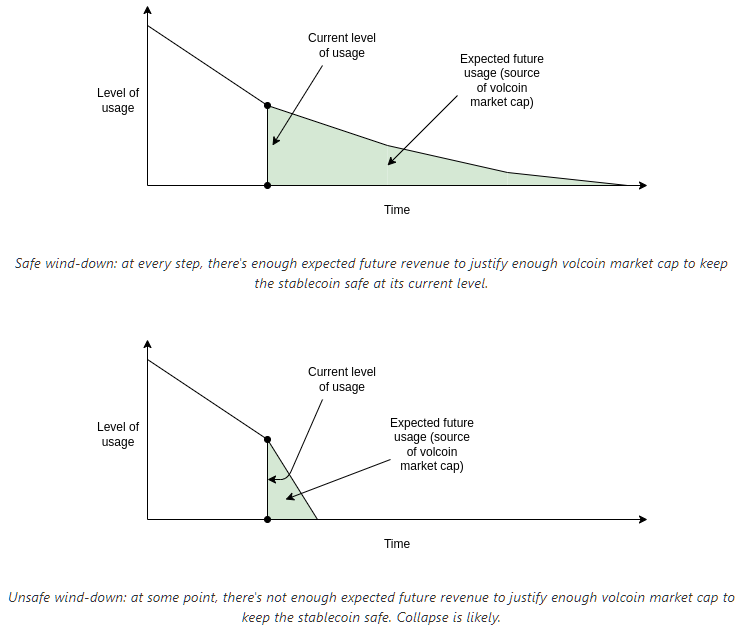
As a stablecoin that passes the test, Buterin named RAI from Reflexer Labs. It operates on a DAI-like scheme and is an overcollateralized ETH-stablecoin.
“The security of RAI depends on the external asset outside the stablecoin system (ETH), so RAI is much easier to unwind safely,” he noted.
According to Buterin, the second question that would help assess a stablecoin’s resilience is what happens if it is pegged to an index that grows 20% per year.
In such a scenario, the project behind the stablecoin should be able to set a negative interest rate, otherwise it will become a Ponzi scheme, the Ethereum founder noted.
“For a stablecoin that tries to track such an index, there are two possible outcomes. It charges holders a negative interest rate, effectively offsetting growth, and it becomes a Ponzi, delivering holders a spectacular return for a period,” he wrote.
Buterin stressed that negative interest rates can be implemented in RAI. That capability was not available in UST.
That said, he added that meeting this condition does not make the asset “safe.”
“It can still be unstable for other reasons (for example, insufficient collateralization), have bugs or governance-related vulnerabilities.”
Earlier, Tether’s chief technology officer Paolo Ardoino described TerraUSD as a poorly designed product.
Follow ForkLog’s Bitcoin news on our Telegram — crypto news, rates and analysis.