



In November 2022 Ethereum cofounder Vitalik Buterin published a post on the evolution of scaling solutions. He urged rollup teams to standardise their decentralisation milestones and introduced the notion of “training wheels.”
In September 2024 Buterin returned with a call for a unified vision of the Ethereum ecosystem and the removal of centralising factors. He demanded that L2 developers reach “Stage 1+” by 2025, or he would keep publicly silent about such rollups.
ForkLog’s newsroom set out to unpack the cofounder’s ultimatums and explain the essence of the projects’ “stages” of autonomy. This piece looks at how L2BEAT analysts helped adapt the complex theory and which projects got to full decentralisation first.
The community adapts the theory
Over roughly seven years, layer-2 solutions have benefited the blockchain industry. They have lowered the barrier to entry for DeFi investors, improved user experience and helped users save on transaction fees. Developers and Web3 enthusiasts gained a proving ground and generous early airdrops.
More than a hundred scaling solutions use different architectures with trade-offs between trust minimisation and centralised control. When the balance tilts toward the latter, it means transaction censorship and attracts undue attention from attackers. Centralisation throws the blockchain’s defence out of kilter, enabling attacks of power or scale (Sybil attacks, DDoS attacks on server nodes).
After “training wheels” were first mentioned, the ecosystem entered a new phase of maturity. Buterin explained that a project’s initial centralised phase is inevitable. The key is to keep the “training wheels” temporary—needed only to ship upgrades and fix bugs in a controlled environment. In the end, “the wheels should come off” so that L2s fully inherit the base layer’s (L1) security properties of Ethereum.
Buterin highlighted the value of the L2BEAT analytics platform. He proposed adding the “stages” to its Risk Analysis category, easing the burden of technical jargon for non-specialists.
The response was swift—within ten days L2BEAT cofounder Krzysztof Kaczor produced a trial version. He set out the team’s view and delivered a test Stages interface.


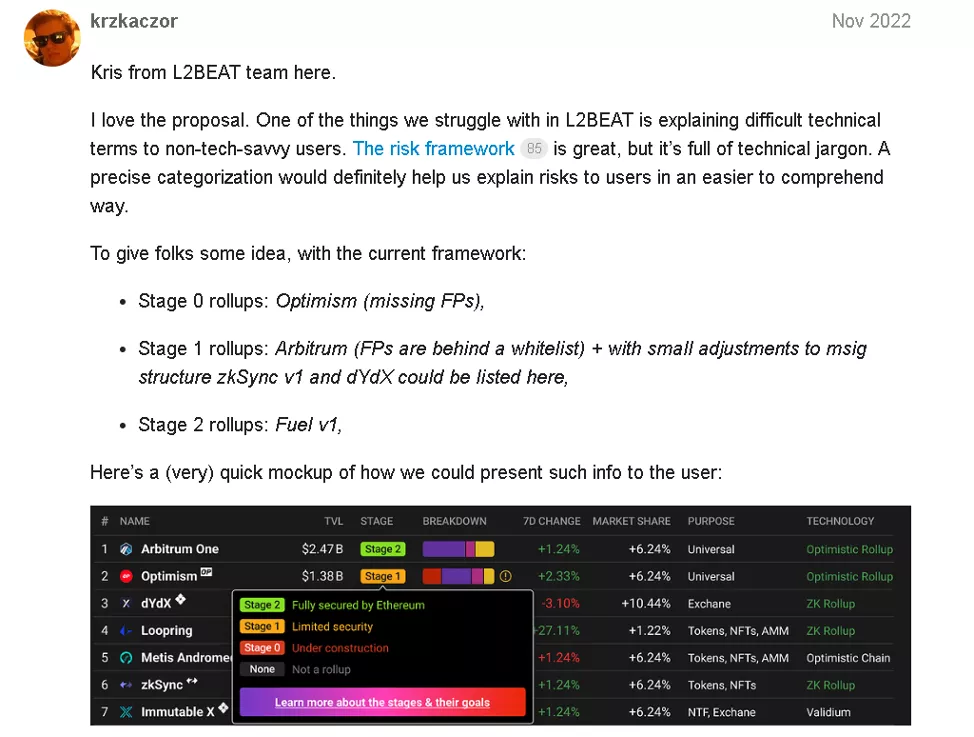
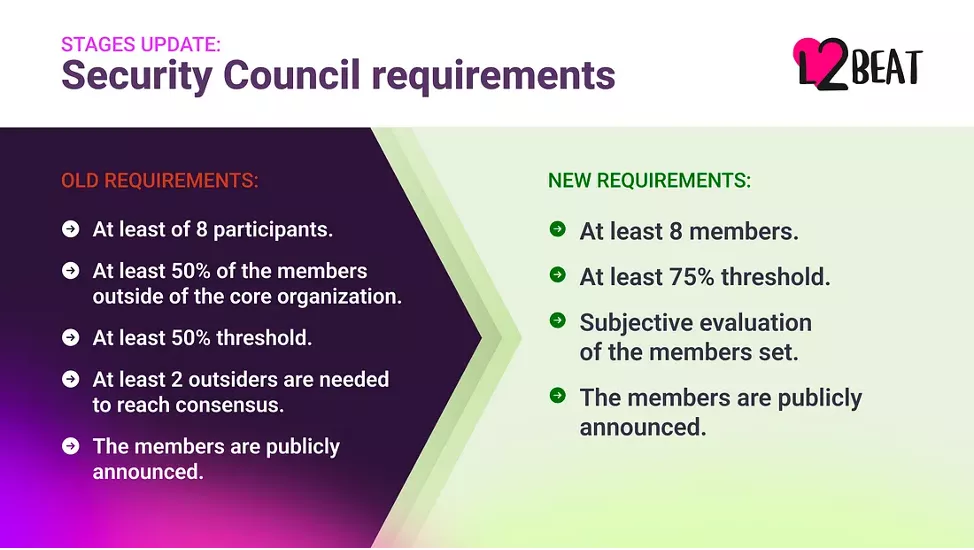
By the summer of 2023 the final Stages Framework was ready, with a detailed description of each rollup-evolution step. In December an update addressed the powers and quorum of the Security Council. It is elected by vote and comprises core developers and external participants. The Council is represented by a corresponding number of signing keys of a single governance multisig wallet.

Rollups today sit at an intermediate stage of decentralisation, relying on a mix of on-chain and off-chain data and creating security trade-offs.
In Buterin’s vision, “proper” L2s should lean as much as possible on cryptography, sidestepping human unpredictability and moving toward the following changes:
- a shift from centralised nodes (sequencers) that set transaction order to a network of independent validators;
- use of trustless, permissionless cross-chain bridges to move assets or data between networks. Full decentralisation implies no party controls the protocols;
- distributed control to reduce the likelihood of censorship. With a single operator or bridge, it is easier to pressure it to block a transaction;
- trustless, permissionless systems for generating proofs such as ZKPs, with fully homomorphic encryption (FHE) in the future. Today proofs are generated by a limited set of centralised parties, but full decentralisation would let anyone participate;
- fully decentralised governance via a DAO, gradual curtailment of the Security Council’s powers, moving away from multisig technology and using decentralised infrastructure in the spirit of DePIN.
The stages of rollup maturity
With Buterin’s input and consultations with leading industry players, L2BEAT analysts laid out requirements for rollups’ phased transformation—from zero to second stage. Their synergy is reflected in three “training wheels” stages:
- Stage 0, or “with training wheels.” A project must call itself a rollup, meaning all transactions must be posted on-chain. While effectively under manual operator control, it must be possible to run a full node with open-source software. This helps reconstruct the data posted to L1 and compare their state root hashes. One vector remains for locking funds and censoring user transactions—the team can post false proofs to Ethereum;
- Stage 1, or “partially with training wheels.” Governance shifts to smart contracts. Creating a Security Council to guard against potential errors is allowed. This stage features a fully functional proof system, decentralised submission of fraud proofs and the ability for users to exit without coordinating with the operator. Major changes require Council action with six of eight votes or a 75% consensus. At least 26% of members must be outside the core team;
- Stage 2, or “without training wheels.” Decentralisation is achieved with full smart-contract control. Users are given more than 30 days to exit in the event of undesirable upgrades, with protection against governance attacks. The Security Council’s role is strictly limited to correctness failures, such as assuming control if no transactions are confirmed for more than seven days.
A scaling phenomenon — Fuel Network
Buterin’s September 2024 “ultimatum” likely gave L2 developers pause. Given that most solutions are Validiums or Optimiums, they will not reach Stage 0.
The Ethereum cofounder allowed a “short grace period” for new and genuinely interesting projects, but kept a hard line for 2025.
“It does not matter whether I invested or you are my friend; Stage 1 or collapse,” he emphasised.
Several ZK-rollup teams told Buterin they were on track to reach Stage 1 by year-end. He said he “looks forward to it.”
According to L2BEAT, at the time of writing the “Rollups” category lists 51 projects, of which only two have reached Stage 2—Fuel v1 and DeGate v1. And only four have Stage 1 status: Arbitrum One, OP Mainnet, ZKsync Lite and dYdX v3.
Consider briefly a phenomenon in scaling—Fuel Network.
Fuel v1 launched in 2020 on Optimistic Rollups with a focus on payments. It became one of the first Ethereum rollups and the first Stage 2 project.
The developers later chose a modular approach, positioning the system as an execution layer for various blockchain configurations.
To enable parallel transaction processing Fuel Network uses FuelVM—an alternative to the Ethereum Virtual Machine (EVM). The UTXO model helps detect and isolate transaction dependencies before execution. The rollup uses implementations of the Rust and Solidity programming languages, targeted at a specific task—Sway.
In 2022 Fuel Labs raised $80 million from Blockchain Capital and Stratos Technologies.
As of October 14, 2024 Fuel v1’s metrics look like a deserted forest with no residents but perfectly “green” security indicators. TVL sits at around ~$800. The network nevertheless attracts developers’ attention for testing.

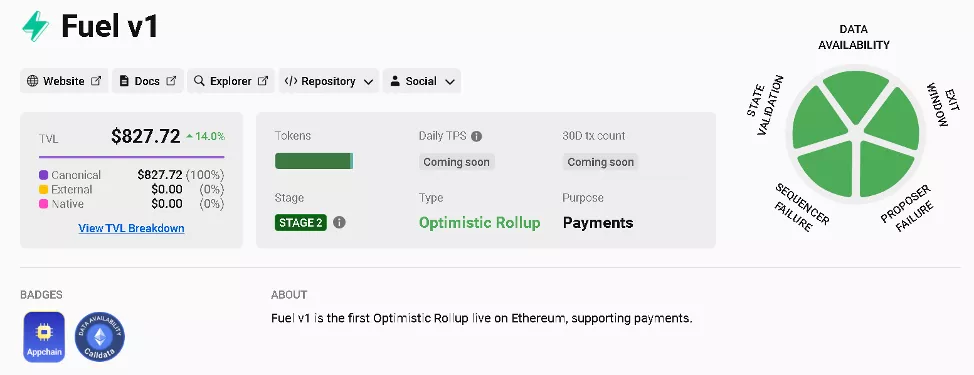
Analyst Krzysztof Kaczor, who helped adapt the Stages, ran a test of safety under full decentralisation, in a network that was practically empty at the time. He wanted to see whether a fraud proof would work with a TVL of ~$10, without any visible network provers. After a few minutes Kaczor received a penalty from an Ethereum layer-one security validator of 0.5 ETH. The experiment succeeded, demonstrating the autonomy of the decentralised conditions Buterin calls for.
On February 21, 2024 Fuel—positioning itself as “the world’s fastest modular execution layer”—introduced Rollup OS. According to the developers, the “operating system” is an evolution of the Fuel v1 platform. The technology aims to eliminate the “critical constraints” inherent in current architectures.
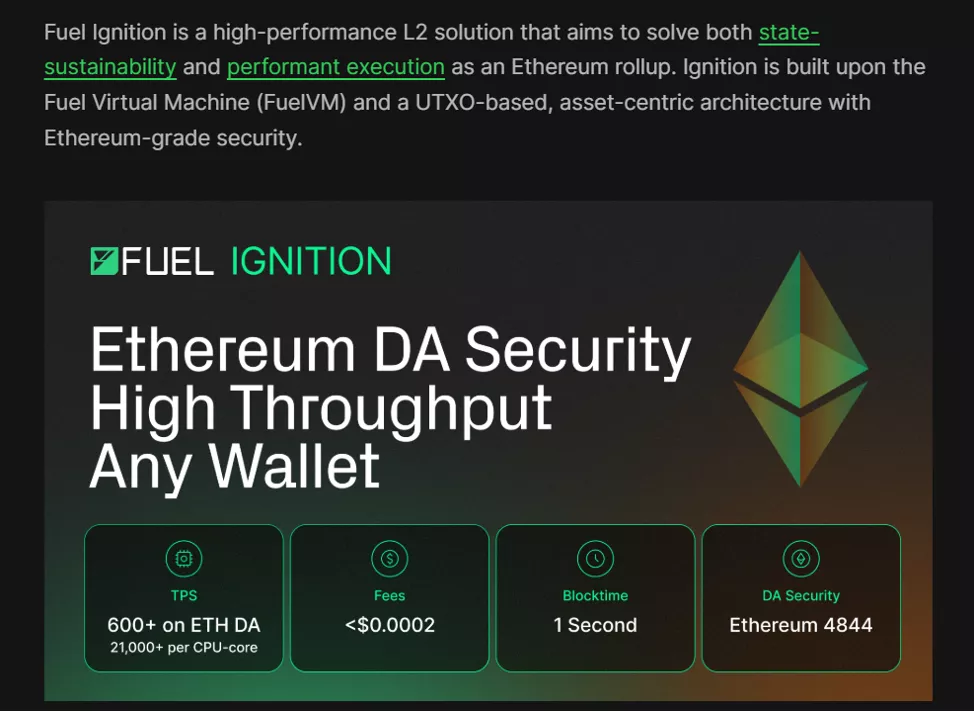
On October 16, 2024 the Fuel Ignition (Fuel v2) mainnet launched. At the outset the project is at Stage 0, but the team promises to raise security quickly, as with the first version, and “take off the training wheels.” To that end they use a permissionless hybrid fraud-proof system—hybrid zero-knowledge proving.

According to DeFi Llama, a month after launch the platform’s TVL exceeds $38 million.
On November 8 the DeFi protocol Spark deployed an order book on Fuel Ignition for fast and secure trade execution.
An optimistic forecast
In June 2024 the OP Mainnet team integrated Cannon fault proofs into its smart contracts, reaching Stage 1. According to the team, in the long term Optimism will reach a “multi-proof nirvana,” in which several systems are used to ensure the sequencer confirms valid transactions. At least four other OP Stack networks will soon join the system, including Base, Metal, Mode and Zora.
Optimism cofounder Karl Floersch told Cointelegraph that the move to the second stage would be “fast and decisive.” In his view, reaching it is a complex process because it requires multiple proof systems and because these are “the most security-critical code with an incredible level of assurance.” Even so, he expects his network to get there soon.
Floersch also says that once one network reaches Stage 2, others will quickly follow—thanks to open-source development:
“Once we reach Stage 2, most L2s will also get there. This is the beauty of building open-source ecosystems: the value created through contribution can be shared among all the participants and projects using the standards.”