



VR Sociology: How We Turn Ourselves into a Spectacle
Matrix — a podcast series from ForkLog in which we examine how the digital environment is transforming with the advent of VR and augmented reality technologies, and discuss metaverses with pioneers: entrepreneurs, researchers and philosophers. In this episode, sociologists Maria Yerofeyeva and Nils Klovait explain how virtual reality entered their field of study and why we have not yet even approached an adequate understanding of the role of this technology in society.
ForkLog: How would you briefly define what you do?
Nils: We are multimodal micro-sociologists. This means we are interested in how people in daily life achieve practical goals. How they order coffee in a cafe, how they exit the subway, how they cross the street and what resources they use — gestures, glances, voice, intonation. And separately we study how the social world transforms when we add new technologies to it, and how, within these frames, virtual reality is contextualized. My current main project is a study of human–artificial intelligence interaction at the University of Paderborn.
Maria: The word ‘micro sociology’ contains a key part — ‘micro’. We look at human interactions at a small scale, while classical sociology turns to the macro level — classes, society. Qualitative methods are best suited to solving our tasks, that is, those that aim to answer the question ‘how?’. For example, what practices do people generally use to interact.
Currently I’m starting a postdoc at the Free University of Brussels, which will be entirely devoted to a socio-ethnographic study of virtual reality. In particular, I will study what people do in VR, what meanings they attach to their actions, how their identities are formed, how they form communities.
ForkLog: What problems does VR pose for sociologists?
Nils: Let me give such an example. When technological mediation of interaction occurs, as in VR, some notions that seemed self-evident change. For instance, micro-sociology was defined as the discipline that deals with the space of mutual visibility and audibility. And now this question becomes very problematic. What I say in a room now reaches you after a certain delay. Accordingly, it is quite possible that the order of events that for me is 1-2-3, for you due to connection glitches may become 1-3-2. Moreover, physical co-presence falls out of sociological research. In VR it is not mandatory.
Maria: Technologies pose a serious challenge to sociological theory. This in itself is very inspiring: an empirical object emerges that makes us think, study, and formulate new conceptualizations.
ForkLog: When did micro-sociologists start taking an interest in VR?
Maria: A historian of virtual reality would answer roughly as follows: VR is a long-standing phenomenon that arose in the 1970s–80s. But back then the technologies were extremely expensive and bulky, used primarily in military and medical laboratories. We are interested in the moment when virtual reality begins to go mainstream, becomes easier to use and accessible to consumers.
The first watershed runs around 2010–2014, when commercial VR headsets appear. The second phase is 2019, when the Oculus Quest came out, not requiring a connection to a gaming PC with a powerful GPU. This gadget began a new page in VR history. It allows a person from the street who knows nothing about it to try virtual reality and perhaps become interested in the technology.
ForkLog: How do you study VR?
Nils: We are primarily videographers — we film everything and then analyse. In addition, we use multimodal conversion analysis. For example, recently my article on how people in virtual reality put on and take off masks in a zombie shooter. In this case I’m interested in how new resources and old bodies shape activity in strange spaces where some things are visible to others, and some elements of bodily action, for example, are not. We also use ethnographic methods to help understand how certain communities in virtual reality develop.
Maria: In any case one of the researchers must be present in VR to record. Accordingly, the question arises: do we remain neutral observers or not. Yes and no. We often preserve anonymity. But when it comes to studying specific communities, we reveal our identities. For example, we began studying a community that teaches sign languages in VR. We told its participants that we were researchers and asked for permission to record. There have been no consent problems yet.
ForkLog: Give an example of some of the most outrageous behavior you have encountered in your research.
Nils: Masha and I early on opened up VRChat space. Wild things happen there all the time. For example, we have video data where one person hands another an object, and the giver sees the object as a bottle of vodka, while the receiver sees it as a pack of chips. Another example: in the same room there are five users. Three of them see only three others, the fourth sees only one, because in virtual reality you can selectively remove people from the room, but it happens only for you. Or, for instance, we are used to the idea that when someone looks at you, they pay attention to you. But in VR avatars can be configured to look at everyone in the room. If you see someone turning their head toward you, that does not necessarily mean they are actually turning their head toward you.
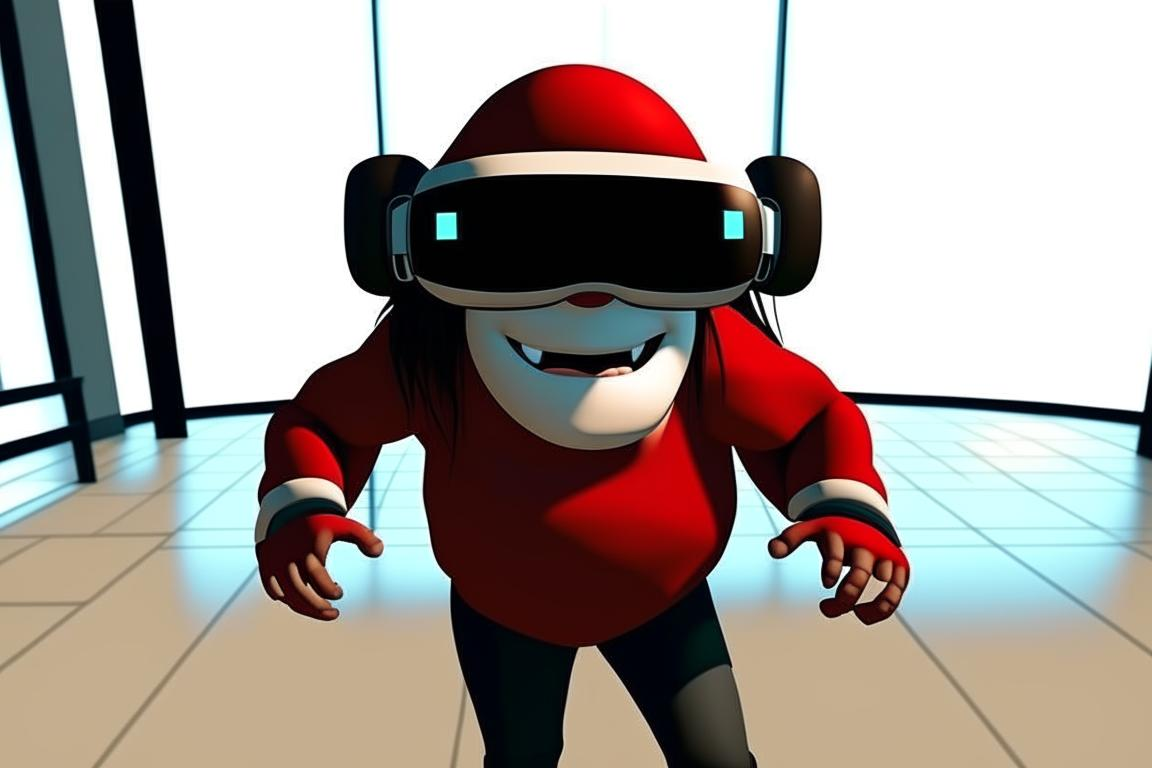
Finally, in VRChat avatars, which we typically think of as bipedal humans, are not at all mandatory. I have seen virtual bodies in the form of kilometer-long roller coasters on which others could ride, in the form of everyday objects, in the form of avatars assembled from multiple avatars. All these appearances affect interaction opportunities. In sum, it’s a colossal field of oddities and curiosities, which, nonetheless, are ordered and organized—and raise a host of questions for sociologists.
ForkLog: Who might be interested in such research?
Nils: On the one hand, our research is avant-garde. We simply dive into the strangest spaces and try to derive tasks from them that we can later present to potential clients in light of corporate pragmatism. On the other hand, we have quite ‘classical’ cases. Then there is a client who asks concrete questions: how does everything in VR happen, what influences the success of a given interaction, what tools do people turn to to achieve practical goals, how can we improve, transform, adapt them?
But VR today is still a solution looking for a problem. We understand that it is cool to be together in a virtual space, but it is a very strange co-presence. For now this space remains in the avant-garde, where we are slowly figuring out what, in general, can be done well with it.
Maria: It is worth noting that we are talking about interaction inside virtual reality. But VR is also used in classical physical environments. For instance, we conducted research on how VR headsets are used in school classrooms. Training is a fairly large segment of VR, including for various complex professions where you need to gain skills to operate extremely expensive machines. In such cases it is cheaper to simulate them.
ForkLog: And do you study metaverses?
Maria: The word ‘metaverses’ carries a lot of hype. But conceptually the notion is too vague. If by metaverses we mean relatively autonomous worlds in which one needs certain technologies to inhabit them and within which activity is not predefined, that is not games but free space where users can decide what to do, then yes, we study such spaces.
Nils: I think the hype around this topic is created by corporations like Meta, which think: if we capture a large part of the future digital infrastructure, we will de facto control a significant element of people’s everyday life and do with it whatever we want. This is a dubious approach.
There is no radical difference between the virtual and physical worlds. Our everyday reality is already in many ways transformed, linked to very distant actors who are not co-present physically. Accordingly, the distinction between mediated and unmediated interaction, ‘meatspace’ as some of our informants put it, and virtual spaces, is breaking down.
Maria: On the one hand, I agree with Nils, but not entirely. Yes, our everyday life is mediated and permeated by technologies, but VR has not yet reached that threshold: it remains bulky and inconvenient. It may merge with daily life as it miniaturizes and simplifies, but it is unclear when that will happen. I do not yet see a clear horizon.
There is also another point: people may use VR to escape ordinary reality, to literally live in an alternate world. That is, users themselves may not link the two realities, but instead distance them.
ForkLog: Nils, what do you think of ChatGPT in relation to your current university research?
Nils: We have no public understanding of what this technology and its iterations can do. Instead there is a huge amount of magical thinking: ‘I’ll sell you such a prompt now because I’m a prompt engineer!’ The very emergence of prompt engineering signals a gap in knowledge about this space, contrasted with the belief that some people have understanding. How real that understanding is or not is a deeply secondary question.
Here also lies the fact that access to ChatGPT is extremely fragmented. Not everyone can use it, not in all countries. There are, of course, people who program with its help and produce highly creative things. There is also a segment of people — I think not a very large one — who are now silent, astonished by the new possibilities, and simply use this thing. For example, me.
As for further development, it is a political issue. Not about whether Microsoft will manage to embed ChatGPT into all its products, so that it sits in our video conferences, reads our correspondence, creates notes in Outlook calendars. It is about whether we want such systems, without our understanding of how they decide, to interact with our world more and more. I have no illusions that their presence will deepen, but what matters is how it is configured socially, how we can defend our boundaries and our voice.
ForkLog: Maria, are you not too scared by AI development?
Maria: I am not afraid at all. I look at it with optimism, because it is a very interesting process that needs to be studied. It is something that gives me work and food for thought.
Рассылки ForkLog: держите руку на пульсе биткоин-индустрии!