



We can scale: how pyramid schemes went crypto
Russia is in the grip of a boom in pyramid schemes. According to the Central Bank’s data, more than 3,700 organisations with the hallmarks of such schemes were identified in 2024—70% more than in 2023 and 93% more than in 2022.
Fraudsters, when explaining high returns to depositors, hide behind cryptocurrency trading and the use of artificial intelligence. By the Central Bank’s count, in 2021 one in two pyramids attracted Russians using digital assets.
How crypto schemes differ from the traditional kind—and why, despite numerous lessons, people still invest in dubious projects—is explained for ForkLog readers by Lina Valitova.
What is a pyramid scheme?
A pyramid scheme is an economic model in which participants’ income is sustained by the continuous influx of funds from new investors. Early backers are paid with the contributions of later ones, not from genuine profits. In such schemes the true sources of income are typically concealed or replaced with false, trivial information—hence the fraud.
The Ponzi scheme
The first pyramid scheme is considered to be the famed Ponzi scheme. In the 1920s the American fraudster Charles Ponzi promised depositors fabulous returns, claiming that his lucrative system was based on exchanging coupons. The scheme rested on simple arithmetic: early investors were paid with the cash of newcomers, and the whole edifice collapsed when the inflow dried up.
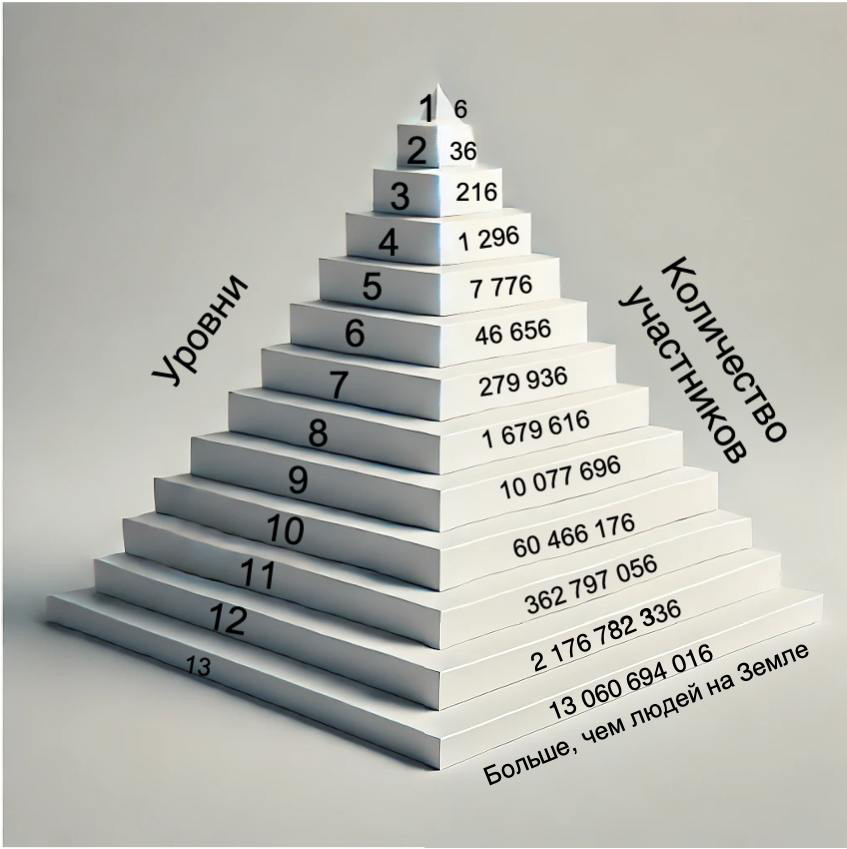
Ponzi is a fairly primitive example of a pyramid in which each participant must recruit six people. The mathematical problem is that by the 13th layer it would require 13.1bn people, far exceeding the human population.
The “Airplane Game”
In the “Airplane Game” pyramid there can be only 15 participants, divided into four levels with their own names. For example: “captain”, “co-pilot”, “crew” and “passenger”. Once the “airplane” fills up, the “captain” exits the pyramid, it splits into two sevens, and all participants automatically move up one level.
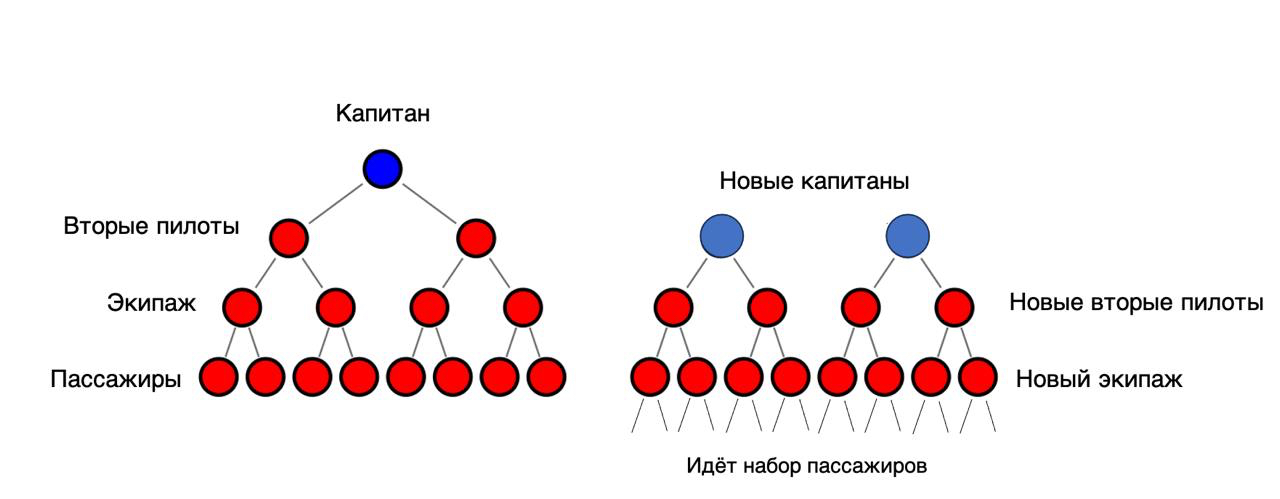
Because the “captain” can return to the scheme as a “passenger”, the pyramid is sometimes called a “Circle of Giving” or a “Fractal of Abundance”. There are also countless variants with metaphorical labels: “Invitation-only Dinner”, “Treasure Traders”, “Living Workshop”, and so on.
The “Airplane Game” is more mathematically stable, but by exploiting opaque transactions and participation terms and using fake accounts for the top levels, scammers typically siphon money to external wallets and eventually topple the pyramid.
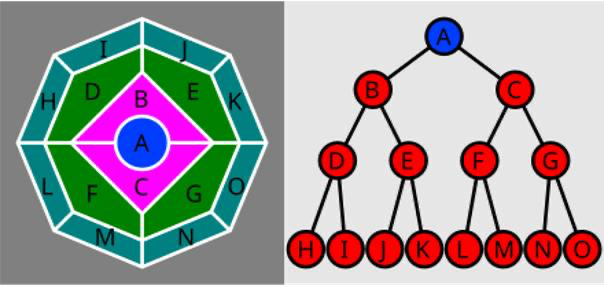
The Ponzi scheme or the “Airplane Game” can be visualised as a circle, essentially a top-down view of a pyramid. Using more elaborate visualisations, fraudsters tout the project as innovative. They insist that by creating new circles participants increase the area of “fabric” on a “loom” and move closer to the centre. These visuals may also be called “fractal mandalas” and feature esoteric references.
Crypto pyramid schemes
Although crypto pyramids are a relatively new phenomenon, dreams of easy money and instant riches are as old as social inequality itself. In the 1830s–1840s Britain’s railway mania drove people to invest blindly in “the key innovation of the 19th century”, ruining thousands. In the 1880s the French The Universal Company of the Panama Interoceanic Canal for several years collected on average up to 200m francs of people’s savings a year. In the early 2000s people invested in dotcoms, and 15 years later—in ICOs.
These examples show that in any era there are people ready to bring money to loud but opaque innovations, often unwilling to delve into the details. Moreover, the murkier, more complex and more ambitious a project appears, the faster it attracts ordinary people. Railways and interoceanic canals have given way to digital assets. Fraudsters deftly invoke successful “moonshot” stories such as Ethereum or Tesla, creating the illusion that their start-up will be the next global giant. They play on FOMO, prompting impulsive decisions and clouding critical thinking.
Yet the same arithmetic underpins crypto scams as classic pyramids. By cloaking a Ponzi scheme in terms like “blockchain”, “smart contracts” and “decentralisation”, creators try to inspire trust and project expertise. In practice such “projects” may not use real technology at all. In OneCoin, the best-known crypto pyramid of Ruja Ignatova, there was no real blockchain: all transactions were recorded in an internal database.
Crypto pyramids often mint their own tokens and pitch them as a revolutionary investment tool. The prices of such assets are controlled by the organisers and do not reflect real value. An example is the Prizm coin, which promised “financial freedom”, but its price plunged as soon as the number of new participants fell.
Fraudsters also benefit from the fact that traditional pyramids are constrained by banking systems, whereas crypto schemes can operate anywhere in the world. In addition, investors contribute in digital assets, making it harder to recover funds if the scheme collapses.
In 2017 the organisers of BitConnect presented it as an investment platform that would earn up to 40% a month thanks to an “innovative trading algorithm”. Participants paid in bitcoin, which was then converted into the platform’s own token (BCC). When the scheme collapsed in 2018, investors were left with BCC, whose price fell almost to zero.
Why do people invest in dubious projects?
The rich history of pyramid schemes shows that, to attract participants, fraudsters exploit basic human instincts and deep-seated attitudes. The authors of the study “Financial pyramids: the arsenal of techniques used to influence the victim” note that offenders most often use tried-and-tested psychological devices to manipulate the perceptions and behaviour of potential victims.
The paradox of regret over missed opportunities
Scammers play on FOMO, which hides a subtle paradox: we feel disappointment about not taking past chances only because we now know their consequences. Remembering when bitcoin cost less than $1, we want to invest back then. Fraudsters exploit this contradiction, persuading us that their project is that very “bitcoin of 2010”. They create the illusion that the past can be repeated exactly and that by investing now we are, as it were, going back in time to make the “right choice”.
Authority bias
People tend to trust authority. Organisers of pyramids often create an illusion of expertise, pointing to ties with famous figures or large organisations. For example, they may cite support from “influential investors” or cooperation with government bodies to shore up audience trust.
Social proof
The example set by people around us strongly influences decisions. Showcasing the number of “successful participants” and their testimonials creates an illusion of reliability. Collective actions, such as singing anthems or taking part in group discussions, heighten the sense of belonging and reduce critical scrutiny.
The illusion of exclusivity
Pyramid schemes are often positioned as closed elite clubs, entry to which is not available to everyone. This stirs a desire to belong to something unique. Using terms such as “investment circle” or “programme for the chosen” amplifies the impression.
Psychological manipulation techniques
These include:
- foot-in-the-door — organisers start with small requests (for example, a minimum investment), which gradually turn into large commitments;
- scarcity effect — an artificially created shortage of time or resources urges quick decisions;
- anchoring effect — an initially inflated valuation of an asset or potential profit makes the real figure seem more attractive.
Emotional manipulation
Emotions play a key role in decision-making. Positive emotions lead people to overrate benefits, while fear or anxiety can push them to invest out of a search for safety. For example, promises of financial independence and protecting children from “global economic threats” create emotional attachment to the project.
Simplicity of language and metaphor
Fraudsters often use accessible language, adding vivid metaphors and comparisons to make complex financial concepts comprehensible. This creates a sense of trust and expertise, especially if the speech is laced with humour or personal stories.
Conclusions
The history of pyramid schemes shows that their marketing evolves with technology, but the essence remains unchanged: the manipulation of human emotions and the promise of easy money. Crypto pyramids are especially dangerous because of their global scale, flashy tech buzzwords and real stories of rapid ascent.
Exposing such schemes and improving financial literacy are key steps to protecting investors in a fast-changing world of digital assets.
Рассылки ForkLog: держите руку на пульсе биткоин-индустрии!