



Web3Eco Tokenizes Trees in Uzbekistan
Web3Eco has tokenized the rights to profits from the sale of trees from plantations in Uzbekistan.
The platform is built on the Polygon network and employs the ERC-1155 standard for tokens, each representing between one and 600 trees, depending on the denomination.
Digital rights to the trees are sold exclusively on the Web3Eco platform for ERA, the project’s utility token, which is traded on exchanges and used for staking.
According to the company’s business model, users earn profits based on the number of tokenized trees they purchase.
With a minimum investment of $75, each investor is promised about $300 per tree over a six-year growth cycle. Funds are distributed as the wood is processed and sold. Web3Eco estimates an annual return of 50%.
The company itself profits from the sale of timber, carbon credits, seedlings, and by-products such as leaves, which are used as animal feed.
Entrepreneur Philipp Bolotov launched Web3Eco in 2023 with the idea of combining an eco-initiative with the crypto industry.
The decision was made to plant paulownia—a fast-growing tree capable of regenerating a new trunk from the stump. Young shoots grow at a rate of up to six meters per year, and the trees are ready for harvesting in five to six years.

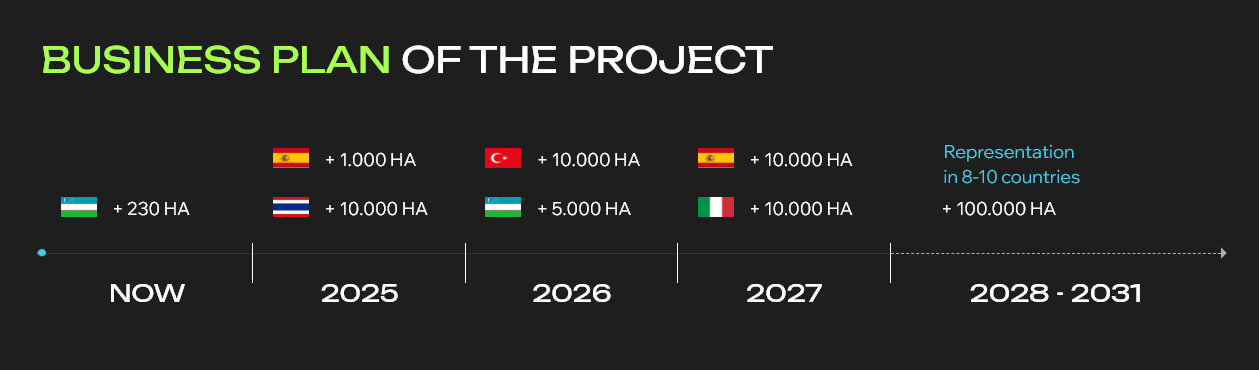
More than 230 hectares of land in the Fergana region of Uzbekistan have been allocated for the plantations. In 2025, the company plans to establish a 1,000-hectare plantation in Spain and a 10,000-hectare plantation in Thailand, aiming to cover a total of about 100,000 hectares across several countries by 2031.
According to Web3Eco, the debut batch for 2023 comprised 20,000 trees. The company plans to grow 100,000 paulownias in 2024 and 380,000 in 2025.
As reported by the IMF, to reduce hydrocarbon emissions, a proposal was made to increase electricity taxes for Bitcoin miners.
Рассылки ForkLog: держите руку на пульсе биткоин-индустрии!