




Looking back at the past week, we recall the bitcoin price drop from $12,000, the arrest in China of dozens of PlusToken pyramid participants, another private token sale by Polkadot, new records in the DeFi sector and Grayscale Investments, and other events.
Cryptocurrency Market
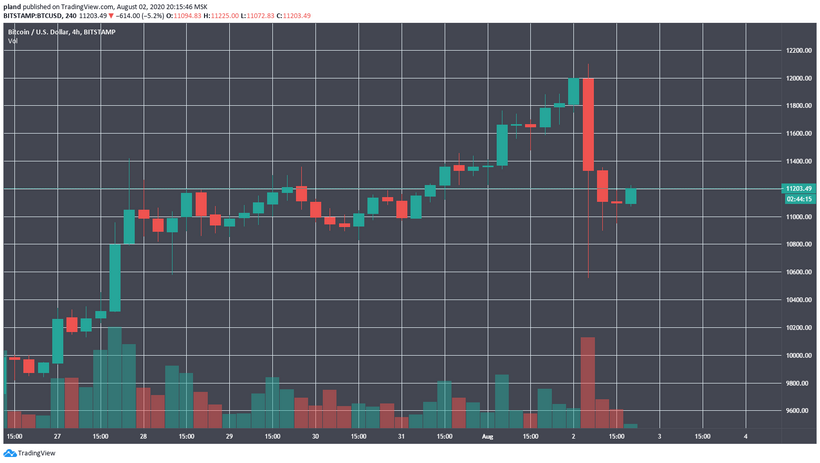
After breaking last Sunday the psychologically important $10,000 level, Bitcoin began to rise at the start of the week. By Monday evening, July 27, the price of the leading cryptocurrency rose above $10,500.
This came amid a record inflow of bitcoins onto exchanges over the last three months.
The $11,000 level was breached on the following day, 28 July, trading at that level until the past weekend.
On Saturday, August 1, Bitcoin reached a year-to-year high above $11,500. The price at that level last stood in early August 2019.
On Sunday morning the prices of the cryptocurrency surpassed $12,000 (Bitstamp), but within a few minutes fell to around $10,500. At the time of writing Bitcoin trades in the range of $11,100-$11,200.


ETH also hit a two-year high in tandem with Bitcoin, rising above $400 on Sunday morning. The subsequent ETH pullback was not as deep as Bitcoin’s.
Despite Sunday’s drop, Bitcoin gained almost 15% for the week. ETH and XRP rose more—21.2% and 34.6%, respectively. Among the top assets, only these cryptocurrencies remained in the green over the last 24 hours, along with Chainlink (LINK), which displaced Binance Coin (BNB) from the top 10.


Data: CoinGecko.
EOS to publish a new roadmap with long-term goals
EOS developers are preparing to publish an expanded roadmap for the project. Brendan Blume, CEO of Block.One, said that since July last year the team has achieved most of the goals and now it is time to set longer-term objectives.
He promised to unveil additional details in the near future.
The head of Block.One assured that in the ongoing development of the network the project would focus on improving the EOS token characteristics.
27 PlusToken managers arrested in China
Chinese police arrested 27 top suspects in the operation of the PlusToken cryptocurrency pyramid. A further 82 key group members, who had been hiding in the country and abroad, were also detained.
According to law enforcement, About 2 million people were victims of PlusToken. The total losses from the pyramid’s activities are estimated at $5.8 billion, though earlier figures stood at $3 billion.
The investigation into PlusToken was launched by police in March 2019. In August, authorities managed to detain five key suspects.
Grayscale assets under management exceed $5 billion
Grayscale Investments, the manager of cryptocurrency funds, attracted $1 billion in investments for them in 11 days. The total assets under management reached $5.1 billion.
Of these, the flagship Bitcoin Trust (GBTC) accounts for $4.31 billion. The Grayscale Ethereum Trust holds $581.7 million, or 11% of the total value.
Polkadot raises $43.6 million in private token sale
The Polkadot project’s founder non-profit Web3 Foundation carried out another private token sale of DOT tokens, raising $43.6 million.
The wallet used for the sale received 3,982 BTC over three days, according to BitInfoCharts. Based on the number of incoming transactions, 1,059 investors participated.
Although there were several large transfers, most transactions were well under 1 BTC. The sale took the form of a standard auction with a starting price of $125.
Fidelity Investments calls Bitcoin a store of value and insurance
Fidelity Investments’ digital assets unit called Bitcoin an “inspirational store of value” and an “insurance policy” against problems in the financial system.
In the first report in the Bitcoin Investment Thesis series, Fidelity Digital Assets (FDAS) noted that Bitcoin’s potential as a store of value stems from a decentralized settlement system and a scarcity of cryptocurrency.
FDAS emphasised that concerns about active fiat currency issuance by leading central banks during the COVID-19 era undermine trust in traditional finance and spur interest in Bitcoin.
They believe broader adoption of crypto will be aided by the forthcoming $68 trillion wealth transfer from older generations to millennials.
Cardano mainnet activates Shelley upgrade
Cardano developers conducted a hard fork on July 30 at 00:44 MSK, activating the Shelley upgrade.
As a result, community members gained the ability to stake. Users can either operate a stake pool on behalf of other Cardano (ADA) holders or delegate their own coins so that someone else assumes the role.
IOHK, the company behind the project, expects the number of staking pools to reach about a thousand over time. A few hours after the fork, the number reached 250.
Pretches signed into law “On Digital Financial Assets”
On July 31, Russian President Vladimir Putin signed the law “On Digital Financial Assets,” regulating the circulation of cryptocurrencies within the country.
The law, prohibiting the use of digital assets to pay for goods and services, will come into force on January 1, 2021.
The State Duma passed it last week, with the Federation Council endorsing the bill at that time.
Experts say the regulatory act will slow the development of Russia’s cryptocurrency industry.
DeFi assets exceed $4 billion
The total value locked in DeFi services surpassed $4 billion. The most popular asset remains Maker, whose dominance index is above 30%.
Earlier this week Maker became the first DeFi protocol to surpass $1 billion in assets.
For a detailed look at the latest significant developments in DeFi, read ForkLog’s traditional overview:
DeFi Bulletin: the decentralized finance sector hits new records
ForkLog also wrote:
- Chainalysis launched a free analytics portal Market Intel.
- LocalBitcoins has implemented Elliptic tools to track bitcoin transactions.
- Developers launched a ‘launchpad’ for Ethereum 2.0 validators.
- Ledger reported a data breach affecting about a million users.
- A 17-year-old Florida teen was arrested on suspicion of hacking Twitter.
ForkLog Exclusives:
- BitOoda carried out a comprehensive study of the mining industry, analyzing the current distribution of power for Bitcoin mining. Analysts explained why the hash rate could nearly double within a year.
- Kaiko researchers explained on which exchanges big players are most active, identified the average whale trade size, and how they affect Bitcoin’s price.
ForkLog Live
The Polkadot project is considered one of the most promising next‑generation blockchains. On July 27, Max Bit, on ForkShow, spoke with Sergey Lonshakov, Vladimir Ponimayuschiy and cp287 about the network’s advantages for users.

Subscribe to ForkLog’s news on Telegram: ForkLog Feed — the full news feed, ForkLog — the most important news and polls.