



Week in Review: Bitcoin tests $44,000 as El Salvador unveils a ‘visa of freedom’
Bitcoin tested the $44,000 level, experts named the beneficiaries of Binance’s deal with U.S. authorities; the Bitzlato founder pleaded guilty; Dogecoin hit a yearly high on its tenth anniversary, and other developments from the week.
Bitcoin tested $44,000
On Monday, December 4, bitcoin reached the $41,500 mark. The next day the rally continued — the asset’s price tested the $44,000 level.
At the time of writing, bitcoin was trading below $44,000.
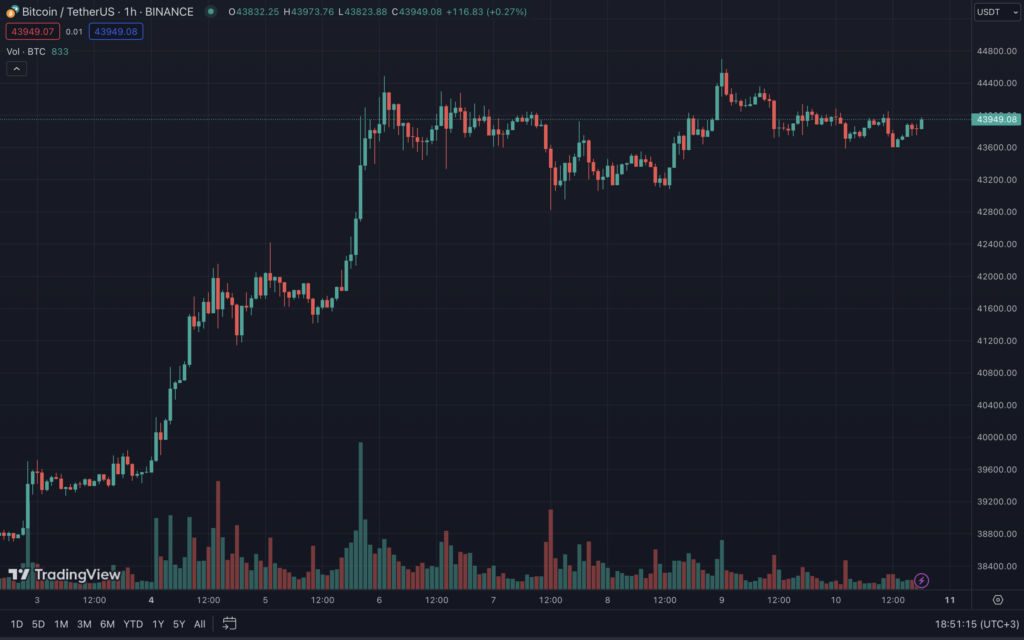
On December 9, the price of the second-largest cryptocurrency briefly exceeded $2,400 for the first time since May 2022. At the time of writing Ethereum was trading around $2,350.
All top-10 assets finished the week in the green territory. The biggest movers were Cardano (+52.9%), Dogecoin (+19.8%) and Solana (+17.3%).
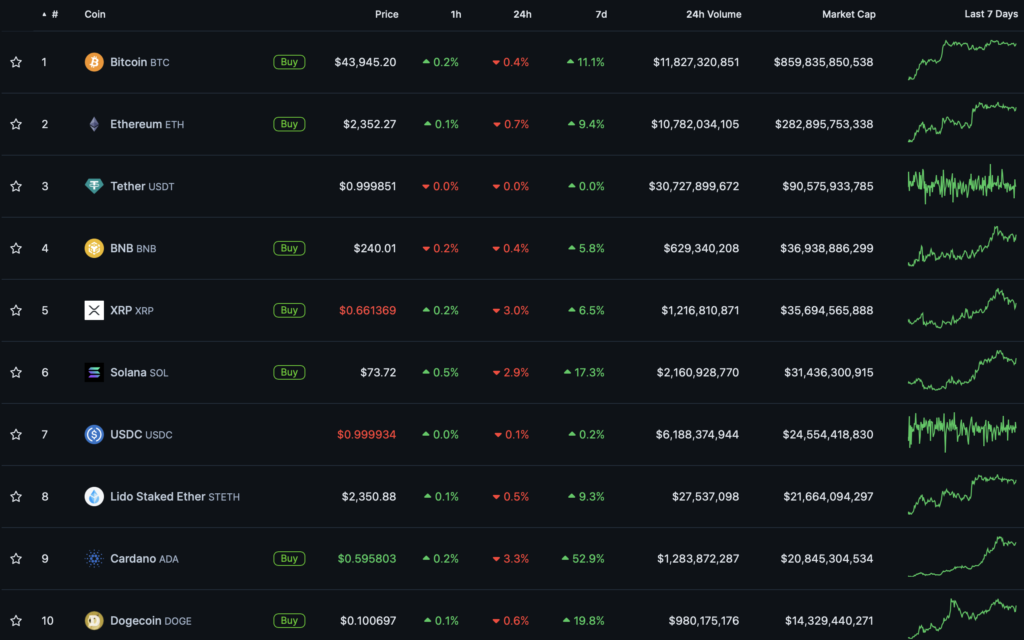
The total market capitalization of cryptocurrencies stood at $1.71 trillion. Bitcoin’s dominance index was 53.7%.
Experts named the main winners of the Binance deal with US authorities
Coinbase and Bybit gained the largest share of centralized Bitcoin exchanges after regulators in the United States settled their claims against Binance. The Kaiko report notes.
Using Bitcoin as a barometer, analysts described Bybit as the “immediate winner” of the Binance settlement with U.S. authorities. Bitcoin trading on the platform surged more than 20% in 16 of the 24 hours following the events.
Analysts also noted an additional lift to Coinbase’s shares. In November, the market capitalization of the largest US Bitcoin exchange rose 75%, and since the start of the year — 250%.
Coinbase’s share rose the most outside US trading hours after the settlement, while OKX’s metrics rose most noticeably at the start of trading in Western Europe.
Other US-registered platforms showed weak results across the board, the analysts noted.
Founder of Bitzlato pleaded guilty and agreed to close the exchange
Anatoly Legkodymov, founder of the Bitzlato crypto-exchange, pleaded guilty to transferring and laundering criminal funds.
According to the prosecutor’s office, the Russian national holds a controlling stake in the company, which served as a main channel for darknet traders and ransomware operators.
Under a plea agreement, Legkodymov agreed to shut down Bitzlato and waive any claims to about $23 million tied to the exchange’s seized assets.
News of a possible deal with the executive first surfaced in April, but at the time platform staff described it as unfounded.
The prosecutor’s office noted that Bitzlato marketed itself as an exchange with minimal user identification and allowed accounts registered under “fronts.” The team knew the service was used by criminals, the prosecution added.
What to discuss with friends?
- Dogecoin hit a new annual high on its tenth anniversary.
- The meme token ORDI rose 45% in 24 hours.
- Blur increased its share of the NFT market to 80%.
- Experts named the reasons for Bitcoin’s rally.
El Salvador presents a “Bitcoin Freedom Visa” for $1 million
The authorities of El Salvador launched a program offering residency and a path to citizenship for investments of $1 million in the country via Bitcoin or USDT, under the name “Bitcoin Freedom Visa.”
The initiative, in partnership with Tether, envisages participation of no more than 1,000 people.
If all spots are filled, the government would earn $1 billion and continue developing the program. Caribbean neighbours such as Antigua and Barbuda, Dominica, Saint Lucia have similar visa schemes that start at $100,000.
Malta offers citizenship for investments costing €750,000 (~$810,000), which grants access to the Schengen area of the European Union, covering 23 countries.
Altana Digital Currency Fund founder Alistair Milne wrote that El Salvador’s offer is “not globally competitive,” and noted the possibility of obtaining citizenship in an EU country for less.
CEO JPMorgan urged US authorities to ‘close’ crypto
JPMorgan Chase chief Jamie Dimon, at a meeting with US lawmakers, stated the need for strong restrictions on digital assets.
When asked by Massachusetts Senator Elizabeth Warren why cryptocurrencies are attractive to criminals, Dimon noted the ability to circumvent state oversight.
“I have always been strongly against cryptocurrencies, Bitcoin, and the like. If I were the government, I would shut them down,” he added.
The JPMorgan chief also called for tighter government oversight of stablecoins.
Also on ForkLog:
- Experts analyzed Bitcoin’s rally and issued a forecast for 2024.
- Google surpassed OpenAI. The company introduced the Gemini chatbot.
- Bitcoin mining difficulty decreased slightly.
- Adam Back predicted Bitcoin at $100,000 in the coming months.
LayerZero team announced airdrop
The LayerZero Labs, behind the development of the omnichain protocol of the same name, announced plans to conduct an airdrop of the native token in the first half of 2024.
According to the developers, the possibility of issuing a native coin was present in the project’s code from the outset.
The team noted that it aims to achieve a “proper distribution” of the asset. Amounts will depend on wallet activity.
What else to read?
This week we explained whether there is a future for “green mining,” what Dan Larimer calls the “true democracy,” and how to pay taxes on Bitcoin transactions in Ukraine.
In the traditional digest we’ve compiled the week’s main cybersecurity events.
The cryptocurrency industry attracts more institutional players. This is reflected in new investments in infrastructure and growing attention from firms to Bitcoin as an asset class. The most important events of the past weeks are in ForkLog’s review.
Рассылки ForkLog: держите руку на пульсе биткоин-индустрии!