
British banks continued to restrict Binance operations, the exchange’s CEO commented on the company’s relationship with regulators amid a raft of statements, while the founders of the Finiko pyramid were suspected of an exit scam, and other events of the week.
Bitcoin trades in a sideways range
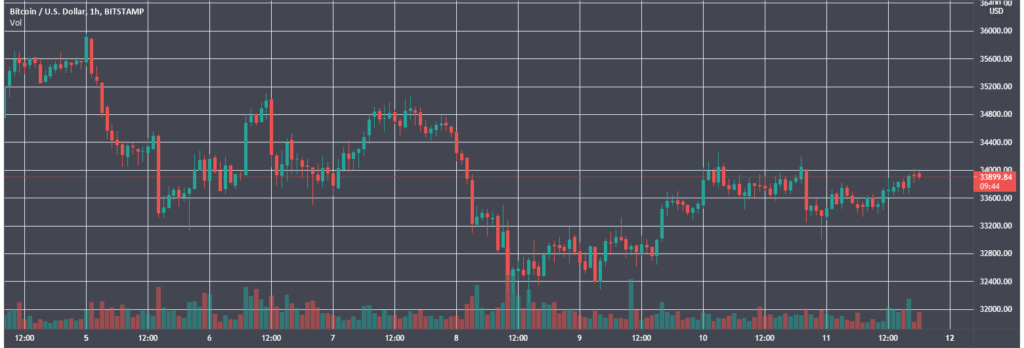
Bitcoin began the week with a drop. On Monday, July 5, the price of the leading cryptocurrency rose to around $36,000, but intraday traded down to below $33,500.
During the week the price hovered near $32,200, but by the weekend recovered, and the digital gold traded in a sideways range around $33,900 at the time of writing (Bitstamp).


noted earlier that the price of the leading cryptocurrency is pressured by forthcoming large unlocks of GBTC shares. However QCP Capital’s analysts are confident that the events will not materially affect the price.
They expect implied Bitcoin volatility to fall to long-term levels of 50%-60%. But firm experts warned of a potential price drop to winter under the 2018 scenario.
Investment chief Scott Minerd of Guggenheim Partners will fall to $10,000. He did not specify a timeframe.
According to CoinGecko, over the last seven days Bitcoin fell 1.8%. Ethereum quotes fell 3.3% after a sharp rebound a week earlier.


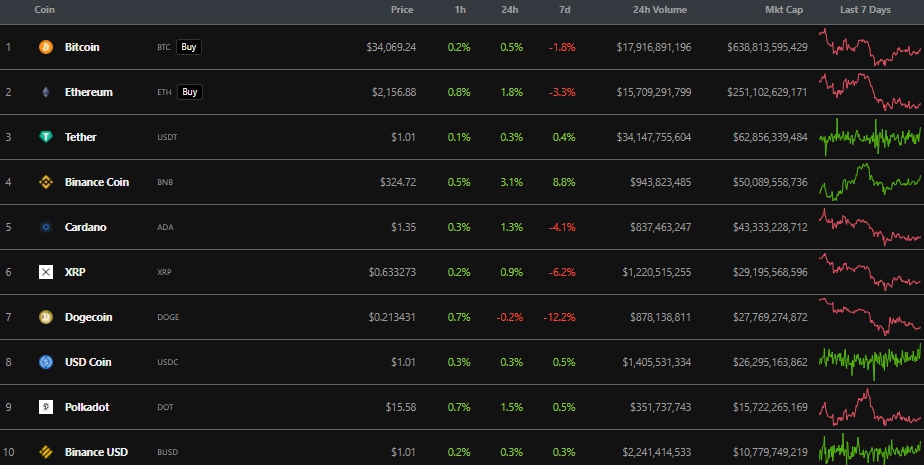
Among leading cryptocurrencies, Dogecoin posted the largest drop of the period — more than 12%.
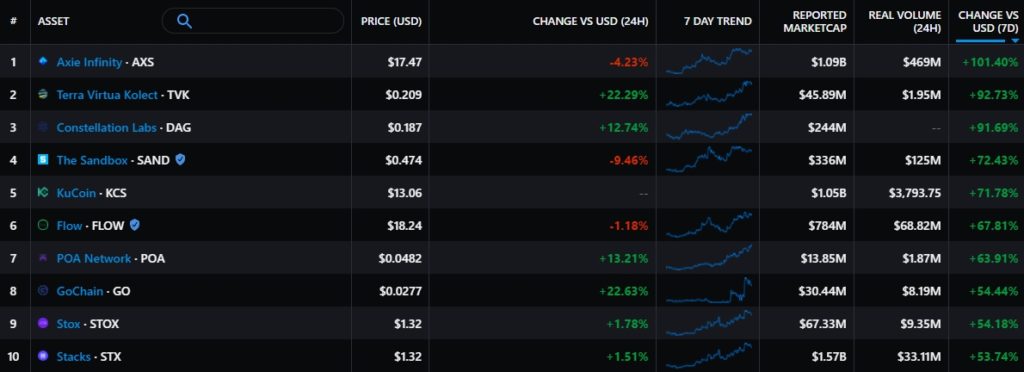
According to Messari, over the last week the AXS token of Axie Infinity rose 101.4%. This was the best performer among digital assets, helping the coin’s market cap exceed $1 billion.


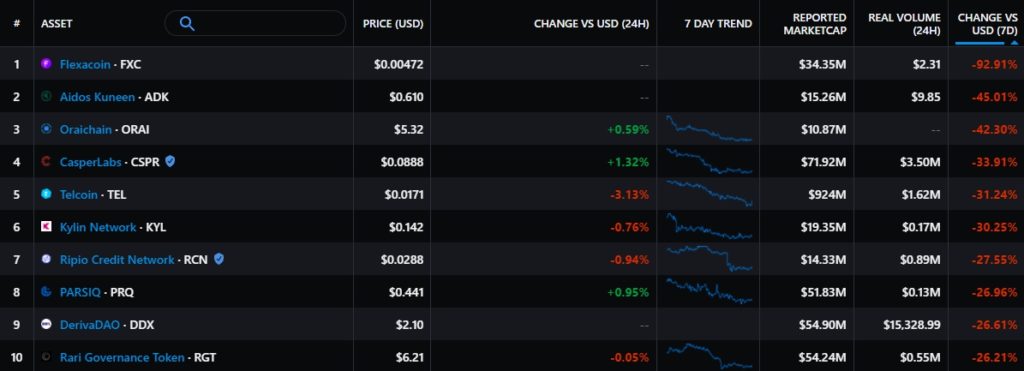
Flexacoin, which had surged 354% the previous week, plunged almost 93% over the past seven days.


The aggregate cryptocurrency market capitalization stands at about $1.46 trillion with Bitcoin’s dominance at 43.7% (by CoinGecko).
Binance troubles in Europe continue as CEO comments on regulator warnings
Barclays, one of Britain’s largest financial groups, prohibited customers from transferring funds to Binance from credit or debit cards.
On July 5 Barclays notified of restrictions on customers who deposited this year. The measure does not apply to withdrawals from Binance.
From July 8 the UK arm of Santander blocked transfers from customer accounts to the exchange.
“We would like to inform you that from 8 July 2021 we will, as far as possible, block sending funds to Binance from Santander accounts,” the bank said.
The institution cited warnings from the UK regulator regarding Binance’s activities.
The exchange itself, since July 6 halted accepting euro deposits via the SEPA payment system:
“This decision was driven by circumstances beyond our control”.
Poland’s Financial Supervisory Authority (UKNF) directed consumers’ attention to warnings from foreign regulators regarding the activities of Binance group entities and urged caution.
The market for crypto-exchanges is not regulated and not supervised by the authority, UKNF noted.
“Given market participant protection and warnings from foreign regulators, UKNF recommends exercising particular caution when using services of Binance Group entities,” the agency said.
The agency provided links to statements from regulators in Germany, the United Kingdom, the Cayman Islands and Thailand.
Amid the warnings, Binance chief Changpeng Zhao published an open letter detailing the company’s plans to bolster compliance and protect customers. He noted significant progress in working with regulators.
SBU uncovers Ukraine’s largest clandestine mining farm
The Security Service of Ukraine (SBU) uncovered in Vinnytsia a mining farm illegally connected to the power grid. The agency said it was the largest clandestine farm ever uncovered by Ukrainian law enforcement.
The equipment was located in one of the former Vinnytsiaoblenergo premises. According to the SBU, the farm was organized by residents of Kyiv and Vinnytsia.
During searches, law enforcement seized nearly five thousand units of equipment, including 3,800 gaming consoles, more than 500 GPUs and 50 CPUs. Preliminary estimates put the monthly loss from the farm’s operation at around 5-7 million hryvnias.
Russia to draft amendments enabling confiscation of cryptocurrencies
Russia’s Prosecutor General Igor Krasnov called the “criminal use of cryptocurrencies in the country” a serious challenge and said that amendments to confiscate digital assets used as proceeds of crime are being prepared.
“At present, work is underway to amend the criminal and criminal-procedure legislation. This will allow the application of restrictive measures and confiscation in relation to virtual assets,” Krasnov said.
Meanwhile Deputy Secretary of the Security Council of the Russian Federation Alexander Grebenkin said that the department, among other things, will include in the new edition of the National Security Strategy the fight against the use of digital currencies for illicit purposes.
“In the new edition of the Strategy, the task of preventing and suppressing offenses and crimes using information and communication technologies, including the use of digital currencies for illegal purposes, is stated for the first time,” he said.
Developer proposes block number to activate the London hard fork on Ethereum
Ethereum developer Tim Beiko initiated a proposal to activate the London hard fork on the Ethereum mainnet at block #12 965 000, expected on August 4.
The final decision was expected to be reached during a call on Friday, July 9.
Tim Beiko said they had not reached a concrete conclusion and would continue the discussion on July 23.
That discussion brought us all the way to the end of the call! There was no very specific conclusion, but this is definitely something I need to think about more, and I hope to have thoughts to share on the next ACD.
I’ll see you then, on July 23, at 14:00 UTC 👋🏻
— Tim Beiko | timbeiko.eth 🦇🔊 (@TimBeiko) July 9, 2021
Earlier the London hard fork was activated on the main test networks of Ethereum. Beiko said Goerli went smoothly, though the team spammed the testnet before and after the upgrade. In Rinkeby, after activation a “slight problem” with the validators’ configuration was found.
Founders of the Finiko pyramid suspected of an exit scam
Investors in the Kazan-based financial pyramid Finiko, which offered returns from cryptocurrency and stock market investments, complained en masse about being unable to withdraw funds.
Independent experts estimate the total damage from the company’s activities at several hundred million dollars.
Since June 17 Finiko detached all operations from the Bitcoin price and allowed withdrawals only in the native FNK token. At its peak, the token reached $231, but over the last three weeks its price has fallen by 98% to $1.5.
Community questions the Bitcoin mining green energy study
The Block analyst Larry Cermak and The Street columnist Zack Voell doubted the objectivity of the Bitcoin Mining Council (BMC) study on the share of green energy in the global Bitcoin mining industry.
Experts were unsettled by the undisclosed methodology and a small sample — 5% of the hashrate, in their view. They also noted that the result, by pure chance, aligns with Elon Musk’s earlier demands on the industry.
Coin Metrics founder Nick Carter pushed back, saying that 32% of the hashrate was included in the sample. He, however, conceded that these were mainly American mining companies and that the data cannot be linearly extrapolated to the entire industry.
China’s central bank calls Bitcoin and stablecoins speculative instruments
Deputy head of the People’s Bank of China (PBoC) Fan Yifei said that Bitcoin and stablecoins have become speculative instruments, posing risks to the financial system and social stability.
“So-called stablecoins, especially global ones, can create risks and threats to international currency, payments and settlement systems. We remain concerned about this issue, which is why we have taken certain measures,” the official stressed.
According to journalist Colin Wu, the Chinese government for the first time articulated the reasons for pressure on the mining industry.
Meanwhile, the Department of Corporate Administration at the PBoC, the Beijing Financial Supervision Bureau and the authorities of the Huaizhou district shut down a local software company developing crypto-operations software.
The measures were taken under a State Council directive to crackdown on illegal Bitcoin mining and trading, the PBoC clarified.
According to Colin Wu, the Beijing-based company mainly dealt with the entertainment industry and had its own virtual currency Mao Li Coin.
Elon Musk criticises Bitcoin and Ethereum for inefficient transactions
Elon Musk criticised the Bitcoin and Ethereum blockchains for slow transaction processing and high transaction costs. This was his reply to a tweet by YouTube blogger Matt Wallace about an upcoming Dogecoin (DOGE) update.
Wallace said that with the update Dogecoin would become “one of the most widely used cryptocurrencies in the world.” The Tesla founder agreed with this view.
“BTC and ETH rely on a multi-layer transaction system, but base-layer throughput is slow and costs are high. In my view, the advantage is that DOGE maximises base-layer throughput and minimizes transaction costs with exchanges acting effectively as a second layer,” he wrote, sparking a lively discussion on Twitter.
Circle to go public. Valued at $4.5 billion
Circle will go public via a reverse merger with SPAC Concord Acquisition Corp. The crypto company’s shares will list on the New York Stock Exchange under the ticker CRCL.
The pre-merger valuation of Circle was $4.5 billion. Under the deal, the merged company will receive $415 million in investment commitments at $10 per share.
Official protocol published for Chia mining pools
On July 7, Chia developers released the official code for mining pools.
The 1.2.0 software version is posted on GitHub. The company also released a guide on how to work with the new release.
The protocol supports trusted pools with low fees, between which users will be able to switch.
In 2021, Visa crypto-card holders spent over $1 billion
In the first half of 2021, the volume of transactions on Visa’s debit crypto cards exceeded $1 billion, the payments network reported.
According to the statement, the company currently works with 50 major crypto platforms under card programs, including FTX and Coinbase. Customers of these platforms can convert and spend digital assets at any of Visa’s 70 million merchant and service points.
Regina Todorenko, star of “Heads and Tails”, lost $40,000 on crypto investments
The television presenter and singer Regina Todorenko said she lost $40,000 trying to profit from cryptocurrencies.
“This is an expensive process that requires large investments. I should have learned about it 15 years ago. That would have been my starting capital, which could have earned millions by now,” she told NTV.
A hamster on Twitch trades cryptocurrencies from its cage
The hamster owner, Mr. Gox, created a special cage from which the rodent trades on the crypto market.
The developer connected a running wheel and two tunnels to optical sensors that detect movement.
By turning the wheel, the hamster “selects” a cryptocurrency to trade. The program will sell a coin when the rodent runs through the left tunnel and buy if it goes through the right.
All Mr. Gox’s trades are streamed on Twitch.
South Korea: students earn digital currency for visiting the toilet
The Ulsan National Institute of Science and Technology uses excrement to generate electricity. For each toilet visit, students are paid with the digital currency Ggool.
Professor Cho Jae-Weon developed an eco-friendly toilet, BeeVi. It is connected to a laboratory that uses excrement to produce biogas. It powers devices in the building, including the gas stove and boiler.
“If you think outside the box, faeces have value for producing electricity. I have put this value into the ecological cycle,” Cho said.
Also on ForkLog:
- Trading volume on Bitcoin exchanges in June halved.
- Bitcoin.org was subjected to a DDoS attack. The hackers demanded a ransom in Bitcoin.
- Nassim Taleb criticized the trading of tokenised securities.
- Popular YouTube blogger was accused of organizing a Pump & Dump scheme.
- Steve Wozniak called Bitcoin a mathematical marvel.
- Argo Blockchain announced a Nasdaq listing.
What else to read and watch
ForkLog analysed in a report the key changes to market metrics and conditions for June.
In traditional digests we collected the main events of the week in the fields of cybersecurity and artificial intelligence.
Ongoing initiatives in blockchain technology were highlighted in a review.
On Monday, July 9, ForkLog hosted the online conference “Solana Season Hackathon and the development of the Solana ecosystem.” We spoke with Solana Season Hackathon winners, discussed ecosystem milestones, and learned about partner projects’ plans.