



News about the name of Changpeng Zhao’s dog set off a wave of themed memecoins; Ethereum developers moved to shorten the cadence between upgrades; the SEC paused litigation with Binance; and other events of the week.
Altcoins may have bottomed
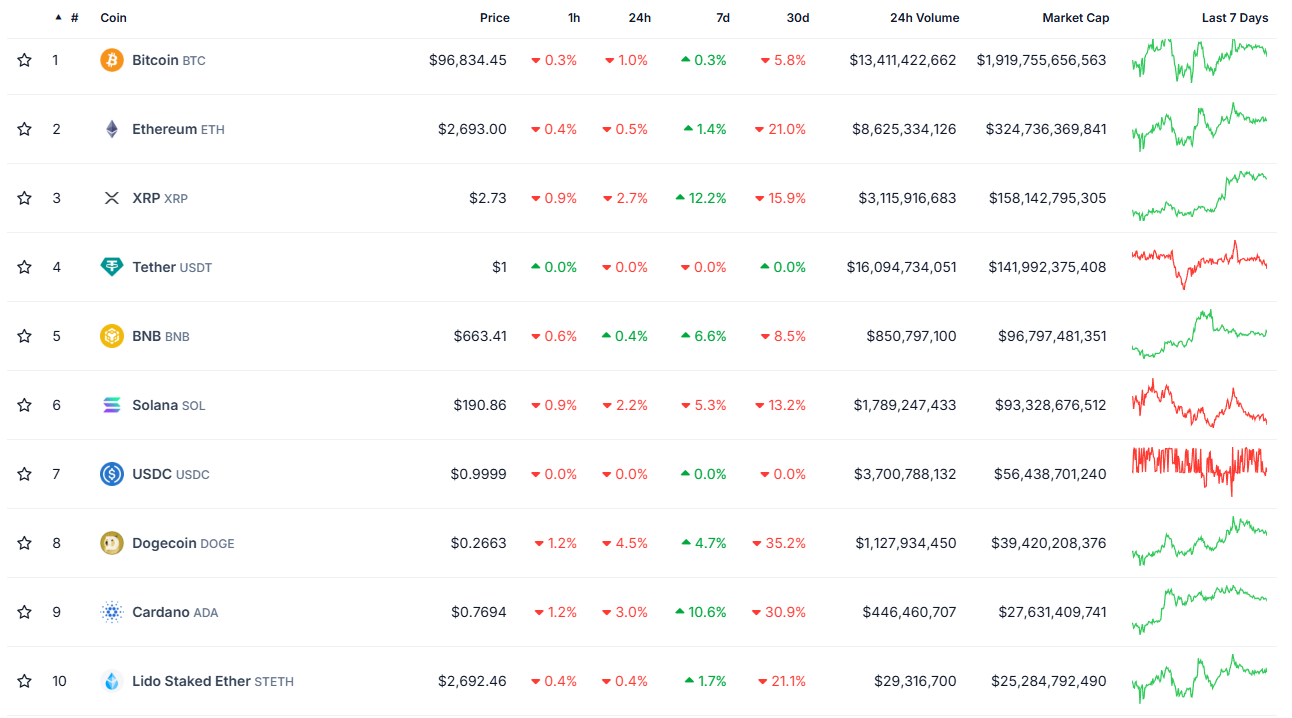
Bitcoin was volatile throughout the week but ended little changed. Altcoins, by contrast, moved more.
Among the top-cap risers: XRP (+12.2%), ADA (+10.6%) and BNB (+6.6%).


According to Glassnode, the recent sell-off brought “significant sell-side pressure” to the sector. Over the past two weeks, altcoin market capitalisation fell by $234bn.

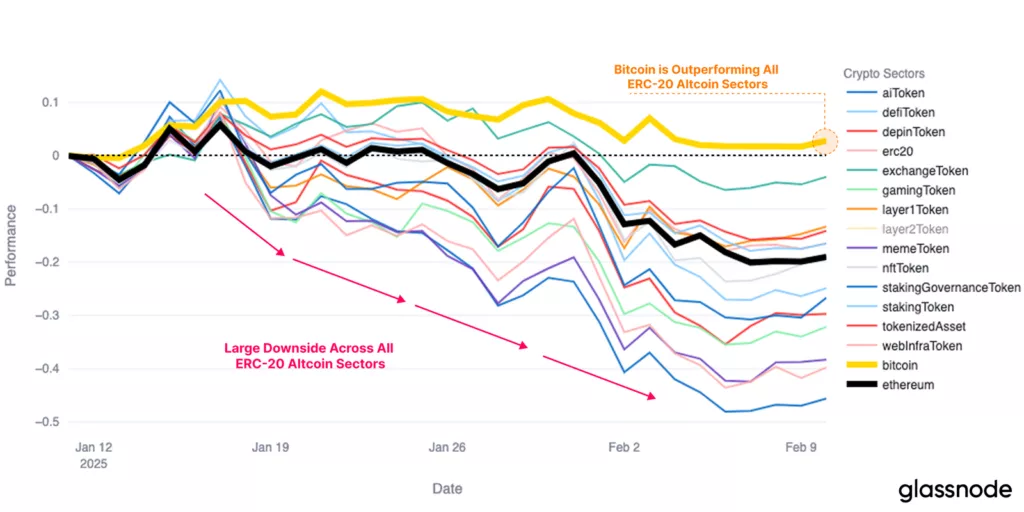
“The severity of this drawdown underscores the scale of capitulation and can reasonably be viewed as a bear-market event within the altcoin sector,” said Glassnode’s specialists.
The segment’s muted response to remarks by Fed chair Jerome Powell that there is no rush to adjust rates is a sign of a bottom, argues trader Matthew Hyland. In his view, sellers are “exhausted” and the market has likely already reacted to bad news.
By contrast, the host of the Forward Guidance podcast, fejau, forecasts “pain”.
Messari co-founder Dan McArdle said that “decent economics and some credit expansion are enough to sustain a regime of moderate risk-on.”
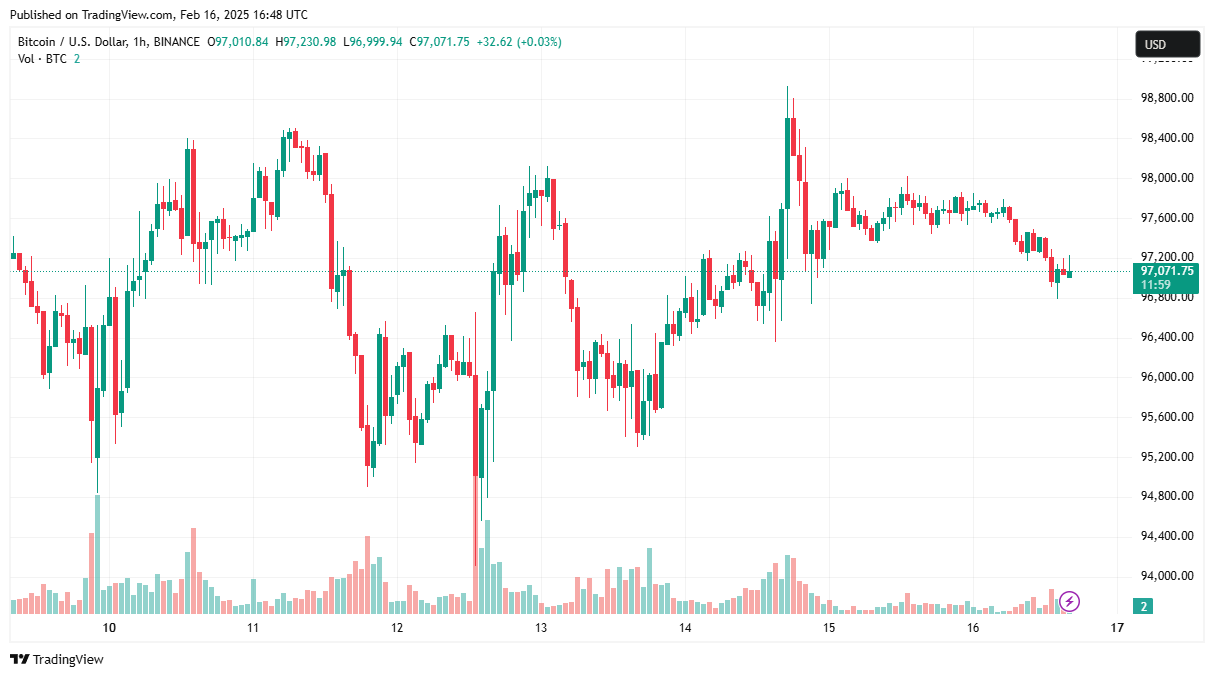
Amid the volatility, bitcoin began and ended the week at roughly the same level — $98,000.
Glassnode also pointed to a shift in bitcoin’s investor base linked to inflows of large capital. In their assessment, “the presence of more resilient and patient holders” is helping to bolster price stability.
At the time of writing, bitcoin is trading around $97,000 with a market capitalisation near $1.92trn. Over the past seven days the price rose 0.44%.

An Argentine crypto scam
On 14 February, after a mention on X by Argentina’s president Javier Milei, the LIBRA token hit a peak market value of $4.56bn, only to crash 94% within hours.

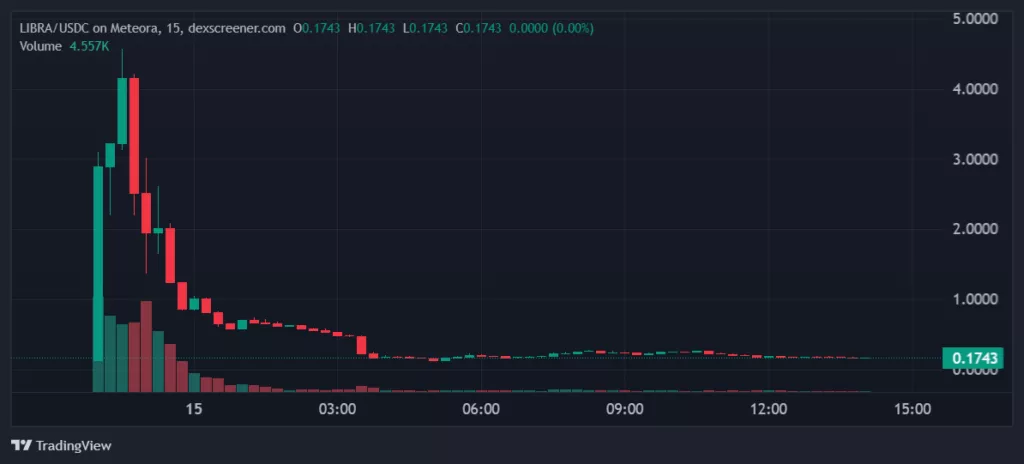
The project was presented as a tool to “stimulate growth in the Argentine economy”. The KIP Protocol team was behind the launch.
After the collapse, Milei deleted the promo post, clarified that he had merely “supported a private initiative”, and accused political opponents of exploiting the incident to cause harm.

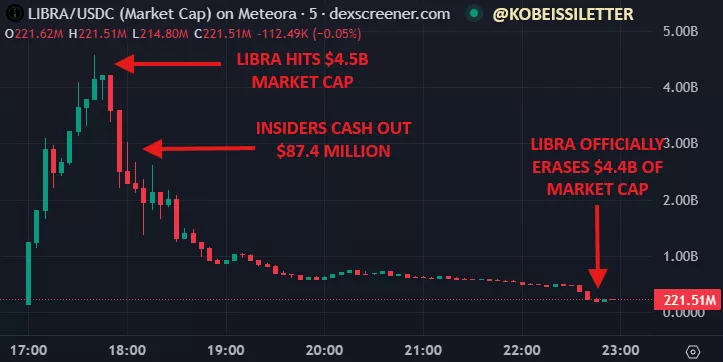
According to Lookonchain, eight wallets linked to the project pulled liquidity of more than $107m (57.6m USDC and 249,671 SOL).
Bubblemaps reported that 82% of the token’s supply was unlocked and available for sale from the start.
Some Argentine politicians threatened the president with impeachment over his ties to the failed token.
“This scandal, which shames us internationally, requires us to file an impeachment request against the president,” said Leandro Santoro, a member of the opposition coalition.
Ethereum development accelerates; Pectra details
Ethereum Foundation’s Tim Beiko urged teams to lock in the scope of an upgrade before the previous hard fork is live on mainnet. That, he said, would speed the move to a defined set of proposals.
Execution-layer developers also confirmed the rollout schedule for the Pectra upgrade:
- 14 February — client teams will ship updated software releases;
- 24 February and 5 March — the hard fork will activate on the Holesky and Sepolia testnets, respectively.
Plans to accelerate the next Fusaka hard fork envisage:
- 13 March — deadline for proposals for included EIP;
- 27 March — client teams choose their preferred upgrade scope;
- 10 March — the upgrade’s final scope is set.
Beiko argues this will allow developers to move more quickly to discussions of the Glamsterdam hard fork.
In a new essay, Ethereum co-founder Vitalik Buterin laid out arguments for expanding L1 block transaction capacity:
- greater censorship resistance for transactions;
- simpler and cheaper movement of assets between L2 protocols;
- the ability to quickly mass-exit funds from a “broken” L2 to the base chain;
- enabling large-scale, low-cost ERC-20 issuance on L1.
“Even in a world where most activity is concentrated on L2, there is value in significant scaling, as it enables simpler and more secure application development patterns,” the programmer noted.
On 8 February, Ethereum’s daily fees fell below $1m for the first time in five months — to $731,472.
Binance and the SEC pause litigation
On 11 February, Binance and the U.S. Securities and Exchange Commission filed a joint motion to stay proceedings for 60 days.
The parties cited the creation of a dedicated digital-assets task force, whose work “may affect the case and enable its potential resolution”.
“The SEC’s case was baseless from the start. We are eager to put this behind us and continue focusing on keeping Binance the safest, licensed and most trusted exchange in the world,” a platform representative told ForkLog.
On 14 February, the SEC requested an additional 28 days to consider the Coinbase appeal, pointing again to the task force’s expected work.
Talking points
- Alexander Vinnik returned to Russia in a prisoner swap.
- Sam Altman turned down Elon Musk’s $97.4bn offer to buy OpenAI.
- A Briton plans to buy a landfill in hopes of retrieving 7,500 BTC.
- U.S. customs blocked the import of Bitmain ASIC miners.
The week’s most popular dog
Binance founder and former chief executive Changpeng Zhao (CZ) sparked a wave of memecoins dedicated to his Belgian Malinois named Broccoli.
He first mentioned the dog in a discussion on X about launching memecoins.
“How does this work? I post the name and photo of my dog, and people create memecoins? How do they know which one is ‘official’, if that even matters?” asked CZ.
He noted that many users would like to learn more about the pet, but that he needed a couple of days to think before such an important decision.
Soon after, he posted about the dog on his profile. He stressed that he was not launching his own memecoin but allowed that such initiatives might appear from the community.
“I would never have thought that Broccoli would become part of the blockchain ecosystem. […] In crypto, it is never boring,” Zhao said.
The entrepreneur said he intends to engage with several coins on BNB Chain.
A surge in users following CZ’s posts led to issues on BNB Chain.
HashFlare’s last gasp
Estonian citizens Sergei Potapenko and Ivan Turygin — founders of the cloud-mining service HashFlare — pleaded guilty to running a cryptocurrency pyramid scheme.
According to the U.S. Attorney’s Office for the Western District of Washington, they offered clients contracts entitling them to a share of HashFlare’s purportedly mined cryptocurrency.
The company’s actual computing power did not match claims, and its web interface displayed false mining-profit data.
From 2015 to 2019, sales exceeded $577m.
Authorities seized assets worth more than $400m from Potapenko and Turygin. The funds will be used to compensate victims of the scheme.
Sentencing is set for 8 March; each faces up to 20 years in prison.
Also this week, Indian authorities said they had seized $190m in cryptocurrencies as part of an investigation into the BitConnect pyramid. Losses from the platform’s collapse totalled $2.4bn, with roughly 4,000 victims across 95 countries.
Also on Forklog:
- Uniswap launched the Unichain mainnet.
- Proton released a public version of its bitcoin wallet.
- Lido announced the v3 upgrade.
- Telegram’s Wallet opened fee-free access to USDT.
What else to read?
In a new feature, we unpack virtual and augmented reality.
Our weekly digest rounds up the main events in cybersecurity.