




Bitcoin prices fell below $38,000, Elon Musk agreed to buy Twitter for $44 billion, Binance, the Bitcoin exchange, unveiled a crypto card for Ukrainian refugees, the team behind the Bored Ape Yacht Club NFT collection launched the Otherside metaverse, and other events of the past week.
Bitcoin hits local low below $38,000
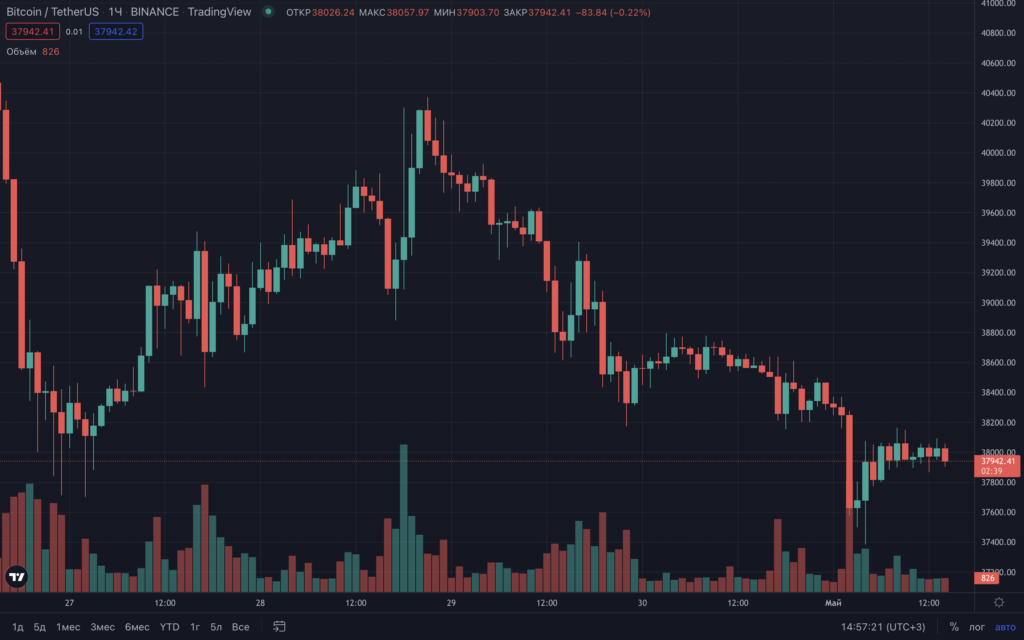
On Sunday, May 1, bitcoin prices hit a local low, slipping briefly below $37,400.
At the time of writing, bitcoin was trading around $38,000.


Traditionally, the flagship pulled the rest of the market. All top-10 assets by market capitalisation ended the week in the red.


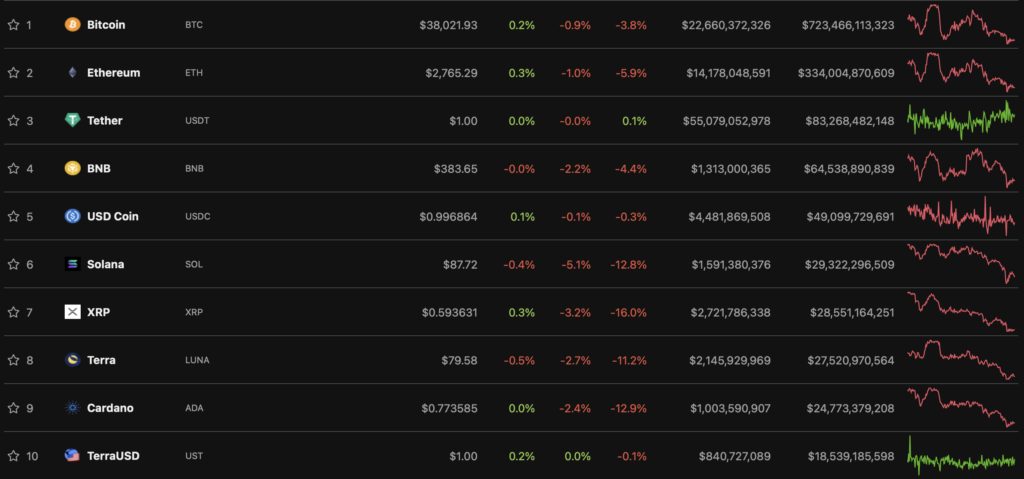
XRP fell the most, down 16%, Cardano (ADA) down 12.9%, and Solana (SOL) down 12.8%.
Elon Musk agrees to buy Twitter for $44bn
The price of meme cryptocurrency Dogecoin (DOGE) at one moment reached the $0.17 mark amid news that Twitter’s leadership had decided to sell the social network to Elon Musk for about $44 billion.
Tesla chief will pay $54.2 per share — about 38% above their price as of April 1, when Musk acquired 9.2% of the company’s shares. He earmarked $21 billion of personal funds for the purchase. A further $25.5 billion was provided to the entrepreneur by a group of banks led by Morgan Stanley.
The deal is expected to close by the end of 2022. Twitter would become a private company. Shares would be tradeable only on the over-the-counter market.
The independent chair of Twitter’s board, Bret Taylor, said the board had carefully considered the acquisition and concluded it was the best outcome for shareholders.
“I want to make Twitter better than ever, by adding new features, making the algorithms open to increase trust, defeating spam bots and authenticating everyone. Twitter has enormous potential — I look forward to working with this company,” Musk wrote.
He expressed hope that his fiercest critics would not leave the platform, “because that is what free speech means.” Musk also called Twitter “a digital town square,” where vital questions about humanity’s future are discussed.
Twitter founder Jack Dorsey welcomed the board’s decision. He stressed that Musk’s goal to build the “most reliable and open platform” is the right one. It resonates with the aims of the current CEO Parag Agrawal.
CEO Coinbase Brian Armstrong supported Musk’s plan to acquire Twitter and called the deal a “big win for freedom of speech.” He expressed optimism that, in time, the social network could be transformed into a decentralized protocol.
Binance announces launch of crypto card for Ukrainian refugees
The bitcoin exchange Binance announced the launch of the Binance Refugee Card for current and new users from Ukraine, forced to relocate to Europe due to Russia’s invasion.
Cardholders will be able to conduct cryptocurrency payments and purchases in European Economic Area countries.
Refugees who contact local NGOs and apply for the Binance Refugee Card will receive 75 BUSD per month for three months. The cryptocurrency will be automatically converted into local currency at the point of sale.
To obtain the Binance Refugee Card, customers may use an existing account registered in Ukraine or create a new account using a Ukrainian home address, even if they currently reside in another European country. All users must undergo full KYC verification.
New York Assembly passes two-year mining moratorium
The New York State Assembly voted for the bill, designed to freeze current carbon emission levels from cryptocurrency mining.
The bill provides for a two-year moratorium on issuing new permits for crypto mining using energy generated from hydrocarbons. Firms operating under such a regime may not expand their operations.
The act also requires the Department of Environmental Conservation to prepare a report on mining’s environmental impact in the state. The study should be completed within a year, giving lawmakers time to act before the moratorium expires.
Supporters in the Assembly were 95 to 52. A similar measure is under consideration in the Senate.
Bitcoin mining difficulty hits a record high with a rise of over 5.5%
As a result of another adjustment, the mining difficulty of the first cryptocurrency rose 5.56% and reached a record high of 29.79 TH/s.
The percentage increase was the second-largest this year. On January 21 it had risen by 9.32%.
The average network hash rate, which correlates with difficulty, reached 213 EH/s in the period between adjustments. According to Glassnode, as of April 27 the metric (a 7-day smoothed moving average) exceeded 223 EH/s.
Since the 2021 China mining ban caused the hash rate to plummet, it has shown a steady upward trend. Since August, negative difficulty corrections have occurred only four times; the maximum drop occurred twice at just 1.49%.
BAYC team launches Otherside metaverse
The company behind the NFT collection Bored Ape Yacht Club (BAYC), Yuga Labs launched the Otherside metaverse. All Otherdeeds tokens sold out in under three hours.
Yuga Labs reported “unprecedented” demand for Otherdeeds NFT, which exceeded the most ambitious expectations. The team apologised for the failed Ethereum transactions and pledged to compensate gas costs.
Yuga Labs issued 55,000 Otherdeeds NFTs at a price of 305 APE. The project team introduced mandatory KYC verification of buyers and a limit of 2 NFTs per address.
Against the backdrop of the Otherside launch, the BAYC ecosystem token ApeCoin (APE) fell about 30%. At the time of writing the asset was trading around $17.
BitMEX co‑founder forecasts Bitcoin to reach $1m by 2030
Former BitMEX CEO and co‑founder Arthur Hayes predicted that the price of the first cryptocurrency could reach $1 million by the end of the decade, driven by the dysfunctions in Western monetary policy.
According to him, the pandemic exposed numerous weaknesses in Western financial systems. The US Federal Reserve prints money to fight COVID-19, Hayes said.
He also pointed to gold as a traditional store of value. Hayes argues that if Western financial markets collapse, gold could surge to $20,000 per ounce.
Sanctions on Russia over the war in Ukraine will worsen the situation, Hayes said. In his view, Bitcoin supporters should work to broaden its adoption and use the asset for day‑to‑day transactions.
Shiba Inu developers launch token burn mechanism
The Shiba Inu team launched a portal where SHIB holders can burn their tokens. In return, investors will receive burntSHIB, which accrues rewards in RYOSHI tokens at a variable rate.
Coin burn reduces the supply of tokens and, all else equal, tends to lift prices. The initiative aligns with the wishes of the project community, which had pressed for such a mechanism.
The portal was developed as part of a partnership between Shiba Inu and Ryoshis Vision (RYOSHI), a DeFi project in the Ethereum ecosystem focused on supporting the SHIB ecosystem’s growth.
Within 24 hours of launch, SHIB supply shrank by 8 billion tokens. Holders of burntSHIB will receive 0.49% of all transactions in RYOSHI.
Edward Snowden played a key role in the launch of ZCash
The former National Security Agency (NSA) and Central Intelligence Agency (CIA) employee Edward Snowden revealed his involvement in the launch of the privacy‑focused cryptocurrency ZCash in 2016. He spoke about it in a video produced by Zcash Media, a media group that creates educational content about the coin.
“When ZCash was launched, a cryptographic key was created that was used to lock the code on which the cryptocurrency runs. After that, no one could tamper with transactions,” the video explains.
Users, however, must trust the developers. To address this, the ZCash team decided to split the key among six participants in a so‑called “trusted setup.” If any one of the key fragments is destroyed, the network’s security will remain intact.
Shortly after the genesis block, five participants disclosed their identities. The sixth, under the pseudonym John Dobbertin, turned out to be Snowden.
“When it came to this concept—having several people from many places collaborate in the hope that at least one would not be compromised, would not work against public interests, and would be necessary for the ceremony’s success—I was happy to say, ‘Of course, I’ll help.’”
The whistleblower has lived in Russia since 2013, where he obtained political asylum.
Goldman Sachs offers bitcoin‑backed loans
Goldman Sachs issued the first loan secured by bitcoin. The lender was drawn by the structure of the deal and a 24/7 risk‑management framework.
The move marks Goldman Sachs’ full entry into the crypto markets. The deal had been in the works since December 2021.
Currently, crypto‑friendly banks such as Signature and Silvergate offer similar bitcoin‑backed loans.
A bill on mining in Russia submitted to the State Duma
In the State Duma of the Russian Federation a bill on mining in the Russian Federation was submitted to regulate the crypto mining sector.
The explanatory note states that the absence of regulatory rules pushes activity into the grey zone.
The bill defines mining as activity using Russian information infrastructure objects and equipment located on the territory of the Russian Federation.
The document also contains concepts of the organization of digital currencies, mining pools and mining operators.
The project envisions creating a special registry by an “authorized federal body.” Both individuals and mining operators may mine cryptocurrencies subject to inclusion in the registry.
Individuals would also have to register as individual entrepreneurs or self‑employed if their electricity consumption exceeds government limits.
If enacted, the bill envisages a one‑year amnesty for registry participants for:
- customs clearance of equipment imported before the law’s effective date;
- filing income declarations from mining and informing tax authorities about mined cryptocurrencies;
- payment of value‑added tax on mining operations conducted before the law’s effective date;
- compliance with currency regulation and related measures governing capital controls, in force since March 8, 2022.
Also on ForkLog:
- A solo miner mined a bitcoin block.
- A poll showed El Salvador’s experiment with bitcoin failed.
- A city in Texas became the first in the country to start mining Bitcoin.
- Binance blocked accounts of relatives of Kremlin officials.
What else to read and watch
In a new ForkLog special project with Tezos Ukraine, we explain everything you need to know about staking. We provide step‑by‑step instructions and answers to the main questions about staking in Tezos.
In educational cards, ForkLog outlines the Binance ecosystem, the Move‑to‑Earn fitness app STEPN and the main blockchain platform Ethereum.
In a separate piece, learn about the Chinese social credit system that grants moral and material benefits to people with good reputations and marginalises those with a low standing.
ForkLog analysed how Anchor issues could destabilise Terra’s economy and the broader crypto market. The article answers this and other questions about protocol resilience.
ForkLog AI gathered the most important AI news from the past week.
The cryptocurrency industry is attracting more institutional players. This is evident in both new investments in infrastructure and heightened attention to bitcoin as an asset class. The most important events from recent weeks are in ForkLog’s overview.
On Monday, April 25, in a ForkLog LIVE broadcast, Ton Veis — a trader and ForkLog resident — and Elina Sidorenko — Doctor of Legal Sciences and chair of the Digital Disputes Board at the Arbitration Center of the Russian Union of Industrialists and Entrepreneurs — discussed cryptocurrency regulation in Russia.

Read bitcoin news from ForkLog in our Telegram — cryptocurrency news, prices and analysis.