




Elon Musk announced SpaceX’s investments in bitcoin, the crypto-derivatives exchange FTX attracted a record $900 million at an $18 billion valuation, Jack Dorsey outlined plans to integrate digital gold into Twitter, and other events from the past week.
Bitcoin price breaks above $33,000
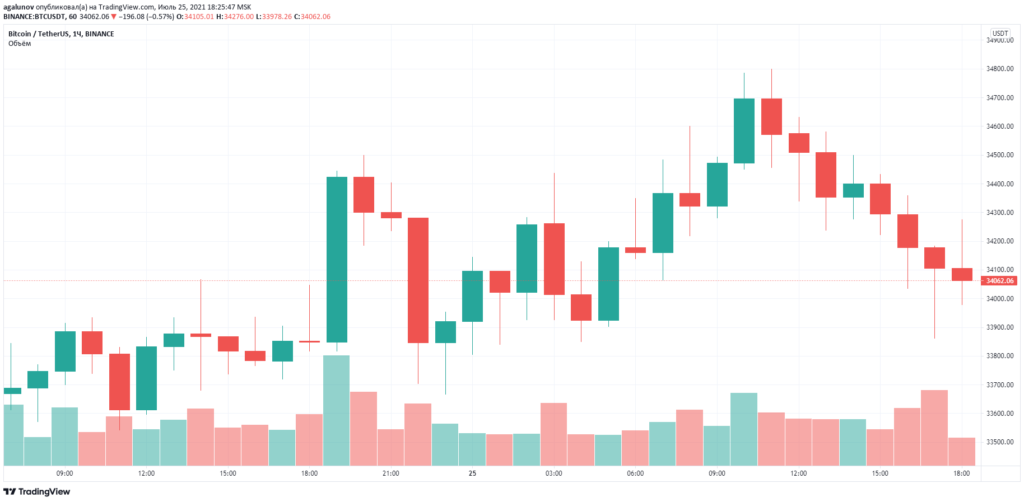
Bitcoin began the week with a drop. From Monday, prices declined, until Tuesday they had not yet reached a local bottom at $29,600. By the weekend the price recovered and on Saturday, July 24, breached the $33,000 mark.
As of writing, the digital gold is trading around $34,000.


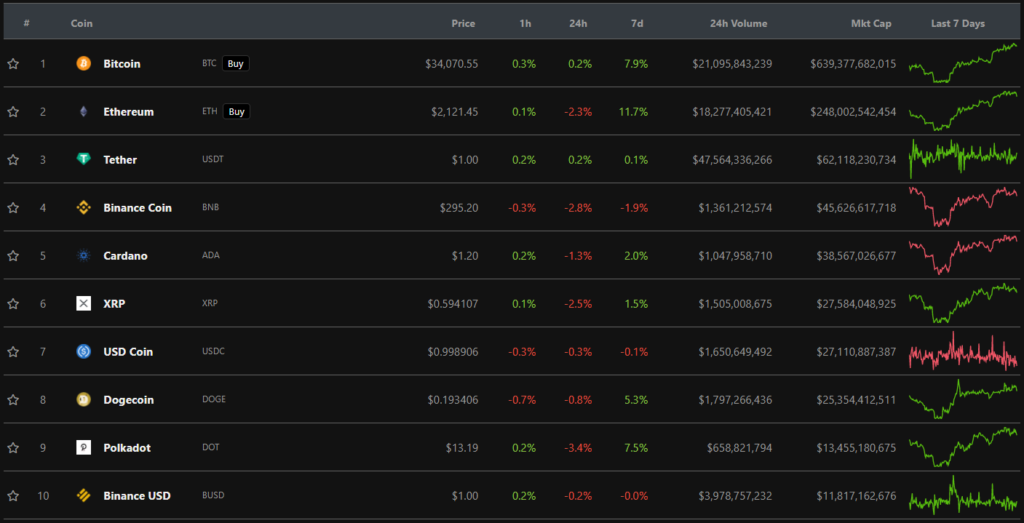
Over the past seven days, bitcoin rose by more than 8%, according to CoinGecko. All assets in the top 10 by market capitalization, with the exception of Binance Coin (BNB), were in the green. The price of BNB over the week declined by about 2%.


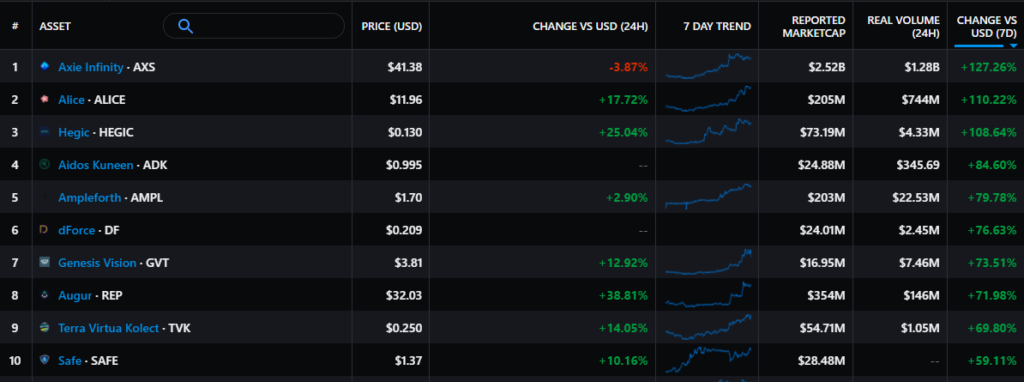
According to Messari, among digital assets over the past week the token AXS from Axie Infinity rose the most — by 127%. The token’s market capitalization exceeded $2.5 billion.


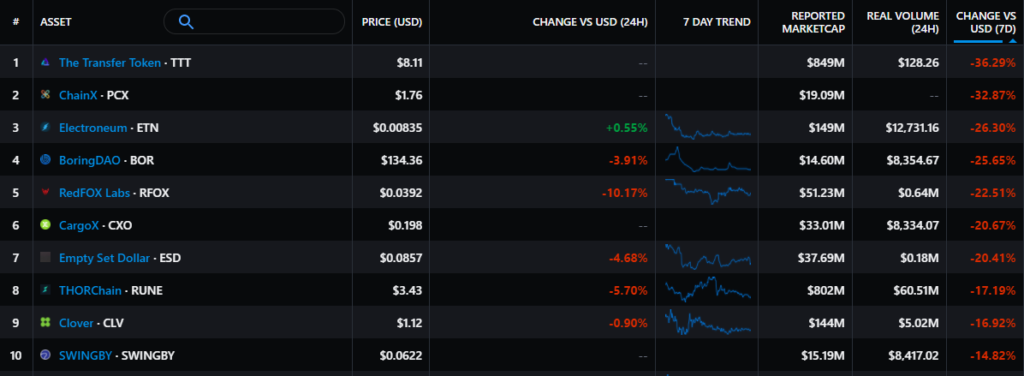
The native token of Eternal Wallet — The Transfer Token — fell the most, losing more than 36% in value, and its market capitalization dropped to $849 million.


The market capitalization of the cryptocurrency market rose to $1.43 billion, and bitcoin’s dominance index increased to 44.7%.
Elon Musk reveals SpaceX investment in bitcoin
At The B Word conference, Elon Musk revealed SpaceX’s investment in the first cryptocurrency. The billionaire also said he personally owns Ethereum and Dogecoin.
Joining Musk at the event were joined Jack Dorsey and Kathy Wood. The Ark Invest founder said that over time bitcoin will become more environmentally friendly than the traditional financial services and mining sectors, and the Twitter chief noted that the first cryptocurrency “will help create a world for everyone.”
Jack Dorsey outlined plans to integrate bitcoin into Twitter
According to Dorsey, bitcoin is one of three key trends defining the future of the social network, alongside artificial intelligence and decentralization. He noted that integrating cryptocurrency into existing products and services in the future should become a “big part” of Twitter.
Vitalik Buterin discusses reduced likelihood of block reorganisations in Ethereum with ETH2
In collaboration with Paradigm partner Georgios Konstantopoulos, the co-founder of the second-largest cryptocurrency presented a proposal envisaging a split of network participants into two categories: block proposers and attesters.
The first group proposes a block, and the second group votes on which continuation of the canonical chain is deemed correct. The selection of one of the 32 validators occurs every 12 seconds, reducing the odds of attackers reorganising blocks to less than 1%.
Buterin also said that after the merge with the second version of the protocol, expected in roughly six months, the network is anticipated to undergo a number of significant changes.
In particular, the next major step will be implementing sharding. He noted that blockchain sharding and the Rollups technology will increase the network’s throughput to 100,000 transactions per second.
Circle and Paxos disclose stablecoin backing
Most USD Coin (USDC) issued on the market by Circle backed by US dollars. The remaining coins are backed by bonds and other highly liquid assets.
Meanwhile Paxos stated that its USD-pegged stablecoins are fully backed by cash and cash equivalents, as well as U.S. Treasury securities.
Mastercard to use USDC for converting crypto to fiat
Mastercard will expand its card program for cryptocurrency companies to simplify the conversion of digital assets into fiat.
In partnership with Evolve Bank & Trust, Paxos and Circle, it will test a new capability that would allow more banks and crypto firms to offer cards enabling users to “spend their digital assets wherever Mastercard is accepted.”
The payments giant said that USDC is currently the only stablecoin involved in the trials.
FTX raises record $900 million at $18 billion valuation
The crypto-derivatives exchange FTX raised a record $900 million in a Series B round.
The round included 60 investors, among them SoftBank, Sequoia Capital, Paradigm, Coinbase Ventures, Ribbit Capital, Sino Global Capital, Multicoin, Circle, Lightspeed, Third Point, and billionaire Alan Howard and Paul Tudor Jones. FTX’s valuation stood at $18 billion.
The funds will be used to expand global footprint, improve products, make strategic investments, and build White Label software and offer it to traditional financial institutions looking to enter the crypto industry.
In a recent interview, FTX founder Sam Bankman-Fried said that after the deal closed, the platform repurchased Binance shares. He attributed the move to a need to boost flexibility and differences in management styles.
Uniswap Labs halted trading of more than 100 tokens via its interface
Uniswap Labs stopped trading 129 tokens on its interface amid what regulatory landscape calls for.
Among the tokens whose trading was halted are tokenised shares of Tesla, Google and Microsoft, as well as derivatives of digital assets and national currencies.
Binance conducts BNB token burn
The bitcoin exchange Binance carried out the sixteenth quarterly burn of 1,296,728 BNB tokens worth $393.6 million. CEO Changpeng Zhao emphasised that the exchange’s team has “never used or sold BNB, only burned them.”
This week Zhao also said that Binance’s U.S. subsidiary may pursue an IPO in the future. In the meantime, regulatory pressure is prompting more banks to block transfers to the exchange. The latest such move was by NatWest in Britain.
U.S. regulators target BlockFi
The New Jersey Bureau of Securities forbidden BlockFi from opening new custody accounts for state residents, while existing customers can continue to use its services.
Later, Alabama Securities Commission specified complaints against BlockFi, accusing the platform of selling unregistered securities. Unlike New Jersey, the regulators gave the company a month to explain why the state should not halt its activities.
Colleagues were also backed by financial regulators in Texas and Vermont. Preston Byrne of the Anderson Kill law firm said that regulators are viewing BlockFi’s crypto-savings accounts as investment products rather than accounts, as securities laws “place substance over form.”
BlockFi said regulatory problems would not affect its planned IPO, and on July 27 the company plans to close a Series E round at a valuation of about $4.75 billion.
British tax authority requests data on foreign bitcoin-exchange clients
The UK tax authority began collecting information on customers of foreign cryptocurrency exchanges from overseas tax authorities.
The data includes names and addresses of both permanent and one-off users of trading platforms. According to Gherson Solicitors, the agency is also seeking details on transaction frequency and total asset amounts.
Senators urge US to ban athletes from using digital yuan
Republican senators stated that the US Olympic and Paralympic Committee should ban American athletes from using the digital yuan during the Beijing Winter Games over security concerns.
Chinese Foreign Minister spokesperson Zhao Lijian said this move was unfounded and urged the authors to “spend a little time understanding what a digital currency is.” He also called to “respect the spirit of the Olympic Games” and stop politicising sport.
European Commission proposes to ban anonymous crypto transactions
Under the Commission’s draft legislation, companies must collect data on participants in crypto transactions to combat money laundering. This information includes: name, address, date of birth and sender account number, as well as recipient identification data.
Anonymous transactions would be prohibited. Currently, similar requirements apply to bank transfers.
Ukraine unveils strategy for crypto market development through 2024
The Ministry of Digital Transformation of Ukraine, together with representatives from other agencies and business, presented a three-year strategy for the virtual assets market.
The roadmap includes regulatory, educational and infrastructural measures across various sectors. Ten working groups have been formed to implement them. By May 2024, participants aim to place Ukraine in the top-10 countries for crypto integration.
Central Bank of Russia urges exchanges not to list crypto-linked instruments
The Bank of Russia recommended that exchanges refrain from trading securities of Russian and foreign issuers whose payments depend on crypto prices, prices of foreign digital financial assets, crypto asset indices, or the value of crypto derivatives and crypto fund securities.
The regulator also advised fund managers not to include these assets in mutual funds.
RAKIB launches project to attract miners to Russia
The Russian Association of Cryptoeconomics, Artificial Intelligence and Blockchain (RAKIB) announced the launch of a project to attract mining companies to Russia. The association compiled a list of suitable facilities for building data-centre mining farms with total capacity of more than 2 GW.
The association stressed that many Chinese miners are currently migrating to other countries, primarily the United States and Canada, and Russia should join this process to avoid a new concentration of mining resources in one region.
BNY Mellon joins crypto trading platform Pure Digital
In response to rising demand from institutional clients, Bank of New York Mellon (BNY Mellon) joined a six-bank consortium behind the launch of the Pure Digital platform for trading digital assets.
It will use the platform to provide trading services and launch related offerings.
JPMorgan offers retail clients access to crypto funds
The financial group JPMorgan opened access for its asset-management clients to crypto funds based on Bitcoin, Bitcoin Cash, Ethereum and Ethereum Classic from Grayscale, as well as the Bitcoin Trust from Osprey.
Grayscale launches DeFi-focused index and trust
The digital-asset manager Grayscale Investments announced the launch of a new investment product comprised of components of the CoinDesk DeFi Index in the DeFi space.
The fund is open for daily subscriptions from accredited investors. Grayscale intends to enable secondary trading for the Grayscale DeFi Fund.
Also on ForkLog:
- Analysts from Glassnode considered arguments for and against ending the bear market in bitcoin.
- In 2021, crypto companies accounted for 3% of global venture capital activity.
- JPMorgan will expand its blockchain unit’s staff.
- Abkhaz authorities reported talks with Russia about electricity supplies for miners.
- Australian mining company Iris Energy, ahead of Nasdaq direct listing, plans to raise $200 million from investors.
- Bitfury counted the number of Chinese ASIC miners that will not return to the network.
- BitMEX launched perpetual contracts on baskets of altcoins and DeFi tokens.
- Durov confirmed that his number is on Pegasus spyware targets list.
- Crypto exchange FTX reduced maximum leverage.
- Goldman Sachs opened restricted access to a crypto-based ETP.
What else to read and watch
In early 2021, the value of assets blocked in MakerDAO DeFi contracts exceeded $3 billion. To date, this figure has reached $6.5 billion.
In ForkLog’s educational cards we analyzed what MakerDAO is, who stands behind one of the oldest DeFi platforms, and how the project is developing.
In traditional digests we have gathered the week’s key events in cybersecurity and and artificial intelligence.
For the most significant news from the venture-capital sector, see our “Institutional Almanac.”
On July 19, ForkLog discussed regulation of stablecoins, Binance’s challenges, bitcoin’s price drop, and upcoming changes in the Ethereum ecosystem in a live broadcast. Guests included trader Tone Vays, CEO of Pressman Capital, Dmitry Machihin, co-founder and partner at GMT Legal, and Dmitry Starodubtsev of crypto funds.

Read ForkLog’s bitcoin news on our Telegram — news, prices and analysis.