




Regulators stepped up pressure on Binance, the People’s Bank of China released a white paper on the digital yuan, the Finiko pyramid halted withdrawals, Bitcoin mining difficulty fell by another 4.8%, and other developments from the week to a close.
Bitcoin tipped to fall to $23,000
The first cryptocurrency closed a third straight week in the red. It began the week near $34,000 and tested the $31,000 level, which held. At the time of writing, the digital gold is trading around $31,400.


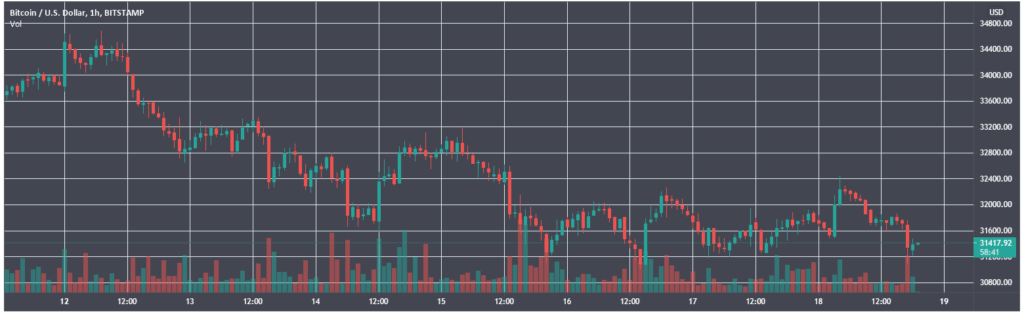
Jeffrey Gundlach, head of DoubleLine Capital and known as the “bond king,” called the Bitcoin chart “scary” and predicted a drop in price to $23,000 in the near term.
Yet analysts at Glassnode flagged a positive signal for the asset in the form of a decline in miners’ selling, which has again moved into accumulation territory.
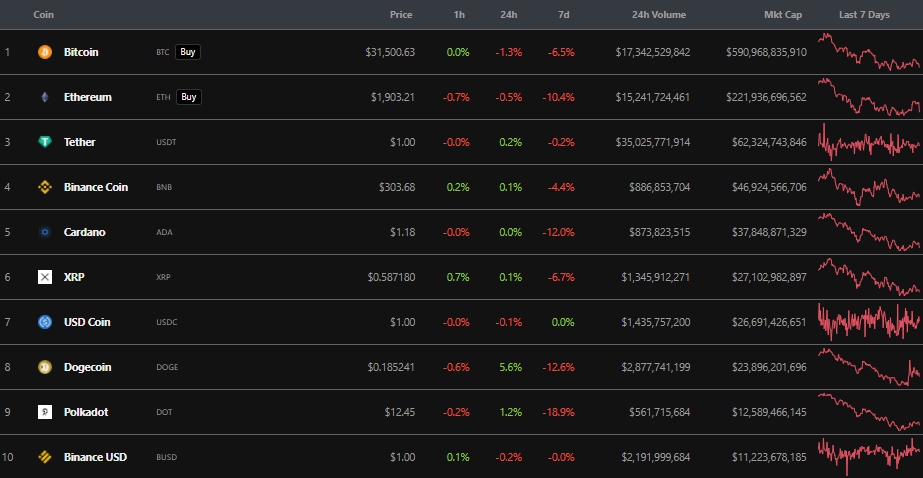
Over the past seven days Bitcoin slipped 6.5%, according to CoinGecko. Of the top-10 by market cap, only Binance Coin fared slightly better, down 4.4%.
Dogecoin fell 12.6% over the period, although it rose 5.6% in the last 24 hours. This followed another mention of the meme coin by Elon Musk.
«Lil X hodls his DOGE, like a champion. Literally never uttered the word “sell”!», — wrote Musk.
Lil X is hodling his Doge like a champ. Literally never said the word “sell” even once!
— Elon Musk (@elonmusk) July 17, 2021
The coin reacted with a sharp rally of nearly 20%, but later price corrected.


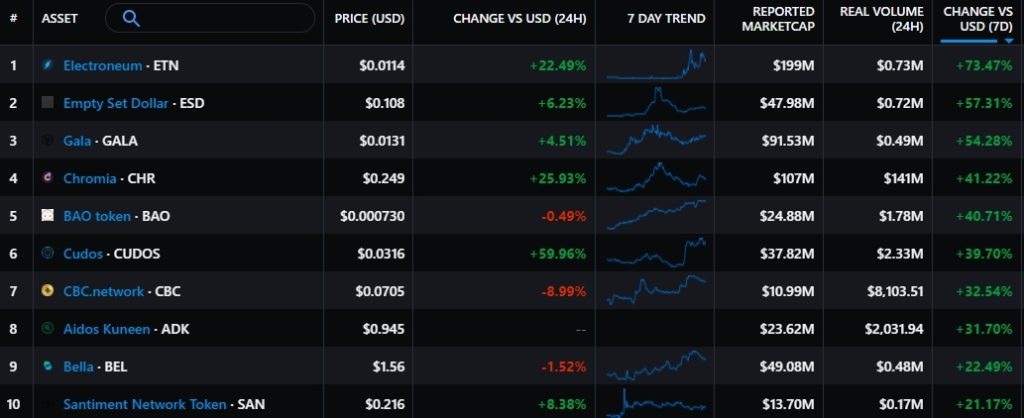
According to Messari, the top weekly gainer among digital assets was ETN from the Electronium payment platform — up 73%, with the token’s market cap approaching $200 million.


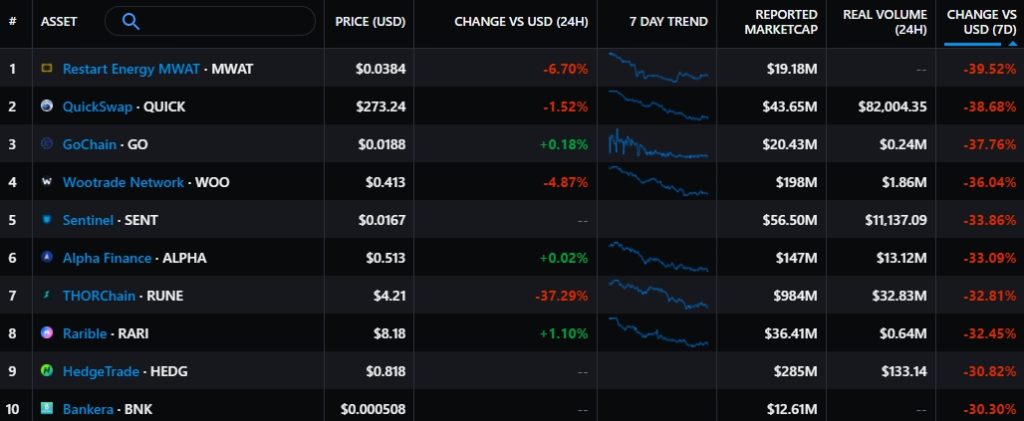
Over the past week, the worst performer was MWAT from Restart Energy, down more than 39.5%. Not far behind was the native token of the QuickSwap decentralized exchange, down 38.7%.


The total cryptocurrency market cap fell to $1.33 trillion, and Bitcoin’s dominance index rose to 44.4%.
Bitcoin mining difficulty fell by another 4.8%
On July 18, as a result of another recalculation mining difficulty, Bitcoin’s metric fell by 4.81% to 13.67 trillion hashes (T).
This is the fourth consecutive reduction. The previous record was set on 3 July 2021 when it fell by almost 28%.
At similar levels to the current difficulty, the last time this happened was about a year ago.
Uniswap rolls out layer-2 scaling solution Optimism
Leading DEX Uniswap launched an alpha version of its platform on the mainnet of Optimistic Ethereum (OΞ), promising fast and cheap transactions.
According to the developers, OΞ transactions are confirmed instantly — “no more waiting and stuck swaps.”
Representatives of Uniswap noted that with this layer-2 solution one can achieve tenfold savings in transaction costs.
PBoC publishes the first white paper on the digital yuan
The People’s Bank of China (PBoC) research and development team for DCEP has published a technical document on the national digital currency of the PRC.
The PBoC emphasised that as cash usage declines with digitalisation, more crypto assets and global stablecoins appear in the market, bringing systemic risks. This underpins the development of a tool the regulator calls e-CNY.
The PBoC defined e-CNY as a central-bank–issued digital version of the fiat yuan, managed by authorised operators. It is a hybrid financial instrument with the status of legal tender in the PRC.
Media: Ethereum co-founder to sell his company and exit the crypto industry
Bloomberg reports that Ethereum co‑founder Anthony Di Iorio will sell his software company Decentral and move on to projects not related to cryptocurrencies.
«I want to diversify so I’m not a crypto guy, but to solve real problems», — the entrepreneur said.
According to Di Iorio, he does not feel safe in the digital-assets industry.
«I will engage with cryptocurrencies when needed, but often there is no such need. It’s really only a small percentage of what the world needs», — added the Ethereum co‑founder.
Finiko founder receives Turkish citizenship and buys property in Thailand. The project paused payouts and demanded users’ personal data
One of the Finiko creators, Kirill Doronin obtained Turkish citizenship, and his current location is unknown. This was revealed by a journalistic investigation.
Doronin’s interest in Turkey is presumably explained by the country’s refusal to extradite Russians.
Investigators also found that Finiko representatives invested in a developing luxury complex on Phuket Island. This information, confirmed by the developer Andaman Riviera’s Maxim, was not disclosed with a sum.
On July 13, Finiko announced a suspension of withdrawals and asked clients to provide documents proving the origin of their funds.
On July 16, Kirill Doronin said that co-founders of the project stopped responding to calls.
According to him, Edward Sabirov, Marat Sabirov and Zygmunt Zygmuntowicz, “responsible for trading on traditional markets, crypto-processing and the FNK token,” stopped communicating with him since July 2.
He said that he had lost access to the Finiko website, so user withdrawals are suspended indefinitely.
He also claimed to have filed a report against his partners with the Russian Interior Ministry’s main investigative department.
Regulators’ pressure on Binance continued
The Italian regulator CONSOB warned investors that Binance is not authorised to provide investment services or operate in the country.
Malta’s Financial Services Authority (MFSA), in turn, reminded consumers that the regulator had not permitted the company to conduct cryptocurrency-related activity on its territory.
Hong Kong’s Securities and Futures Commission (SFC) said that entities within the Binance Group do not hold licences to operate in the jurisdiction.
Against a backdrop of ongoing regulatory pressure, the UK payments firm Clear Junction refused to process payments linked to the exchange.
Meanwhile, payment giants Visa and Mastercard decided not to sever ties with Binance, despite intensified regulatory scrutiny.
The platform itself said that from 14 October 2021 it will stop trading tokenised stocks.
Ripple wins subpoena of former SEC employee
Judge Sara Netburn denied the SEC’s challenge to compel testimony from former Director of the SEC’s Division of Corporate Finance, William Hinman.
However, James Filan, the lawyer, said that testimony could be delayed “for a short period.”
Hinman’s 2018 speech is of interest to Ripple. In that speech he declined to classify Ethereum as a security, and now must explain the reasoning in court. Ripple’s strategy is to frame the regulator’s case as unfair, pointing to his prior rulings on crypto.
Media: China’s largest electricity supplier calls for stop to mining
State Grid Corporation of China (SGCC) sent notices to every region demanding an end to cryptocurrency mining, journalist Colin Wu reported.
Some regions facing power shortages have begun implementing the directive. Anhui authorities said they were ready to shut down all projects related to digital asset mining. Similar moves were reportedly taken by the administrations of Henan and Gansu.
Meanwhile Cambridge Centre for Alternative Finance researchers found that China’s dominance in Bitcoin mining ended even before the industry crackdown began — in March its share of the hashrate fell below 50%, and by April it stood at 46%.
Brazil becomes first in Latin America to approve Ethereum ETF
The Brazilian Securities and Exchange Commission (CVM) approved the launch of an exchange-traded fund (ETF) based on the second-largest cryptocurrency.
The investment product from QR Asset Management of the QR Capital group tracks Ethereum prices based on the CME CF Ether Reference Rate index from the Chicago Mercantile Exchange (CME Group).
The crypto‑asset custodian is Gemini Custody run by the Winklevoss brothers.
The Ethereum ETF, ticker QETH11, will be listed on Brazil’s B3 exchange in São Paulo. The venue will be the first in Latin America to trade an ETF based on the second-largest cryptocurrency.
US Treasury chief to meet regulators to discuss stablecoins
US Treasury Secretary Janet Yellen announced the formation of a President’s Working Group on Financial Markets (PWG) to discuss stablecoins by July 25.
«In light of the rapid growth of digital assets, it is important that agencies cooperate in regulating this sector», — Yellen said.
PWG members include the Treasury, the Office of the Comptroller of the Currency, and the Federal Deposit Insurance Corporation.
Lightning Network capacity up 70% since the start of the year
Since the start of the year, Lightning Network (LN) capacity has grown by 70% — from 1,058.68 BTC to 1,806.38 BTC.
Lightning Network remains one of the most important scaling solutions for Bitcoin, reducing transaction fees and improving payment privacy. Many experts believe the technology’s growth will spur broad crypto adoption.
Square to launch Bitcoin-focused platform
Square will launch a business focused on building an open platform for non-custodial, inclusive, and decentralised financial services, CEO Jack Dorsey told.
He said the division, yet unnamed, will focus on Bitcoin.
PayPal raises crypto-purchase limit to $100,000
PayPal announced an increase in the cryptocurrency purchase limit for US customers from $20,000 to $100,000 per week.
The company also pledged to continue efforts to raise user awareness of digital assets.
Dogecoin co-founder: crypto industry is run by a cartel of rich people
Dogecoin (DOGE) co‑founder Jackson Palmer described the cryptocurrency as “an ultra‑right, hyper‑capitalist technology” designed to enrich already wealthy people.
Palmer argued that early crypto supporters have amassed fortunes by evading taxes, exploiting a light regulatory touch and artificially manufacturing asset scarcity.
He warned that the crypto industry preys on the least protected segments of society. But in his view it has “taken the worst features of modern capitalism” and used technology to constrain regulatory interventions such as audits.
Also on ForkLog:
- Elon Musk invented a humorous use for Dogecoin in Tesla.
- The Ethereum developer accused of cooperation with North Korea was ordered to return to custody.
- S&P Dow Jones Indices unveiled a new line of cryptocurrency indices.
- The Briton who lost 7,500 BTC will apply it to AI research.
- Cameron Winklevoss: the Bitcoin exchange Gemini will leave behind Binance.
- BNY Mellon will help Grayscale Investments convert the Bitcoin Trust into an ETF.
- The crypto-hijacking trojan was found on the Kazakhstan government website.
- In Cherkasy a cryptocurrency pyramid was shut down with losses of $9.1 million .
- Malaysian police crushed 1,069 Bitcoin miners.
- An oil and gas company will host a million Bitcoin miners from China in Canada.
What to read and watch next
In recent months, many firms and government bodies have faced ransomware attacks. The problem even became the subject of a phone call between the US and Russian presidents, after which the dark-net sites of the operator REvil unexpectedly went offline. The Biden administration formed a working group and said it would monitor ransoms paid to victims. The State Department offered up to $10 million for information about the hackers.
ForkLog investigated what underpins the heightened ransomware threat and what this could mean for the crypto industry.
In an exclusive feature the magazine assembled and analysed the most interesting and timely on‑chain indicators to gauge Bitcoin’s near- and mid-term trajectory.
In our traditional digest we gathered the week’s key AI sector developments. The DeFi news round-up covers a longer span, too.
On 12 July, ForkLog discussed Bitcoin’s price, the Ethereum hard fork, and crypto regulation in a live broadcast. Guests included Tone Vays, Andrey Sobol and Dmitry Machikhin.

Subscribe to ForkLog news on Twitter.