




Bitcoin failed to hold $113,000; Ukraine’s crypto legalisation passed its first reading; Russia’s finance ministry floated tokenising gold, plus other events of the week.
Bitcoin drifts sideways after failing to hold $113,000
Through the week, the first cryptocurrency gradually recovered, and by Friday the price rose above $113,000.


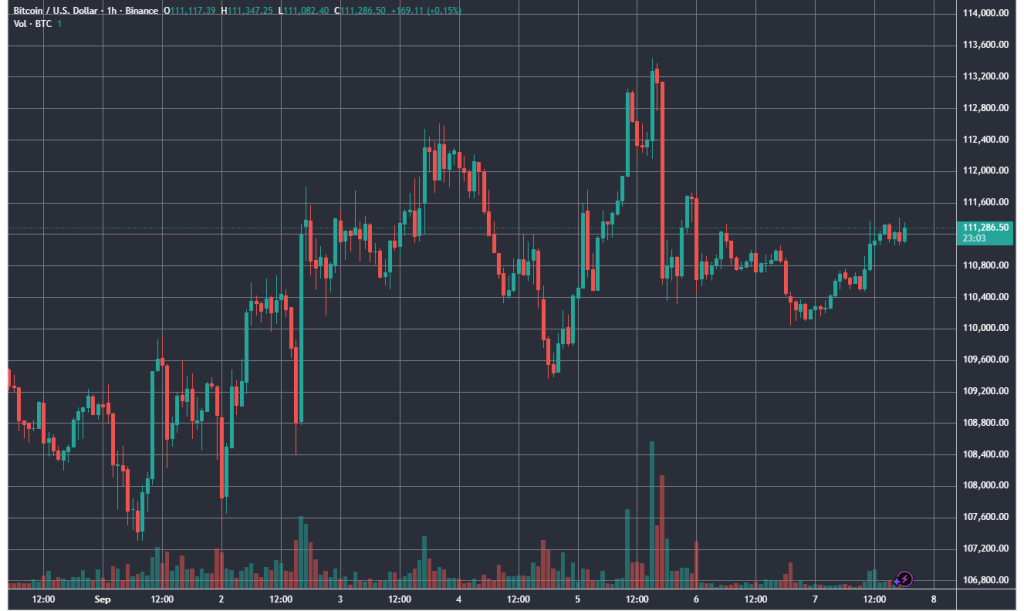
The “digital gold” could not hold those levels. After a pullback, the price moved into a sideways range around $111,200.
The seven-day gain was 2.6%. Market participants generally do not expect major moves before the Fed’s 16–17 September meeting. An expected cut to the policy rate could catalyse a renewed rally.
Ether fell 3.6% to $4300 amid a record weekly outflow of $788m from ETH ETFs (SoSoValue).


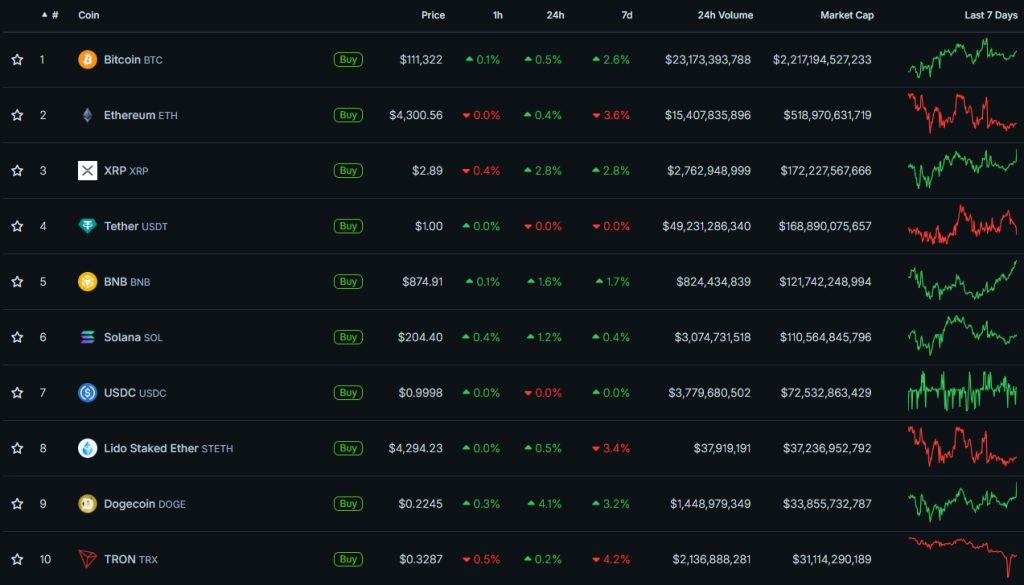
Among leading altcoins, XRP (+2.8%) and Dogecoin (+3.2%) showed moves comparable to bitcoin.
The crypto market’s capitalisation rose to $3.93trn; bitcoin’s dominance increased over the week from 55.9% to 56.4%. Ethereum’s share fell from 14% to 13.2%.
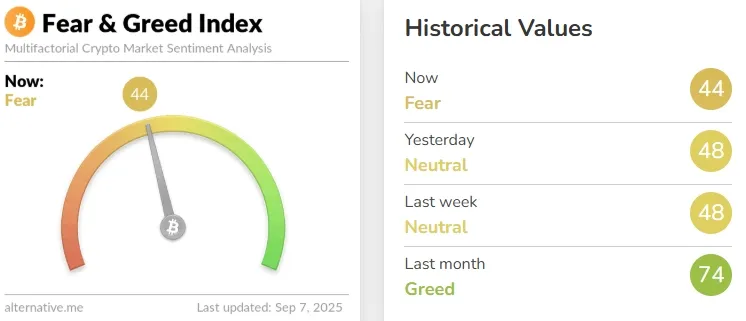
The Crypto Fear & Greed Index slipped from neutral into fear, to 44.


Ukraine’s crypto legalisation clears first reading
On 3 September, Ukraine’s Verkhovna Rada approved at first reading the draft law “On Virtual Asset Markets”, which will define the status and taxation of cryptocurrencies in the country.
The tax base will be the annual profit from virtual-asset transactions — the difference between sales proceeds and acquisition costs. It is included in general taxable income at a rate of 18%. In the first year of the law, the preferential rate on fiat off-ramps will be 5%.
Excluded from the tax base are:
- income from swapping one VA into other virtual assets;
- proceeds from a VA sale if they do not exceed one statutory minimum wage as of 1 January of the reporting year;
- the value of VAs received upon issuance, in exchange for personal data or gratuitously.
Regulation and supervision of activity in virtual-asset markets will be carried out by the National Bank and another, as yet unnamed, agency.
The bill requires substantial revision for the second reading to avoid undue burdens on business and prevent regulatory abuse, said Petro Bilyk, partner in the Technology and Investments practice at Juscutum, in a comment to ForkLog.
In his view, the draft should not contradict the state guarantees of the Diia.City legal regime, whose conditions remain unchanged for 25 years from adoption.
Another key point is the creation of a transition period of at least a year and softer sanctions. This would allow market participants to adapt to new requirements while awaiting detailed rules. Otherwise, the risk of widespread breaches will grow given the practical difficulty of rapid compliance.
Among other necessary changes, the lawyer cited:
- splitting the market regulator’s role between the National Bank of Ukraine and other competent bodies depending on asset type;
- aligning provisions with the EU’s MiCA and embedding them in an international context.
MP Yaroslav Zhelezniak confirmed the document would be thoroughly revised for the second reading.
According to the Royal United Services Institute, the absence of full-fledged crypto regulation has cost Ukraine at least $10bn in stolen funds and unrealised tax revenues.
Analysts highlighted key risks including:
- uncontrolled operations of over-the-counter platforms;
- the role of cryptocurrencies in financing purchases of sanctioned components for the Russian military;
- money-mule activity.
What to discuss with friends?
- Hollywood will shoot a thriller about Satoshi Nakamoto.
- Joseph Lubin: Ethereum will overtake bitcoin by market capitalisation.
- A psychology book helped “hack” ChatGPT.
- Analysts found a “death cross” on bitcoin’s chart.
Russia eyes tokenising gold
Tokenising gold is a “very promising solution” for Russia that could be implemented in the near term, said Alexey Yakovlev, a director in the finance ministry’s policy department.
Digitising the precious metal would enable solutions for cross-border payments and international settlements “in the new reality”, he said.
Crypto investor and founder of the Telegram channel “24 words” Artem Tolkachev suggested that tokenised gold could be used as an alternative settlement instrument amid restricted access to dollar infrastructure.
However, the expert doubts that international counterparties would be interested in such a digital asset.
“Moving an asset on-chain is the easiest part of the task. It is much harder to understand what real use cases this token solves and to build the infrastructure so that it is in demand. Tokenisation by itself gives nothing. A clear use case is needed,” Tolkachev added.
WLFI’s capitalisation hit $8.3bn after exchange listings
On 1 September, major exchanges Binance, Upbit and Gate launched trading in WLFI, the token of the World Liberty Financial DeFi project of the Trump family. The starting price was $0.30.
An initial 24.67bn WLFI — about 24.7% of the total 100bn supply — entered circulation. Most tokens remain locked under an unspecified vesting period.
After the listings, WLFI’s capitalisation briefly reached $8.3bn. The price then fell to $0.17 and recovered to $0.23 by week’s end. The token’s circulating market value is estimated at $6.5bn, FDV stands at $23.6bn.
World Liberty Financial said it suspected manipulation of the token’s price by centralised exchanges and large holders. On Friday, the platform blocked the address of TRON founder Justin Sun after a transfer of 50m WLFI to HTX.
According to the team, they have added a total of 272 wallets to a blacklist, of which:
- 215 were linked by the team to phishing attacks, with purported preventive steps taken to safeguard assets;
- 50 were blocked at owners’ requests after they informed support of compromise;
- 5 were flagged as high-risk and are under review;
- one user was suspected of misappropriating others’ assets.
“We have heard the community’s concerns about recent wallet blacklists. Transparency above all: WLFI intervenes only to protect users, not to suppress normal activity,” the platform said.
Also on ForkLog:
- The Ethereum staking entry queue hit a two-year high.
- Russia and Ukraine fell in Chainalysis’s crypto adoption ranking.
- A quantum computer cracked a “tiny” cryptographic key.
- Scientists created a non-invasive AI BCI.
Kazakhstan allows regulatory fees to be paid in stablecoins
The Astana Financial Services Authority (AFSA) launched an initiative allowing organisations registered in the AIFC to pay regulatory fees in US dollar-pegged stablecoins.
According to a press release, Bybit Limited became the first to sign a memorandum of understanding during the Astana Finance Days 2025 conference. Other digital-asset service providers can also join the project.
They will act as an agent on behalf of each payer intending to cover AFSA regulatory fees using stablecoins. The executor must convert the cryptocurrency into fiat and deposit the money into the Authority’s account.
What else to read?
With Web3 researcher Vladimir Menaskop, we compared the current levels of decentralisation of the two leading cryptocurrencies — bitcoin and Ethereum.
We examined how Gulf countries are pursuing grand plans to build a new economy based on artificial intelligence and Web3.
In our traditional digest, we rounded up the week’s main cybersecurity events.