




U.S. strikes on Iranian territory have turned cryptocurrencies into the “world’s main trading platform.” This view was expressed by Bitwise’s Chief Investment Officer, Matt Hougan.
The military operation came to light on the night of February 28, when traditional stock exchanges were closed. To swiftly respond to geopolitical events, investors flocked to 24/7 on-chain systems.
“For almost the entire Sunday, the on-chain space was the center of the financial world. For the first time in my memory, crypto markets simply became the market, period,” wrote Hougan.
The shift to decentralized environments led to a sharp increase in activity on specialized platforms:
- trading volumes of oil and cryptocurrency futures surged on the Hyperliquid exchange;
- the daily turnover of tokenized gold from Tether (XAUT) exceeded $300 million;
- prediction platforms Kalshi and Polymarket set new trading volume records;
- Bitcoin and Ethereum attracted increased trader attention.
Hougan acknowledged that the weekend’s events prompted him to revise his forecasts. Previously, he believed that on-chain markets would remain peripheral for the next 5-10 years. Now, he is convinced of their rapid integration into traditional finance.
According to the expert, banks, hedge funds, and corporate traders no longer have a choice. To stay in the market, they will need to set up wallets for stablecoins, master trading on DEX, and explore tokenized assets.
“Even if you don’t do it, others will,” concluded the Bitwise director.
Bitcoin’s Impact on Traditional Investment Portfolios
Hougan and quantitative analyst Mallika Kolar also updated their research on the role of the first cryptocurrency in a classic investment portfolio consisting of 60% stocks and 40% bonds. The experts analyzed market data from January 2014 to December 2025.
New study update: Adding bitcoin to a 60/40 portfolio has increased cumulative and risk-adjusted returns in 100% of three-year holding periods.
The win rate over two years is 93%!
Updated study from @Bitwise with data through year-end 2025. Link and details below. pic.twitter.com/ekkgiv5HQu
— Matt Hougan (@Matt_Hougan) March 3, 2026
The specialists concluded that Bitcoin effectively enhances risk-adjusted investment returns. However, it requires strict adherence to three rules: long-term holding, regular rebalancing, and strict allocation limits.
During the study period, the basic 60/40 strategy showed a cumulative return of 127.9% (7.1% annually). Allocating just 2.5% to Bitcoin (with quarterly rebalancing) would have increased the result to 187.4%. A 5% allocation would have doubled the final return to 258.5%. Meanwhile, a 2.5% share minimally impacted the maximum drawdown: 23.7% compared to 22.1% for the classic strategy.


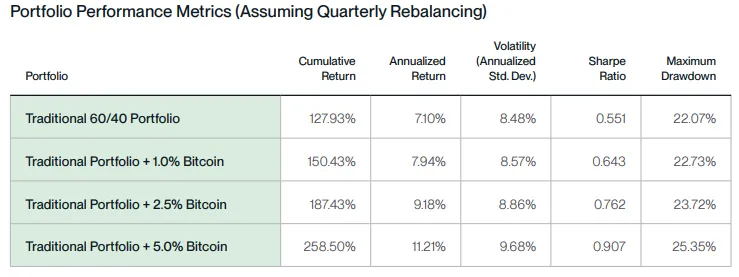
Bitwise emphasized that the optimal investment horizon is three years or more. The longer the position is held, the more stable the result. Over a one-year period, cryptocurrency increased portfolio returns in 76% of cases, over two years the figure rose to 94%, and for any three-year periods, the success rate reached 100%.
Due to the asset’s high volatility, failing to lock in profits sharply increases risks. A “buy and hold” strategy without rebalancing with a 2.5% Bitcoin share could yield 421.4% returns but would increase the portfolio’s maximum drawdown to 50.9%. Analysts recommend quarterly rebalancing as the optimal solution—it maintains high profits while keeping volatility within normal limits.
Analysts noted a nonlinear relationship between the volume of Bitcoin in the portfolio and risk metrics. A share from 0.5% to 4.5% has little effect on the maximum drawdown of investments. However, after surpassing the 5% threshold, potential losses begin to rise sharply, and the increase in the Sharpe ratio (return per unit of risk) slows down.
In conclusion, company representatives emphasized that past successes do not guarantee future results. However, statistics from the past decade confirm that a moderate addition of the first cryptocurrency (up to 5%) structurally improves the performance of any diversified portfolio.
Earlier, on March 2, analysts from the London Crypto Club stated that the U.S. and Israeli military operation against Iran would positively affect the first cryptocurrency’s prices.