




Bitcoin experienced turbulence within the $94,000-$103,000 range, a developer disrupted 69% of Dogecoin nodes, and the community proposed freezing Satoshi Nakamoto’s assets, among other events of the past week.
Bitcoin and Volatility
The leading cryptocurrency began the week around $101,000 but immediately underwent a sharp correction on Monday, plummeting to $94,000.
From December 9 to 10, the volume of forced liquidations in the crypto market reached $1.75 billion, including $1.57 billion in longs. Liquidations in the altcoin segment were the largest since May 2021.
K33 Research noted that cascading liquidations were a feature of the 2021 bull run and seem to be repeating this pattern now.


From Wednesday, December 11, the market began to recover slowly, with Bitcoin returning to $100,000 by evening.
The growth was prompted by an acceleration in annual inflation in the US. In November, the rate was 2.7%, up from 2.6% the previous month. The growth rate matched market expectations.
According to Bloomberg, the report indicates a halt in disinflation. Price growth rates still significantly exceed the Fed’s target level, although they are substantially lower than in 2021 and 2022, when there was a massive increase in the cost of living.
After the Federal Reserve meeting, the leading cryptocurrency briefly dipped below six figures but ended the week at $103,000.
Only digital gold showed positive weekly dynamics. Other top-10 cryptocurrencies by market capitalization ended in the “red zone.”


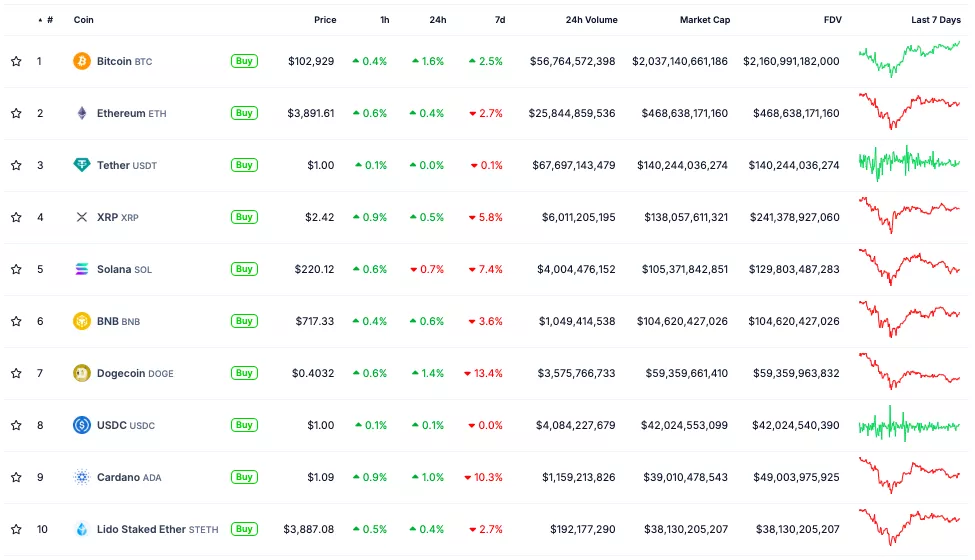
Ethereum fell by 2.7% and is trading at $3,850. DOGE suffered the most, dropping by 13.4%.
Amid ongoing volatility, the “buy the dip” strategy will remain relevant “much longer than everyone expects,” stated Syncracy Capital co-founder Daniel Chung.
According to him, the market participants’ psychology has fundamentally changed in this cycle. Previously, they adhered to hodling and accumulated during downturns, but now they aim to lock in profits.
Freezing Satoshi’s Bitcoins
At the beginning of the week, Ava Labs founder and CEO Emin Gün Sirer proposed freezing 1 million BTC in Satoshi Nakamoto’s wallets, citing the risks posed by quantum computing.
He noted that addresses associated with the creator of the first cryptocurrency used an early P2PK format. The outdated technology fully reveals the public key, giving attackers time to brute-force it.
Gün Sirer also suggested setting a closure date for the P2PK format and freezing all assets in such wallets.
Not everyone in the community agreed with his arguments: some users reminded him of property rights, while others downplayed the threat of quantum computers.
The Ava Labs CEO’s proposal came just days before the 14th anniversary of Satoshi’s disappearance. On December 12, 2010, the creator of digital gold made his last post on the BitcoinTalk forum.
Solana vs. Ethereum
The second-largest cryptocurrency by market capitalization has long faced criticism from the community for the slow development of its ecosystem. This week, Ethereum developer Max Reznik confirmed this sentiment.
He announced his departure from the ConsenSys team to join Anza, a company focused on Solana. His decision followed significant staff cuts at ConsenSys and personal disappointment with the network’s development direction.
“I’m tired of Ethereum losing to Solana. I want us to start winning again. But that means we need to start playing our game, not theirs,” Reznik wrote.
According to him, the ecosystem “has obliterated” the original vision of blockchain as a “public financial substrate for a new world.” The developer also criticized Ethereum’s approach to decision-making five years ahead, given the pace of technological advancement.
Reznik urged remaining team members to return to Ethereum’s original course and outlined five main goals for the network:
- block processing in one second;
- finalization in one slot;
- throughput exceeding 1,000 transactions per second;
- simultaneous addition of multiple blocks.
Later in the week, venture firm Electric Capital released a report indicating that Solana has become the most attractive blockchain for new developers.
Of the 39,148 new entrants to the industry this year, 7,625 have started working on Solana projects. This is the first time since 2016 that the network’s ecosystem is growing faster than Ethereum’s.


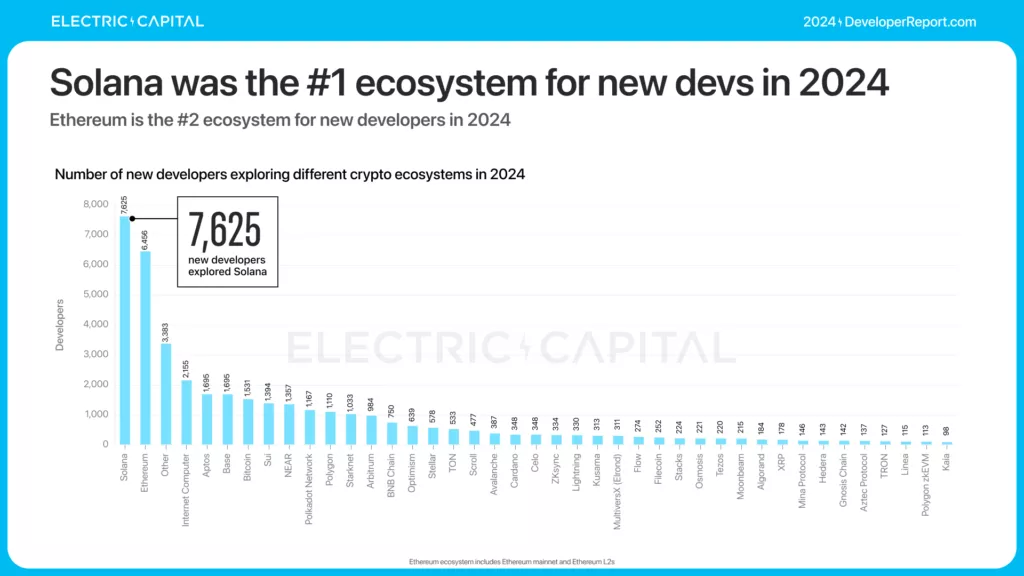
Nevertheless, Ethereum maintains overall leadership in the number of developers worldwide, with Solana in second place.
What to Discuss with Friends?
- Amazon’s board of directors was advised to create a bitcoin reserve.
- A trader turned $3,000 into $73 million on the meme token PEPE.
- A church pastor was accused of promoting a $6 million crypto pyramid scheme.
- Matrixport explained why Bitcoin will reach $160,000 in 2025.
Ripple’s Stablecoin
On December 10, the New York Department of Financial Services approved Ripple’s RLUSD stablecoin for trading. The announcement was made by the company’s head, Brad Garlinghouse.
He reported the imminent listing of the new coin on partner platforms. The list includes Uphold, Bitstamp, Bitso, MoonPay, Independent Reserve, CoinMENA, and Bullish. Liquidity will be provided by market makers B2C2 and Keyrock.
Ripple began testing its own “stablecoin” in April 2024. According to Garlinghouse, the asset, suitable for payments, RWA, and DeFi, will become the “gold standard for the corporate sector.”
He clarified that the company does not intend to abandon its XRP token, which rose by 10% following the RLUSD approval news.
Meanwhile, last week, investors poured a record $134.3 million into XRP-based funds.
Dogecoin Shutdown
Andreas Kohl, co-founder of the Bitcoin sidechain Sequentia, managed to halt 69% of Dogecoin network nodes by exploiting a previously discovered vulnerability.
He revealed that he used a flaw previously identified by researcher Tobias Ruck. The vulnerability, named DogeReaper, allows any node to be remotely disabled if its ID is known in the network.
Thus, Kohl crashed about 69% of Dogecoin validators. Following his intervention, the number of active nodes decreased from 647 to 258. Subsequently, the blockchain’s operation was fully restored.


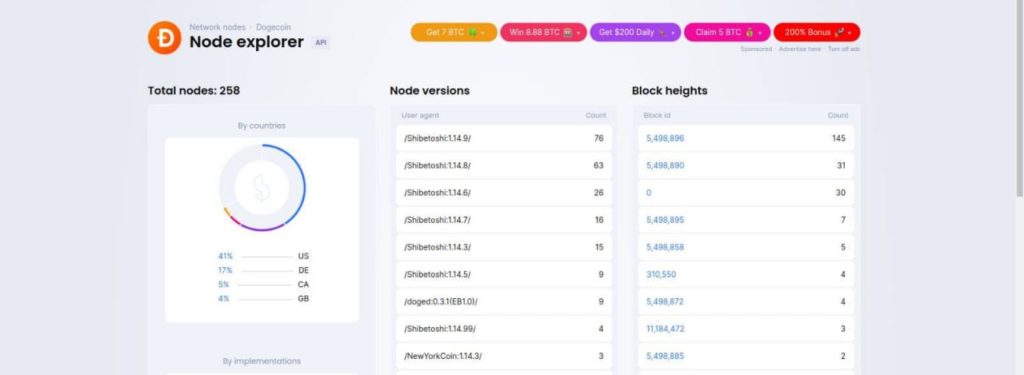
This flaw posed a significant threat to the network’s stability. Therefore, researchers provided detailed information about the exploit to miners and exchanges, and patches were released for most systems.
Bitcoin Taxes in Ukraine
Ukraine’s Verkhovna Rada has nearly completed work on an updated bill on the regulation and taxation of virtual assets, according to the head of the tax committee, Danylo Hetmantsev.
The document will be presented in the first quarter of 2025. The main change is the rejection of the possibility of preferential taxation of cryptocurrency operations. The previously proposed document by the Ministry of Digital Transformation suggested a preferential tax with a phased increase in rates—from 5% to 18%.
It is proposed to tax the withdrawal of assets to fiat as profit tax, similar to securities.
“In consultations with European experts and the IMF, we are very cautious about using cryptocurrencies for tax benefits, as a way to evade taxation in traditional markets,” Hetmantsev explained.
Until the bill is passed, tax is levied on the entire amount of sold cryptocurrency according to the country’s general taxation principle.
Simultaneously, Ukraine’s largest banks signed a memorandum setting limits on outgoing transfers without documentary proof of income.
For high-risk clients, the limit is 50,000 hryvnias. For medium and low-risk clients:
- from January 1, 2025 — up to 150,000 hryvnias per month;
- from June 1 — up to 100,000 hryvnias per month.
Also on ForkLog:
- Experts see signs of an approaching ATH for Ethereum.
- The stablecoin market capitalization exceeded $200 billion.
- MicroStrategy shares included in the Nasdaq 100 index.
- Citi analysts: stablecoins could strengthen the dollar’s leadership.
What Else to Read?
ForkLog explored why El Salvador plans to abandon its Bitcoin strategy and why President Nayib Bukele is making a deal with the IMF.
The traditional digest compiled the week’s main events in the field of cybersecurity.