



Weekly Review: Bitcoin Surges to $42,000 as SEC Delays Ethereum-ETF Decision
The leading cryptocurrency soared past $42,000, while the U.S. Securities and Exchange Commission (SEC) postponed its decision on a spot Ethereum-ETF. Developers of Tornado Cash initiated a fundraising campaign, among other events of the past week.
Bitcoin Climbs Above $42,000
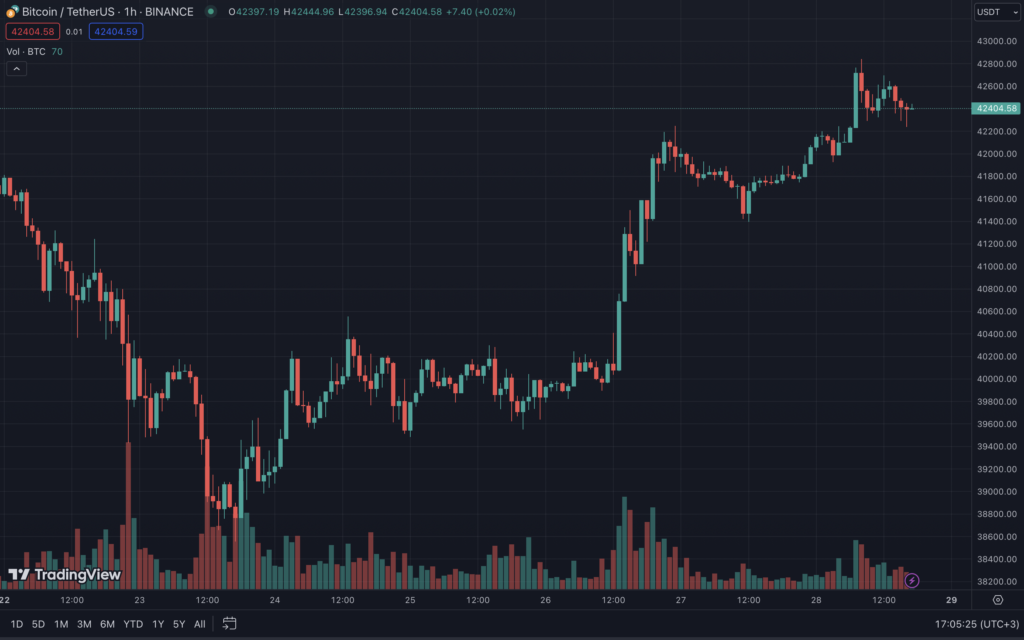
The leading cryptocurrency began the week below $42,000. On Tuesday, January 23, the asset’s price fell below $40,000. By the night of Saturday, January 27, digital gold had surpassed the $42,000 mark.
At the time of writing, Bitcoin is trading at $42,400.
Most digital assets in the top 10 by market capitalization ended the week in the “red zone.” However, Bitcoin (+1.6%), Solana (+4.8%), and Avalanche (+7%) showed growth.
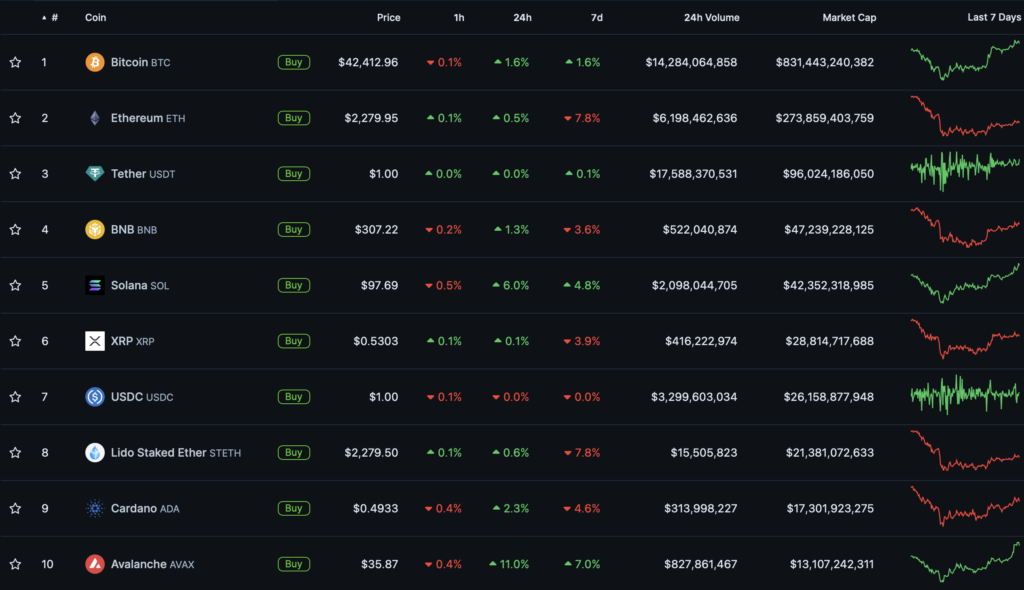
The total cryptocurrency market capitalization stands at $1.71 trillion. Bitcoin’s dominance index is 52.4%.
SEC Delays Decision on BlackRock’s Spot Ethereum-ETF
The SEC postponed its decision on BlackRock’s spot Ethereum-ETF until March 10. The agency’s head, Gary Gensler, urged not to create hype around the instrument, citing the “limited” registration of a similar Bitcoin-based product.
He explained that the January decision was limited to one cryptocurrency and “should not be viewed as anything else.”
“What we did regarding the Bitcoin-ETF pertains to this single commodity, which is not a security,” he explained.
The Commission justified the delay on BlackRock’s proposal by the need for “sufficient time to consider the proposed rule change and the issues it raises.”
Changpeng Zhao Offered $4.5 Billion Bail to Travel to UAE
In December 2023, a court rejected former Binance CEO Changpeng Zhao’s (CZ) request to return home to the UAE, despite offering a $4.5 billion bail.
CZ planned to leave on January 4 for a few weeks, as he anticipated “hospitalization and surgery” for a close relative.
The proposed bail was calculated based on Binance’s latest funding round, which valued the company’s equity at $4.5 billion.
Judge Richard Jones held closed hearings on the matter but denied Zhao’s request. Authorities first refused CZ’s departure in early December. He will remain in the U.S. until the hearing scheduled for February 23, 2024.
“The defendant possesses vast wealth and property abroad and has no ties to the United States. His family resides in the UAE, and [CZ] appears to have privileged status. Under these circumstances, the court concludes that the defendant has not demonstrated his intention to return,” Johnson wrote in the order.
Topics to Discuss with Friends
- An expert confirmed the possibility of removing Bitcoin’s issuance limit.
- Coincall will conduct an airdrop of the CALL token.
- Amazon will produce the film Razzlekhan about the massive Bitfinex hack.
- SEC explained the reason for the X account hack.
“Privacy is Not a Crime”: Tornado Cash Developers Begin Fundraising
Tornado Cash co-founders Roman Storm and Alexey Pertsev organized the JusticeDAO fund to raise money for legal defense.
“The year 2024 will define my entire life. Honestly, I’m scared. But I also hope the community cares about us passionately. Please donate to my defense,” Storm wrote.
The initiative was supported by former NSA and CIA employee Edward Snowden, stating that “privacy is not a crime.”
Coinbase’s Chief Legal Officer Paul Grewal also highlighted the issue. According to him, the exchange’s team proposed amendments to the U.S. Treasury’s bill on crypto mixers.
“We don’t see a regulatory gap here. Exchanges like ours are already required to investigate and report suspicious digital asset mixing activities related to our platform. Why does the Treasury now need us to report non-suspicious activity?” Grewal noted.
Moreover, according to Coinbase’s lawyer, the agency’s rules do not include a minimum threshold of sent funds after which an investigation must be initiated. Such an approach will simply lead to mass reporting of non-suspicious transactions, he believes.
Meanwhile, in the U.S. Congress, it was stated that the Treasury’s proposal to monitor crypto mixers is a “waste of time,” Grewal emphasized.
CommEX Allows All Users to Post P2P Ads
As of January 25, cryptocurrency exchange CommEX has allowed all users to post ads on its P2P marketplace.
Previously, this option was only available to merchant status holders with a high trading volume. Other clients could only search for suitable ads and purchase cryptocurrencies.
For P2P trading security, CommEX has set several requirements: users must complete identity verification, enable two-factor authentication, and link a Telegram bot.
Additionally, the ad author must have at least 20 successfully completed trades with more than 10 unique trading partners. The order fulfillment rate over the past 30 days must exceed 80%.
Merchant status holders retain advantages: a badge highlighting the user among other traders in the order book, the ability to resolve issues with support faster, and exemption from the T+1 rule.
According to CommEX representatives, since the beginning of 2023, the volume of concluded deals on their P2P platform has exceeded 40 million USDT.
Also on ForkLog:
- OpenAI updated ChatGPT and reduced subscription prices.
- Ukrainian politician Vitaliy Kim declared Bitcoin.
- Terraform Labs filed for Chapter 11 bankruptcy.
- Nexo demanded $3 billion in damages from Bulgarian authorities.
Peter Schiff Considers Bitcoin Could Reach $10 Million, With a Caveat
Euro Pacific Capital President and Bitcoin critic Peter Schiff suggested that by 2031, Bitcoin’s price could reach $10 million under a highly hypothetical scenario.
According to him, this would happen if the U.S. dollar follows the path of the “German paper mark”. This term unofficially referred to the currency introduced in Germany at the start of World War I in 1914, replacing the previous gold-backed mark.
In the early 1920s, the paper mark became worthless due to hyperinflation. During these years, companies paid wages several times a day so workers could shop before prices rose again. The money supply grew so rapidly that the state couldn’t print banknotes fast enough, resorting to private printers, lowering quality standards, and other measures. The highest denomination banknote was 100 trillion marks. In 1924, during a monetary reform, the old currency was exchanged at a rate of 1 trillion to 1 rentenmark.
Germany’s hyperinflation ranks third in modern history after Zimbabwe in the early 21st century and Hungary during World War II. Presumably, Schiff used this analogy to indicate how unlikely he considers the scenario.
Initially, his comment was about comparing Bitcoin’s and gold’s returns. Schiff believes that cryptocurrency supporters, regardless of how much the asset’s price falls, still claim its superiority over precious metals.
“For example, even if Bitcoin falls to $100 in 2031 and gold rises to $10,000, they will claim that cryptocurrency has increased 100 times over the past 20 years, while the precious metal has only increased five times,” he stated.
What Else to Read?
This week, ForkLog explained what Celestia (TIA) is and the Lindy effect in investments.
In the traditional digest, we compiled the week’s main events in cybersecurity.
The cryptocurrency industry is attracting an increasing number of institutional players. This is evidenced by new infrastructure investments and the growing attention companies are paying to Bitcoin as an asset class. The most important events of recent weeks are in ForkLog’s review.
Рассылки ForkLog: держите руку на пульсе биткоин-индустрии!