




The price of the leading cryptocurrency has rebounded to $60,000, Payeer has been hit with a record fine by Lithuania’s regulator, and the developers of the clicker game Hamster Kombat have announced a second airdrop, among other events of the past week.
Bitcoin at $60,000
Digital gold began the week with high volatility. On Monday morning, the asset traded at $54,500, rose to $58,000 by noon, but corrected to $55,000 by evening.


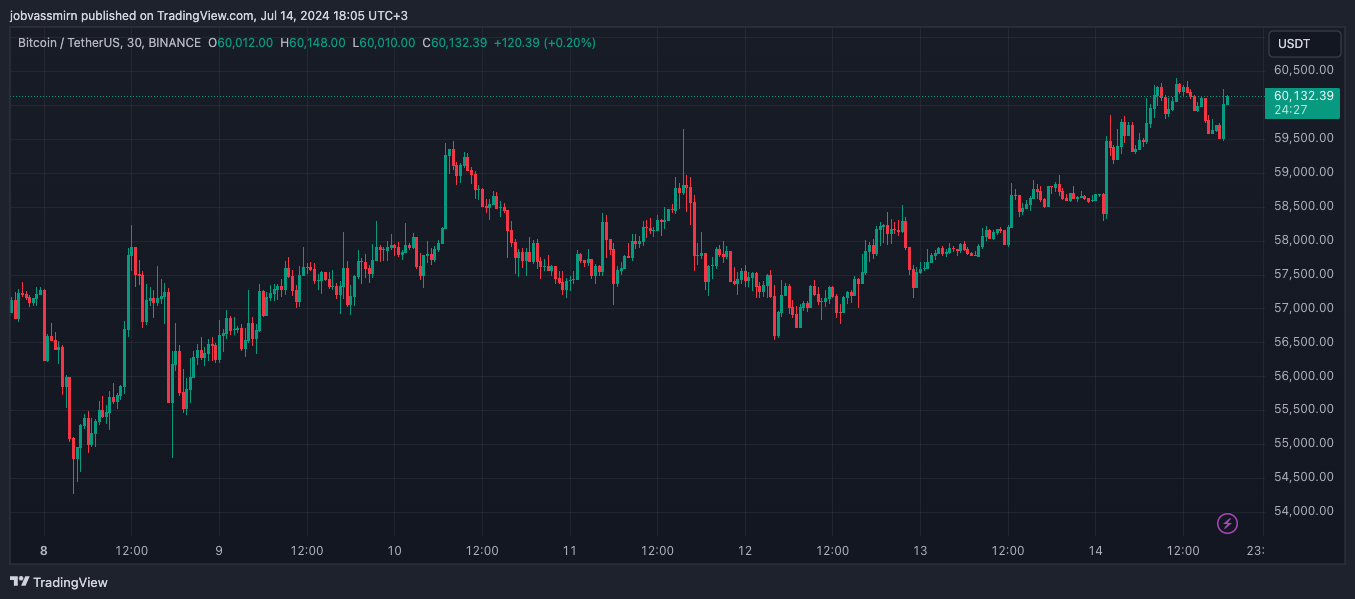
On Tuesday, Bitcoin rose to $58,000. Following the release of data showing a slowdown in US inflation from 3.3% to 3% (against a forecast of 3.1%) on Wednesday, the coin broke through the $59,000 level.
On the same day, Citi analysts announced the start of a cycle of key rate cuts by the Fed. They predict that from September, the Federal Reserve will reduce the rate by a total of 2% over the next seven meetings.
Until Sunday, the leading cryptocurrency traded in the range of $56,500 to $59,000, but after an unsuccessful attempt on former US President Donald Trump, it surpassed the $60,000 mark.
However, some experts warned of the digital gold’s uncertain position. Technical analyst Ali stated that the asset is still trading below the 200-day simple moving average.
Trader Crypto Tony noted that “it would be great for the bulls to see a return to $60,500.” User Daan Crypto Trades pointed out a pattern: recently, Bitcoin has been moving up over the weekend but falling again at the start of the week. He linked this dynamic to the opening of trading on the CME.
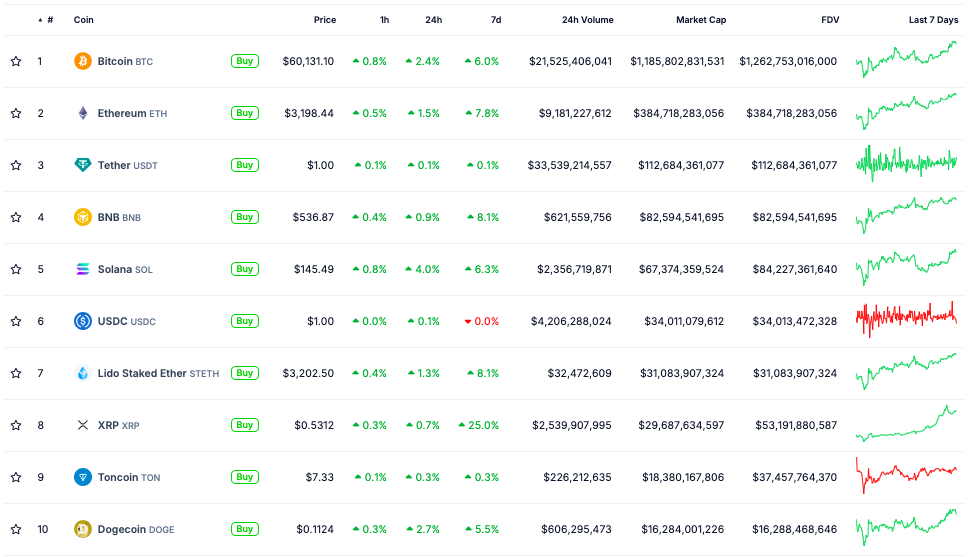
At the time of writing, the leading cryptocurrency is trading at $60,130. According to CoinGecko, the total market capitalization of the crypto market is $2.31 trillion, with Bitcoin’s dominance index at 51%.
Almost all assets in the top 10 ended the week in the “green zone.” Ethereum rose by 7.8% over seven days, while XRP gained 25%. Only TON remained virtually unchanged in price.

Germany Sells 50,000 BTC
On the evening of July 12, German authorities sold all 49,860 BTC worth approximately $2.97 billion, seized from the pirate portal Movie2k in January.
It was also revealed during the week that the assets were seized by the police department of the federal state of Saxony but were held in a wallet by the Federal Criminal Police Office of Germany.
According to Lennart Ante, co-founder and CEO of Blockchain Research Lab, regional legislation requires the liquidation of seized funds within a certain period. Therefore, the government was forced to “offload” the Bitcoin.
After all assets were sent to centralized exchanges, MicroStrategy founder Michael Saylor posted in X in German, asking not to sell the leading cryptocurrency.
CEO of JAN3 Samson Mow and Bundestag member Joana Cotar joined the discussion. They proposed developing a plan for the German government to increase its reserves of digital gold.
Fine for Payeer
Lithuania’s Financial Crime Investigation Service (FNTT) imposed a record fine of €8.23 million on crypto processor Payeer for non-compliance with international sanctions.
The company will also pay €1.06 million for violating the Law on the Prevention of Money Laundering and Terrorist Financing.
FNTT found that Payeer, through its crypto platform, allowed clients, mainly from Russia, to conduct transactions in Russian rubles by transferring them from banks under sanctions.
According to BitOK experts, about $35 million of Payeer’s turnover ($15 million in and $20 million out) was linked to the Russian exchange Garantex, included in the SDN list in 2022. This accounted for 2-5% of the service’s processed funds.
BitOK noted that under Lithuanian law, virtual asset service providers are required to verify clients based on the KYC principle and check the sources of funds. According to FNTT, Payeer did not properly comply with these requirements.
What to Discuss with Friends?
- Vitalik Buterin urged the community to prepare for a potential 51% attack on Ethereum.
- Pink Drainer hackers suffered from “address poisoning.”
- New assets were seized from police officers who took bribes from the “red admin” of WEX.
- The Telegram username dodopizza was sold for 70,000 TON.
Second Hamster Kombat Airdrop
The developers of the clicker game Hamster Kombat shared the project’s genesis and announced a second airdrop. The creators wished to remain anonymous but stated they have been working in the crypto industry since 2013.
When creating the Telegram app, the team was guided by Notcoin. Other sources of inspiration included the meme culture from the GameStop and Reddit saga, where retail investors showed Wall Street their strength.
The developers are optimistic about Hamster Kombat’s prospects following the first airdrop, scheduled for the end of July, and announced plans for a second distribution phase, as well as a commitment to combat bots and fraudsters.
According to the game’s team, its user base has exceeded 250 million accounts.
On Monday, the crypto exchange Bybit opened the pre-market for the HMSTR coin. Currently, the asset is trading at an average of $0.22.
SAB 121 Remains in Effect
On July 11, the US House of Representatives failed to gather the necessary two-thirds majority to override the president’s veto on a bill to repeal SAB 121, which effectively prohibited banks from holding digital assets on their balance sheets.
Despite the rejection of the initiative, Maxine Waters, a Democrat on the House Financial Services Committee, reported ongoing negotiations to amend the document.
The parties aim to introduce changes that would allow some financial institutions to offer crypto custodial services.
“[Without changes to SAB 121] you can’t approach some of the largest and oldest financial institutions in the US because they are not allowed to play this game,” noted Aaron Jacob of TaxBit.
SEC issued SAB 121 in April 2022. In February 2024, four industry organizations approached the agency to request easing the document’s provisions. Commissioner Hester Peirce called the Bulletin and related oral guidance from the leadership a “pernicious weed”.
Also on ForkLog:
- Messari CEO declared war against the “corrupt” SEC.
- The Bank of Russia ruled out the use of stablecoins for domestic payments.
- Bitcoin miners in Malaysia stole electricity worth $724 million.
- Chainalysis estimated the volume of laundered cryptocurrency at $100 billion.
Block and Core Scientific’s $300 Million Deal
On July 10, mining company Core Scientific struck a deal to become the first buyer of 3-nm chips for Bitcoin mining from Jack Dorsey’s Block. The purchase volume in terms of hash rate will be 15 EH/s.
The chips were developed by the Proto team within the payment firm. Both companies intend to jointly create a Bitcoin mining device based on the 3-nm chip with support from equipment manufacturer ePIC Blockchain Technologies.
Bernstein analysts estimated the Core Scientific and Block deal at $300 million. Experts calculated the likely monetary equivalent based on the cost of comparable competitive offerings in the market.
Bernstein noted that following the agreement, Block will enter a market historically dominated by three Chinese companies: Bitmain (with a share of over 80%), MicroBT, and Canaan.
What Else to Read?
This week, ForkLog reported on the upcoming major Pectra upgrade in the Ethereum network. The update is scheduled for the first quarter of 2025.
The most important news about investments in the crypto industry was published in the institutional newsletter. Key metrics of mining companies for June were covered in a separate digest.