



Bitcoin slipped below $67,000, the miner-activity gauge hit a historic low, Ethereum’s quantum defence is slated for 2029, and other highlights of the week.
A skittish market
The past seven days were, again, mixed for digital assets, with the industry reacting sharply to headlines from the Middle East.
Monday opened with bitcoin jumping above $70,000 after US President Donald Trump said a strike on Iran had been paused.
After a brief pullback, the coin resumed its ascent — by Wednesday the price had surpassed $72,000.


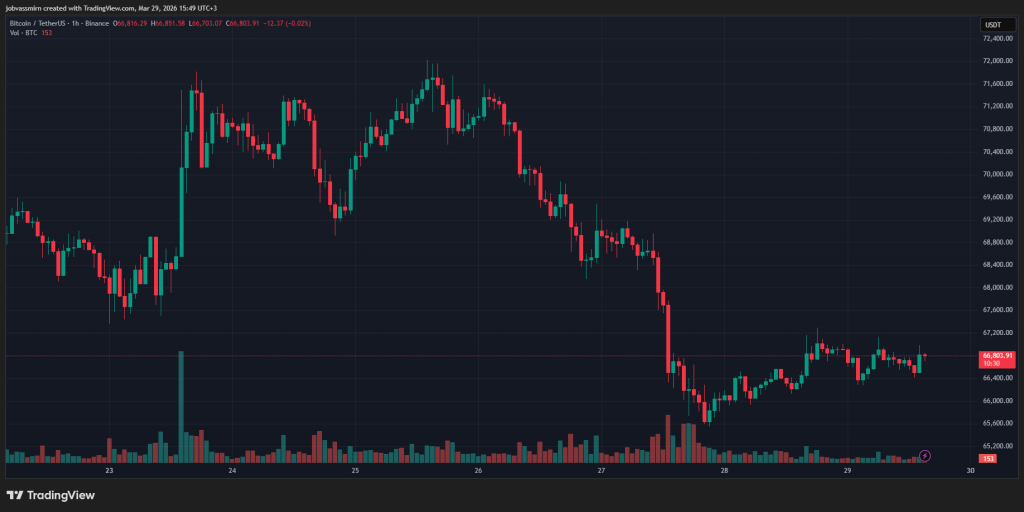
That proved a local peak. On Thursday, March 26, bitcoin turned lower, sliding from $72,000 to $68,000 in a day.
The sell-off extended on Friday as the asset plunged to $65,000. Prices reacted to reports of an escalation in the Middle East and outflows from ETFs.
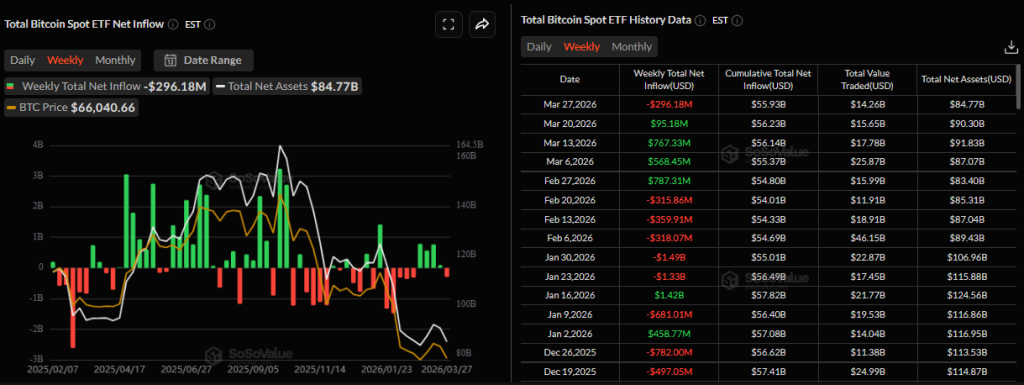
Spot bitcoin funds snapped a four-week run of inflows. From March 23–27 the products lost $296m.


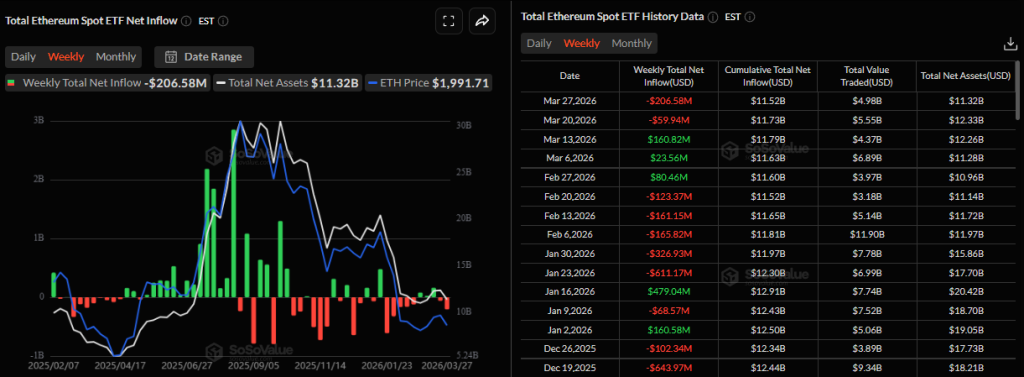
Ethereum ETFs saw outflows of $206m.


Over the weekend bitcoin stabilised, holding just under $67,000 and losing 3% over seven days. Observers reckon the next leg hinges on macro and geopolitics.
The wider crypto market tracked the flagship and, as usual, reacted more sharply to sell-offs.


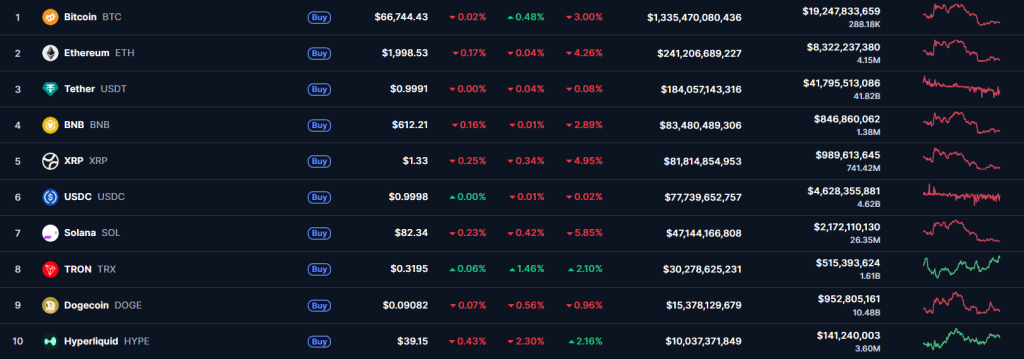
Ether fell 4%, XRP 5% and Solana 5.8%.
HYPE clung to tenth by market value, adding 2% on the week.
Total crypto capitalisation stands at $2.37trn, with BTC dominance at 56.1% and ETH at 10.1%.
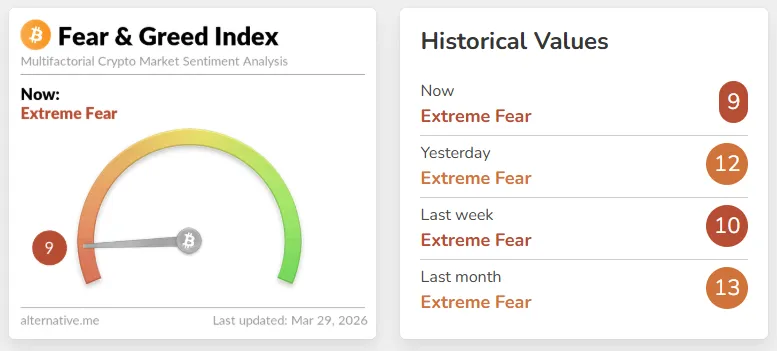
The Crypto Fear and Greed Index remains in “extreme fear” at 9.


Miner inactivity
The Miner Position Index (MPI) fell to -1.04 — the third-lowest reading on record. CryptoQuant analyst Ignacio Moreno de Vicente called it a bullish signal.

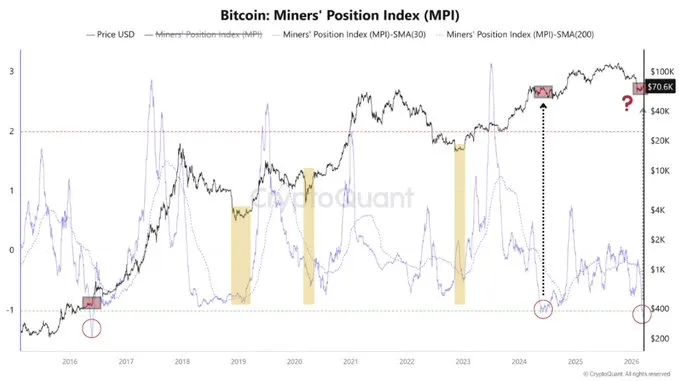
Such levels indicate miners are sending fewer coins to exchanges than usual relative to the yearly average, structurally reducing sell pressure.
“MPI reflects the relative behavior of sellers, but does not show who absorbs the supply. Without a clear expansion of demand (spot flows, ETF inflows or positioning in derivatives), a low MPI alone cannot deliver a sustained upward move,” de Vicente added.
The signal strengthens when the gauge turns up from lows, pointing to a return of activity as conditions improve.
Meanwhile, CoinShares analysts recorded a capitulation by 20% of bitcoin miners. They said the fourth quarter of 2025 was the toughest for miners after the latest halving. The weighted-average cost per coin among public firms reached $79,995.

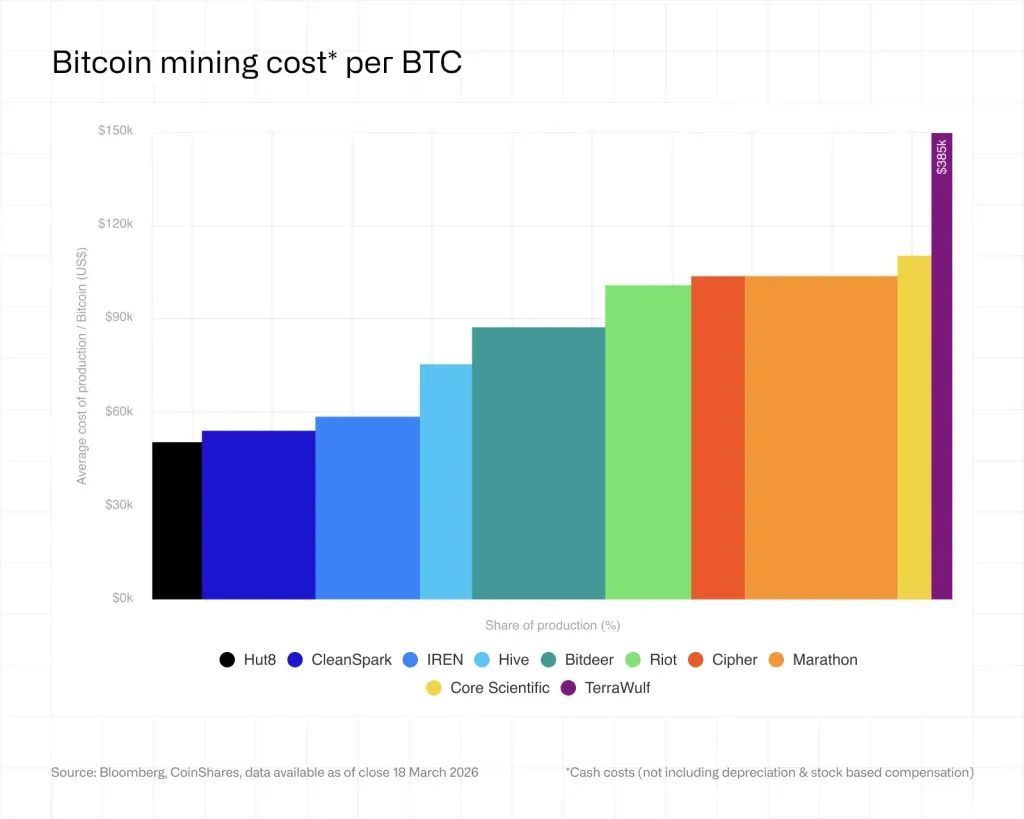
At risk are operators with outdated hardware and high power costs.
Mid-generation rigs run below breakeven at the current hashprice, especially if electricity is $0.05/kWh or higher. To stay profitable, they need cheaper tariffs.
Sideways bitcoin prices would worsen matters. Head of research James Butterfill said a prolonged slump would force inefficient capacity offline, slowing hashrate growth and eventually rebalancing returns.
Large miners also kept selling reserves. This week MARA Holdings said it sold 15,133 BTC for roughly $1.1bn.
The proceeds will go towards repurchasing the company’s own bonds.
Talking points for friends
- In the US, bitcoin-backed lending services will see launch.
- A dispute over cryptocurrencies split a Swiss banking dynasty.
- In Russia, lawmakers proposed curbing the use of AI in education.
- Brad Garlinghouse called stablecoins crypto’s “ChatGPT moment”.
Ethereum’s quantum defence
The non-profit Ethereum Foundation unveiled a roadmap to protect the blockchain from quantum computers, envisaging four hard forks.
Key updates include:
- Fork I will give validators a public key that can be activated if a quantum computer suddenly emerges.
- Fork J will cut gas costs for verifying secure signatures.
- Fork L will introduce state compression using zero-knowledge proofs to pack state and signature data more compactly.
- Fork M will protect L2 networks against future quantum threats.

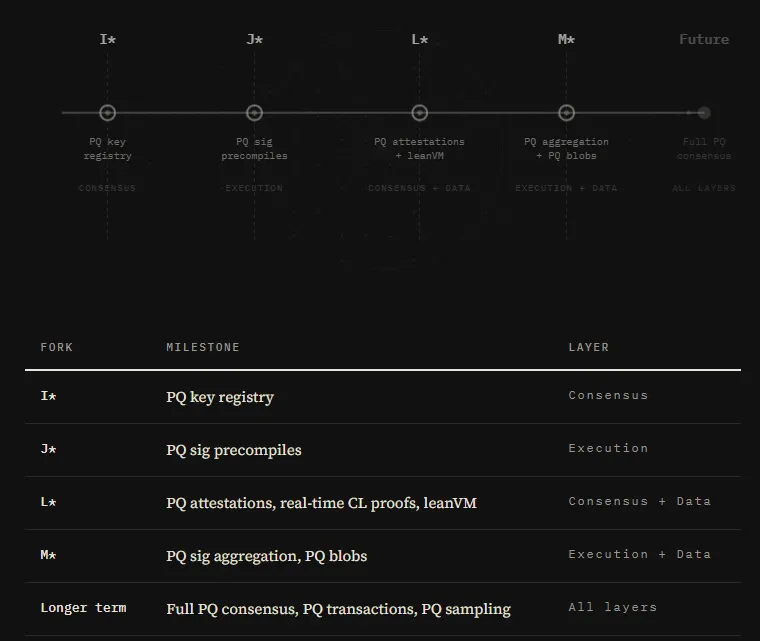
The transition will touch all three layers of the protocol — execution, storage and data availability.
The foundation estimates “cryptographically significant” machines are at least eight, perhaps twelve, years away. Preparation, however, should begin now.
“Quantum computing will ultimately break public-key cryptography, which provides ownership, authentication and consensus across all digital systems. Work must begin long before the threat becomes reality,” the Ethereum Foundation noted.
The team aims to complete the network overhaul by 2029, though full migration will take several more years.
Sora shuts down
OpenAI announced it was shutting its Sora app for AI video generation, without giving reasons.
Despite buzz after the launch of the updated Sora 2 model and its eponymous social network, the product failed to retain users. Downloads peaked in November 2025 at about 3.3m across the App Store and Google Play, but fell to 1.1m by February.
The Sora social network was conceived as a TikTok analogue with an AI bent. Its signature cameos feature let users scan their faces, create realistic deepfakes of themselves and share them with others to generate collaborative clips.
The Sora 2 model remains available, but on a paid basis via ChatGPT.
OpenAI also scrapped its Instant Checkout feature, launched in September 2025. The tool enabled users to confirm orders, delivery and payment without leaving the chatbot interface.
“The company underestimated how complex implementing transactions would be. On the one hand, it’s a little surprising, but on the other — it’s not easy for retailers either,” said Bob Hetu, an analyst at research and consulting firm Gartner.
After reviewing project strategy, OpenAI plans to make ChatGPT a “super-app” — a single ecosystem for the Codex coding assistant, the Atlas browser and the chatbot, housed in one desktop application. Sora is likely to be folded in as well.
Also on ForkLog:
- NYSE enlisted Securitize to launch trading in tokenised equities.
- At a16z, researchers predicted the end of online advertising due to AI agents.
- A Neuralink patient learned to play World of Warcraft with his mind.
- Oil and precious metals displaced altcoins, delivering billion-dollar volumes to Hyperliquid.
Telegram bond redemption
Telegram founder Pavel Durov said the messenger had fully redeemed the convertible bonds issued five years ago.
In March 2021 the company issued five-year dollar notes at 7% for a total of $1bn. The bonds gave investors the option to convert into Telegram equity at a 10% discount to the notional price in the event of an IPO.
In May, on the same terms, the company additionally issued $750m of bonds.
Durov said the monetisation strategy adopted five years ago allowed the messenger to turn profitable as early as 2024.
“As a result, our new bond issue last year was oversubscribed,” he added.
Media had reported that Telegram planned to list by end-2023. Closer to that date, reports appeared of the IPO being pushed back by another 18–24 months.
Telegram had previously conducted debt placements; a quarter of one $270m tranche was bought back by Durov himself.
What else to read?
ForkLog discussed with lawyers and market participants the contentious aspects of forthcoming crypto regulation in Russia.
We examine why the notion of AI as a simple digital adviser is becoming obsolete — and how new blockchain standards turn algorithms into full-fledged market actors.
This week also brought two “Deconstruction” episodes: a special episode unpacking Russia’s draft crypto law, and the regular podcast on the week’s news.