




What are L2 solutions on Bitcoin?
Layer-two (L2) solutions for Bitcoin are protocols built atop the first cryptocurrency’s blockchain. These overlays are designed to boost the network performance of digital gold and expand its capabilities.
L2 solutions process transactions off the base (first) layer, easing its load and delivering several benefits:
- greater scalability;
- enhanced programmability;
- significant potential to support decentralised applications (dapps).
These technologies play a key role in addressing the blockchain trilemma. They also help grow and broaden the Bitcoin ecosystem.
To many market participants, digital gold is primarily a store of value. L2s make Bitcoin far more functional, able to support complex applications and systems.
Which problems do Bitcoin L2s solve?
Bitcoin was originally conceived as a decentralised and secure payment system. Yet as adoption grew and the industry matured, the first cryptocurrency ran into serious scaling limits.
An average block interval of 10 minutes and throughput of seven transactions per second (TPS) struggled under peak loads, driving up fees and causing substantial delays.
Limits of Bitcoin’s Script language hindered the development of complex smart contracts and dapps. This spurred the emergence of second-layer networks for Bitcoin.
The use-cases go beyond scalability, enabling entirely new scenarios within the Bitcoin ecosystem:
- expanded programmability: L2s allow complex smart contracts on the first cryptocurrency’s network, paving the way for decentralised finance, non-fungible tokens (NFTs) and other Web3 areas;
- DeFi on Bitcoin: L2s such as Lightning Network and Stacks let users make low-cost, intermediary-free transactions, trade, lend and borrow, and more;
- tackling the scalability trilemma: Bitcoin L2s help balance decentralisation, security and performance. The base network prioritises the first two; second layers materially improve scalability.
How do Bitcoin L2s work?
Bitcoin L2s execute operations off-chain, reducing load on layer one. Users can make many transactions without recording each one directly on-chain. That raises throughput and slashes fees, making retail payments more practical.
Core approaches to Bitcoin L2s include:
- state channels: solutions such as Lightning Network enable near-instant, near-zero-cost transfers between participants;
- rollups: many transactions are bundled into a single batch that is finalised on layer one;
- sidechains — separate blockchains with their own consensus mechanisms, linked to Bitcoin’s mainnet via two-way pegs.
What are state channels?
Consider the basic principles behind state channels.
Crypto transactions are essentially interactions between two wallets mediated by a blockchain’s consensus layer. The network state changes after each operation and must be validated before it is updated.
As an L2 technique, state channels enable fast, low-cost transactions between parties through dedicated channels. A multisig address is generated to hold funds on behalf of the participants.
Transfers update balances off the main chain. Each new transaction overwrites the previous state, and this can continue indefinitely.
When the session ends, the channel is closed. Final balances from the last state are sent to the base layer as a single transaction, updating the blockchain.
State channels not only speed up transactions but also save on fees, especially across a series of transfers.
A leading example is the Lightning Network micropayments system.
What are sidechains?
Sidechains provide a way to transact without burdening the mainnet.
They are separate blockchains connected to the base network with a degree of autonomy. Unlike state channels, sidechains use their own consensus algorithms and other approaches.
These independent networks can differ markedly in architecture from layer one. For Bitcoin, sidechains enable smart contracts and can underpin complex protocols such as decentralised exchanges (DEXs).
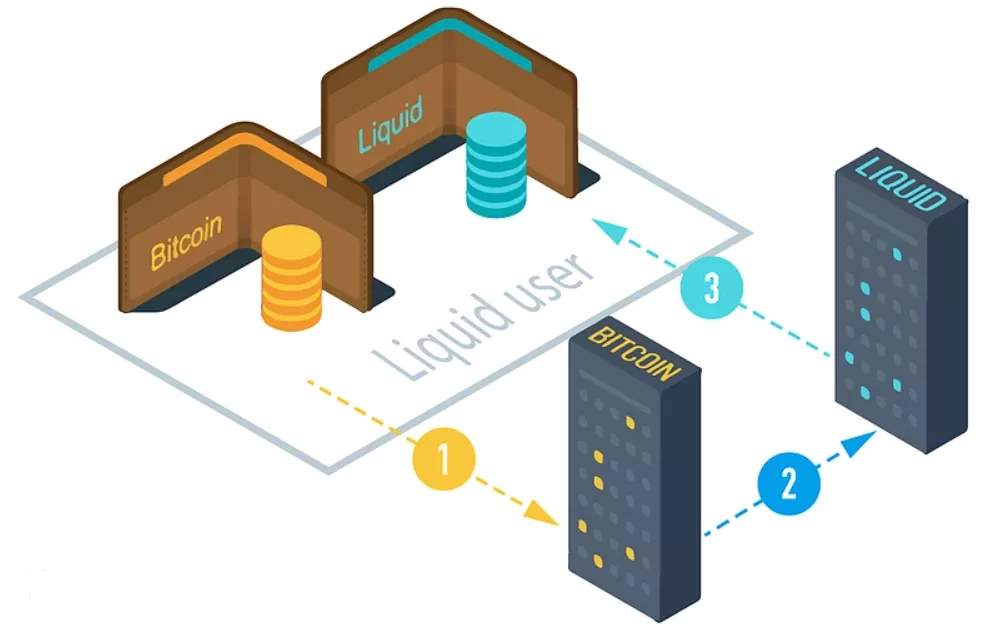
Linked to mainnet via bridges, sidechains extend the ecosystem’s functionality. Users can move assets between chains through smart contracts that lock a sum in one network and mint an equivalent in another.
There are various security models. Some sidechains rely on their own protection, remaining independent of the base blockchain and connected only through resource transfers. Others integrate, to varying degrees, with the parent network’s security.
Well-known examples for Bitcoin include Stacks and the Rootstock Infrastructure Framework (RIF).
What are rollups?
Rollups (Rollups) are L2s built atop the main network, acting primarily as a transaction-execution layer. They accelerate operations and significantly reduce fees.
Rollups aggregate transactions into batches that are submitted to layer one (L1) for final validation. A single batch can include up to 10,000 transactions.
Many rollup designs use zero-knowledge proofs; these are grouped under ZK-rollups.
Rollkit, a platform developed by Celestia Labs, created a modular framework to support sovereign rollups on Bitcoin.
“Rollkit enables developers to create rollups with arbitrary execution environments that inherit Bitcoin’s data-availability guarantees and resistance to reorganisation,” the project participants said.
According to them, the technology optimises blockspace, lowers fees and opens the door to DeFi on the first cryptocurrency’s network.
Rollkit stressed the project was made possible by the Taproot upgrade, and that the Ordinals protocol for issuing NFTs on Bitcoin showed the path by demonstrating how arbitrary data can be published in blocks. It then remained to implement two functions: sending and retrieving rollups, the developers noted.
Rollkit supports configurable execution layers including EVM, CosmWasm and Cosmos SDK.
To test the integration, the team used a local Bitcoin testnet and Ethermint to run the Ethereum Virtual Machine (EVM).
Another rollup example for Bitcoin is Merlin Protocol.
What is the Lightning Network?
Lightning Network (LN) is a Bitcoin layer-two solution comprising a network of payment channels between users.
Satoshi Nakamoto proposed a similar concept early on. In 2009, he shared a code sketch with the community envisaging special channels between users.
In February 2015, Bitcoin developers Joseph Poon and Thaddeus Dryja began work on LN, publishing a paper titled The Bitcoin Lightning Network.
In August 2017, Bitcoin activated the soft fork Segregated Witness — an upgrade necessary for Lightning.
Lightning Labs released a test client in March 2018. By then the network already had more than 1,000 nodes and 1,863 open channels.
This second-layer payments protocol processes transactions between two parties off Bitcoin’s mainnet. The scaling network can handle up to one million transactions per second, far exceeding the base chain’s capacity.
To open an LN channel, both parties deposit bitcoin to a multisig address. They transact within the channel using funds at that address, while Lightning software updates wallet balances. When the channel closes, the network submits the transaction history to the Bitcoin blockchain in a single on-chain transaction.
Lightning enables an unlimited number of transactions for the cost of one on-chain settlement, significantly cutting fees and boosting speed. Since launch, LN has seen broad adoption: many merchants have integrated it, and some centralised exchanges use it for deposits and withdrawals.


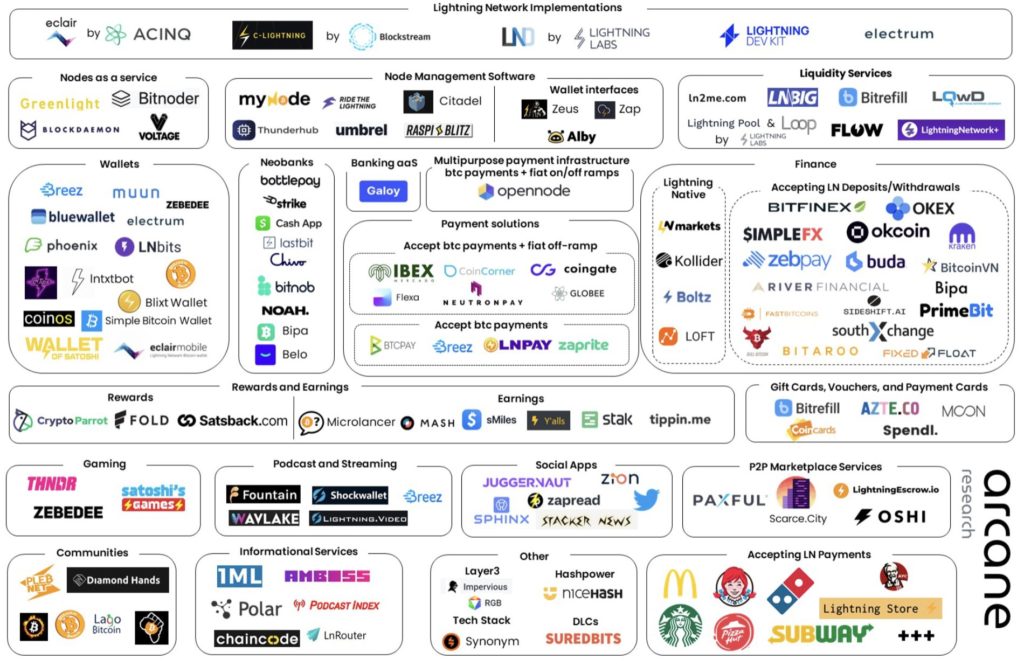
As of 16 March, 13,953 LN nodes are online, connected by 54,109 payment channels. The micropayments network’s capacity stands at 4,574 BTC ($315.5m), according to 1ML.
What is Stacks Network?
Stacks offers Bitcoin-compatible smart contracts and relies on the first cryptocurrency’s security.
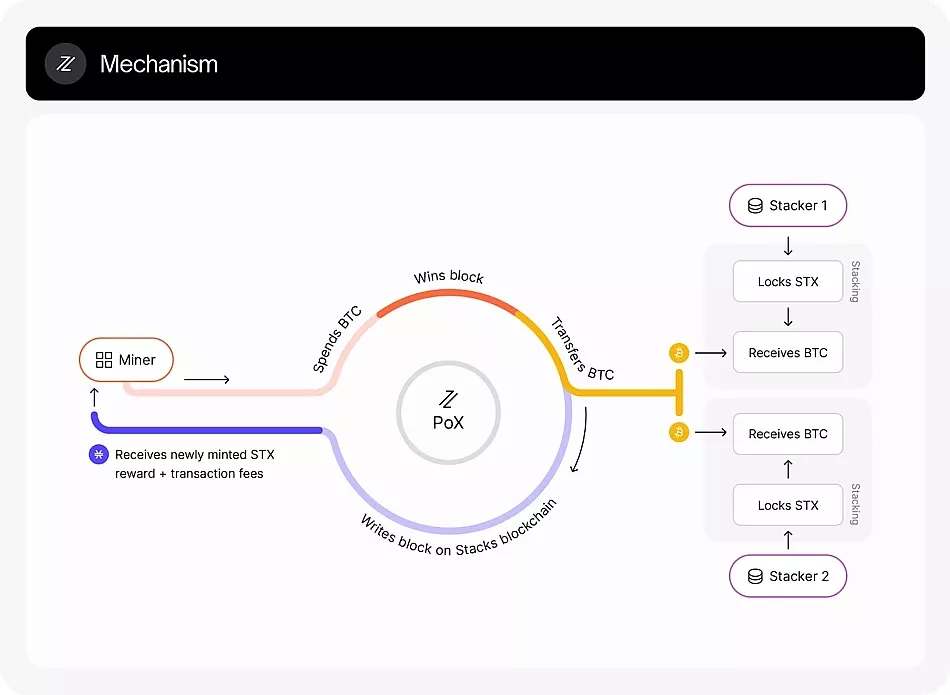
The semi-autonomous Bitcoin sidechain runs a unique Proof of Transfer (PoX) consensus. It blends Proof-of-Stake and Proof-of-Burn, linking Bitcoin miners and Stacks stakers.
Bitcoin miners use BTC to earn the right to validate blocks on the sidechain, receiving STX rewards. Stakers who lock their STX are rewarded in BTC.
Rather than directly using the Bitcoin blockchain, Stacks relies on Bitcoin miners for validation. A bridge moves cryptoassets between networks, and SBTC represents a version of BTC on Stacks.


The platform supports smart contracts and DeFi applications. At the time of writing, total value locked (TVL) on Stacks exceeds $130m.
What is Rootstock (RIF)?
Rootstock Infrastructure Framework (RIF) is a sidechain with Ethereum Virtual Machine support.
Inheriting Bitcoin’s security, the network uses Proof-of-Work consensus. Interoperability with Bitcoin is provided by the two-way PoWPeg protocol.
PoWPeg enables seamless asset transfers between chains. To move BTC into Rootstock, users lock bitcoin in a sidechain smart contract and mint an equivalent amount of RBTC. These coins can be used for fast, low-cost transactions.
Rootstock’s consensus resembles Bitcoin’s own Proof-of-Work. Miners can confirm blocks on both chains simultaneously — known as merged mining.
Active Rootstock participants receive RBTC rewards. Its execution layer, capable of advanced smart contracts, materially extends Bitcoin’s functionality.
Key RIF components include:
- RIF Wallet;
- RIF DeFi Gateways for access to decentralised financial services;
- the RIF Rollup payments solution;
- RIF Relay, which lets users pay transaction fees with ERC-20 tokens;
- the RIF Flyover bridge for BTC transfers.
RIF serves as the ecosystem’s utility token.
In December 2023, Uniswap, the largest decentralised exchange, integrated the Rootstock sidechain.
The ecosystem’s TVL is approaching $200m.
What is Liquid Network?
Liquid Network by Blockstream is the best-known Bitcoin-based sidechain.
The solution is built on the Elements codebase, itself derived from Bitcoin’s code. Liquid shortens the block interval from 10 minutes to one minute by reducing decentralisation.
Liquid has no native asset. Instead, it uses an L-BTC “wrapped” token, minted when bitcoin is moved from the base chain into the sidechain. L-BTC is backed 1:1 by BTC.
The Blockstream sidechain supports confidential transactions.

Even so, Liquid is not as decentralised as Bitcoin. The project is governed by a “federation” — a relatively small group of organisations distributed worldwide and independent of one another.
A small amount of Tether (USDT) stablecoins has been issued on Liquid.
What is Merlin Protocol?
Merlin Protocol is a rollup project that describes itself as “a pioneer in adapting valuable Bitcoin assets to EVM, overcoming the limitations of the first cryptocurrency’s network”.
Users can access the network directly via their Bitcoin wallets thanks to Particle Network’s BTC Connect.
To achieve scalability, Merlin uses ZK-rollup technology. The finalisation of “rolled-up” transactions occurs on the Bitcoin blockchain. According to the developers, this approach provides the highest level of security.
Supporting Web3 wallets such as MetaMask, the protocol aims for a smooth user experience. Projects built on Ethereum and other EVM networks can be ported to Merlin with minimal code changes.
The network supports BRC-20 and ERC-standard tokens. Early DeFi applications are emerging on Merlin, and its TVL exceeds $14m.
What is SatoshiVM?
SatoshiVM is an EVM-compatible Bitcoin L2 built on ZK-rollups. This design delivers high transaction throughput at low cost while maintaining decentralisation and strong security.

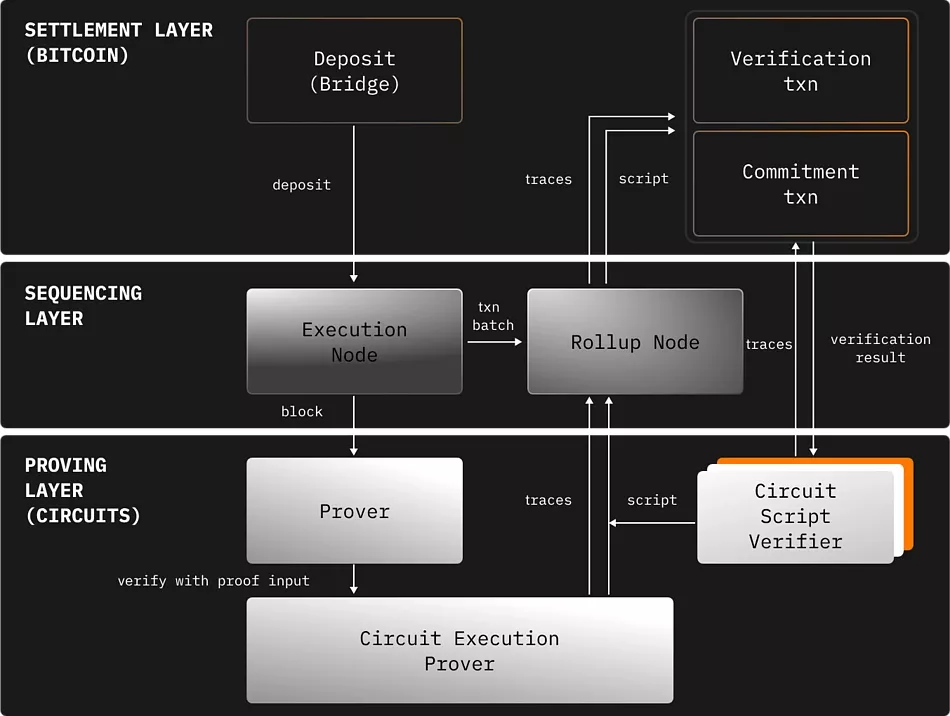
BTC is the native asset of SatoshiVM and is used to pay gas. Bitcoin bridged to layer two can be locked in DeFi applications and used with inscriptions under the SARC20 standard.
What are the pitfalls of Bitcoin L2s?
Sidechains and L2s in the Bitcoin ecosystem use bridges to interact with the base layer. The classic model locks assets on Bitcoin while minting their equivalents on layer two.
This approach carries vulnerabilities and has led to security failures — such bridges have repeatedly been hacked, with aggregate losses in the billions of dollars. Despite efforts to design better bridges, many Bitcoin L2s still depend on the potentially unsafe “lock-and-mint” model.
Rollups and state channels only complete once they finalise on the base chain. The speed and cost of those on-chain operations determine L2 efficiency.
Many solutions on the market have proved viable, but further improvements are needed. Significant optimisations were implemented in Ethereum’s recent Dencun upgrade, and comparable effort will be required to advance Bitcoin L2s.
How are Bitcoin L2s evolving?
L2s will continue to evolve, expanding functionality and improving performance across the Bitcoin network.
In July, the largest crypto exchange, Binance, completed its Lightning Network integration. Users can now deposit and withdraw bitcoin through this second-layer protocol. The move underscores growing L2 adoption and could catalyse major innovation in scalability and usability.
Potential areas of progress include:
- technical advances: improved cryptographic methods and consensus algorithms could enhance the security, reliability and user-friendliness of L2s;
- broader adoption: greater awareness may drive uptake among retail users and institutions;
- integration with TradFi: Bitcoin L2s may connect more closely with traditional financial systems, opening the door to new products and services;
- focus on user experience: developers will prioritise UX to attract a wider audience;
- collaboration and standards: closer cooperation among L2 projects could yield standardisation and interoperability.
In October, Jameson Lopp, co-founder and CTO of Casa, urged developers to experiment more with Bitcoin to expand and improve its ecosystem.
He argued for building on “protocols that are related to Bitcoin but distinct from it”, rather than constantly changing Bitcoin’s code.
He highlighted several relatively new approaches — drivechains, Spiderchain and BitVM — which, in his view, can ease mempool congestion and extend smart-contract capabilities on Bitcoin.
Second-layer solutions are crucial to digital gold’s evolution. They tackle key challenges and create new avenues for mass adoption.