



What is a bracket order?
An order is a trader’s instruction to buy or sell an asset under specified conditions.
When placing an order, a user sets the quantity of the asset and the desired execution price. If there is a matching order with suitable terms on the venue, the order is executed.
Crypto exchanges offer different order types: market orders, limit orders and pending orders. The last group includes take-profit and stop-loss.
Take-profit and stop-loss close a position automatically when a certain price is reached. Take-profit locks in gains; stop-loss limits losses.
A bracket order is a trading instruction that combines a take-profit and a stop-loss.
How do bracket orders work?
Bracket orders let a trader set both a take-profit and a stop-loss at the same time. When one leg is executed, the other is cancelled automatically.
Example: a trader buys 1,000 BTC/USD contracts at $10,000. He plans to lock in profit if the asset rises to $15,000, and to avoid excessive loss if the market moves against him by closing the position at $7,000.
During trading, BTC/USD falls to $5,000. The stop-loss at $7,000 triggers and reduces the trader’s loss to 20%.
What are the advantages of bracket orders?
With bracket orders, a trader defines the target profit (take-profit) and the maximum loss (stop-loss) upfront.
What happens if you use only one leg:
- take-profit. If the price reverses, the trader may incur an unplanned loss;
- stop-loss. The trader may miss a profitable opportunity.
The user need not monitor price changes constantly or place and cancel additional orders by hand.
Where can you trade with bracket orders?
Bracket orders are used in trading traditional assets such as stocks and futures. The tool is also available on some crypto exchanges, for example Binance, Phemex and Kraken Futures.


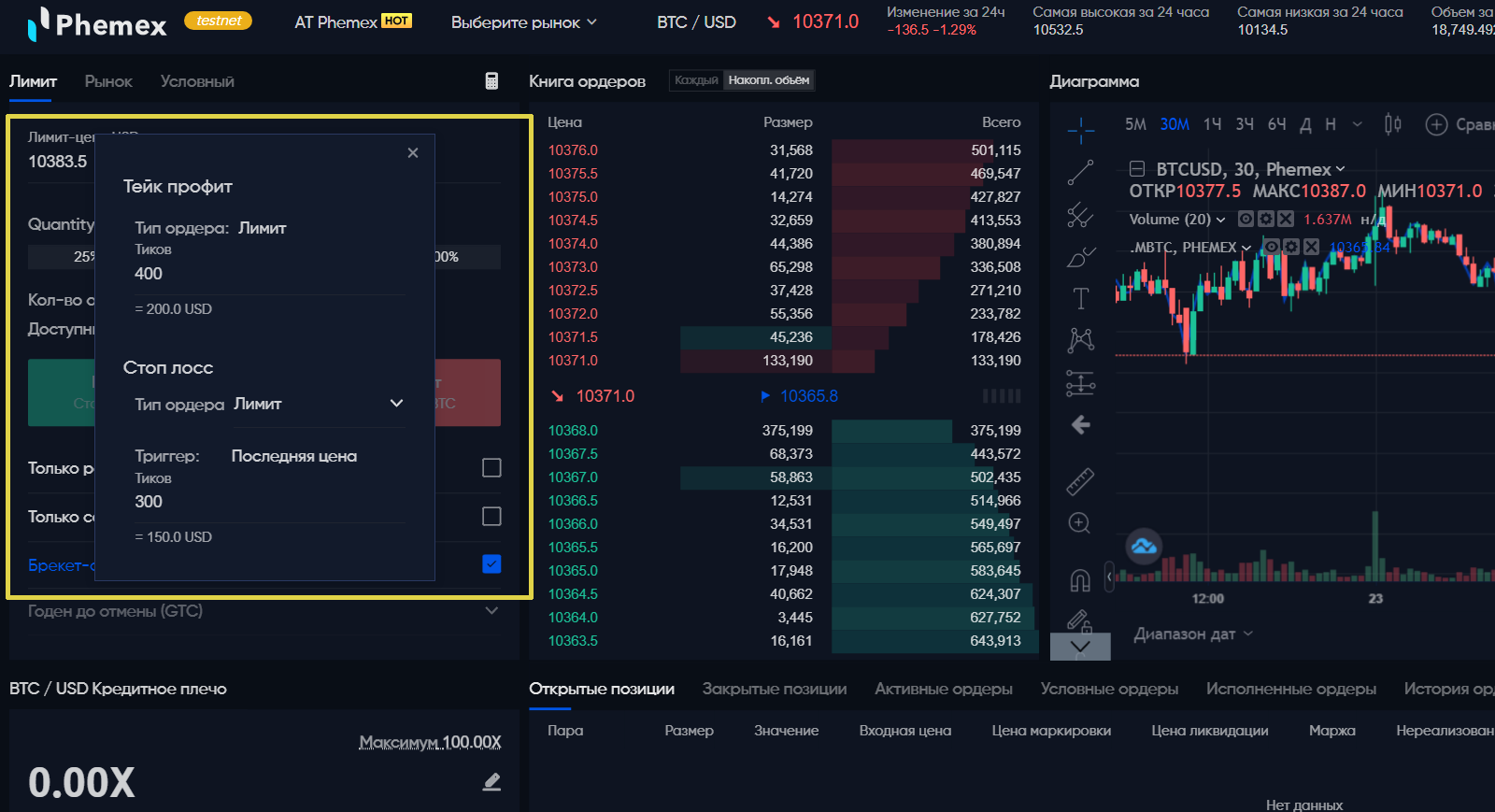
To place a bracket order, select “Bracket order” and enter the take-profit and stop-loss offsets in ticks.
Most crypto exchanges let you apply a bracket order to the whole position—the venue closes it when the order triggers. On Phemex you can apply bracket orders to part of a position. The trader can take some profit even if the asset does not reach the higher target price.
Example: a trader buys 1,000 BTC/USD contracts on Phemex at $10,000, expecting the price to rise to $15,000.
For 900 contracts the trader sets a bracket order with take-profit at $15,000 and stop-loss at $7,000. For the remaining 100 contracts he sets different parameters: take-profit at $12,000 and stop-loss at $7,000.


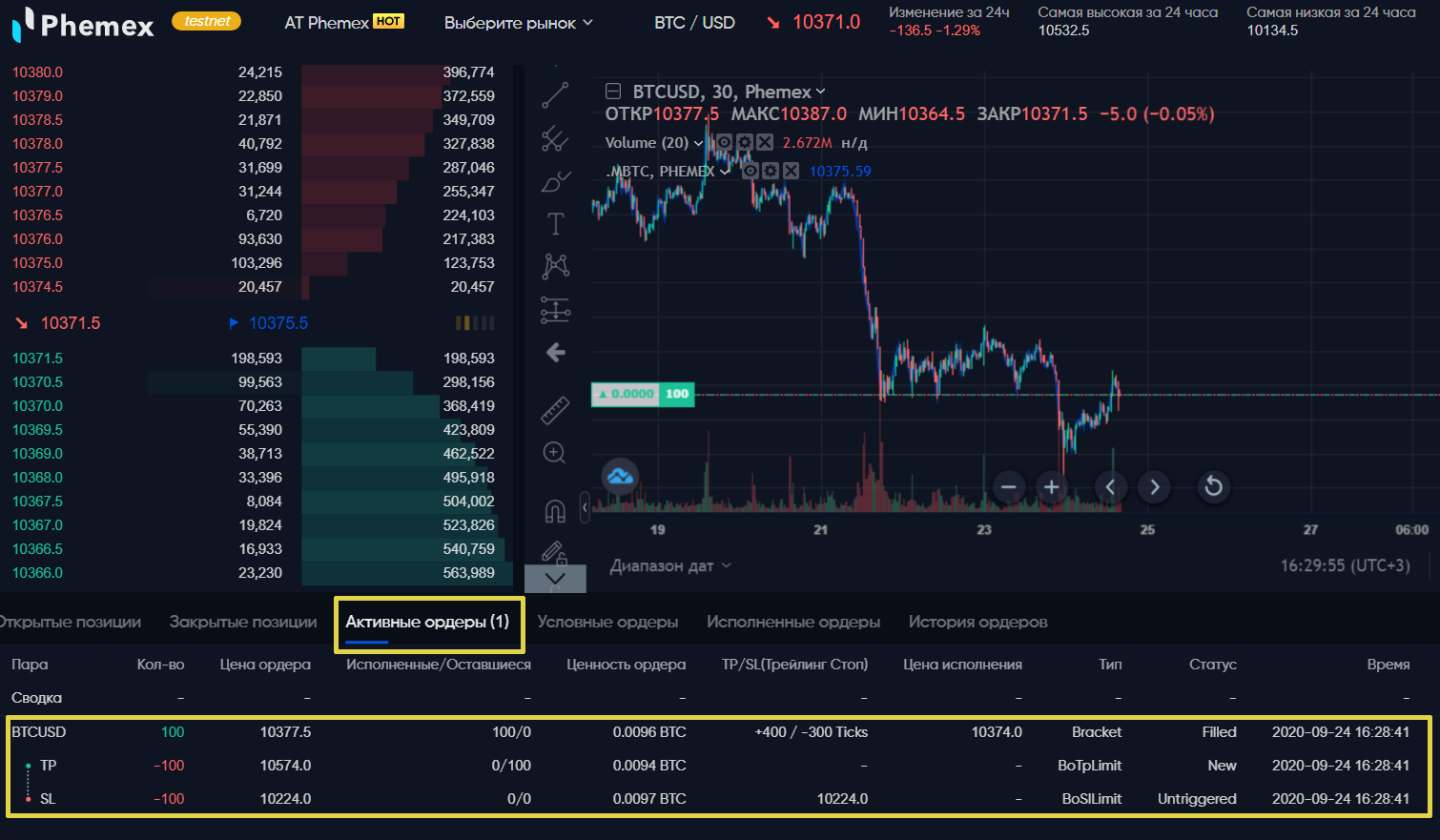
When opening a bracket order on Phemex, the take-profit and stop-loss do not appear on the chart, but you can view them on the “Active Orders” tab.
If BTC/USD rises to $12,000, the trader receives proceeds from selling 100 contracts, then waits for the rest to reach $15,000.
If the asset’s price falls below $7,000, the trader curbs losses across the entire position.
How to make money with bracket orders?
With bracket orders, exchange users can act as market makers. Such orders do not execute immediately and remain in the order book.
Market makers provide liquidity to trading venues and receive reduced fees in return.
On Phemex, makers trade with a -0.025% fee. They receive a portion of the fee paid by the other party to the trade—the market taker.


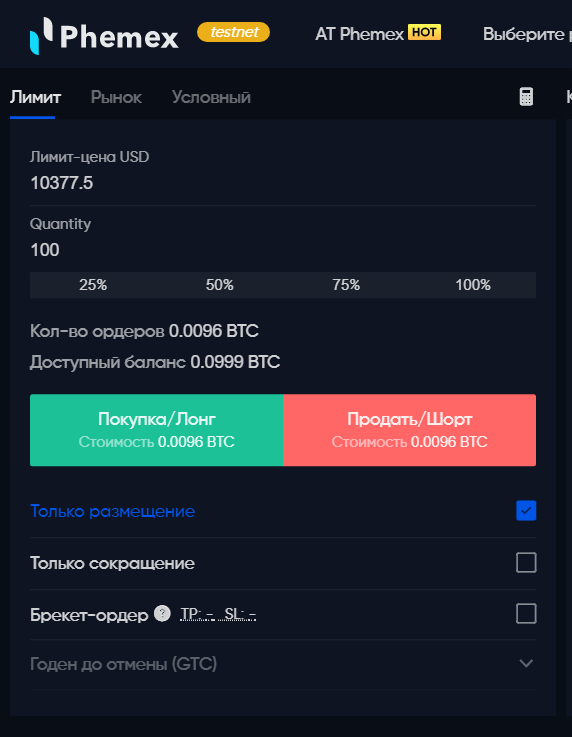
To trade with a negative fee on Phemex, select “Post-Only” when placing a bracket order.
In addition, using several bracket orders you can hold long and short positions simultaneously. This allows you to profit whichever way the market moves. Long positions profit when prices rise; short positions profit when they fall.
Example: a trader buys 1,000 BTC/USD contracts at $10,000 and sets a bracket order for each block of 500 contracts:
- the first opens a long position. If the price rises to $15,000, the take-profit triggers and the user realises gains from selling the contracts. If it falls to $7,000, the stop-loss triggers and the trader locks in a loss;
- the second opens a short position. If the price falls to $7,000, the take-profit triggers. In this case the trader earns on the difference between selling the contracts and buying back at a lower price. If the price rises to $10,500, the stop-loss triggers and the trader locks in a loss.


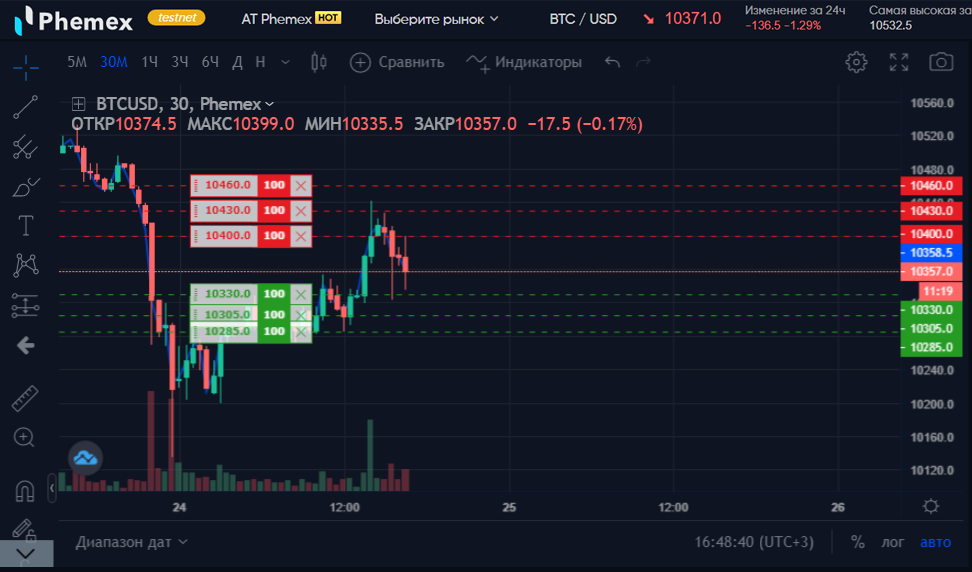
When to use bracket orders—and when not to?
Bracket orders help streamline crypto-exchange trading and protect against risks. They do not, however, guarantee quick profits and are aimed at the longer term.
The instrument suits periods of low volatility, when large gains from price moves are hard to capture. Several bracket orders within a narrow price range can earn money even on small fluctuations.
During bouts of high volatility it is better to use other tools. The asset’s price may rise significantly after the take-profit triggers, leaving you with less profit.