What is a modular blockchain?
To grasp how Celestia works, it helps first to understand what a modular blockchain is, and to be familiar with the data-availability layer and the scalability trilemma.
The essence of the modular approach to distributed systems is specialisation. One network, for instance, handles transaction execution; another maintains consensus.
Thus a modular blockchain focuses on only some tasks, delegating the rest to one or more separate layers. The components resemble Lego bricks that can be combined to build various structures.


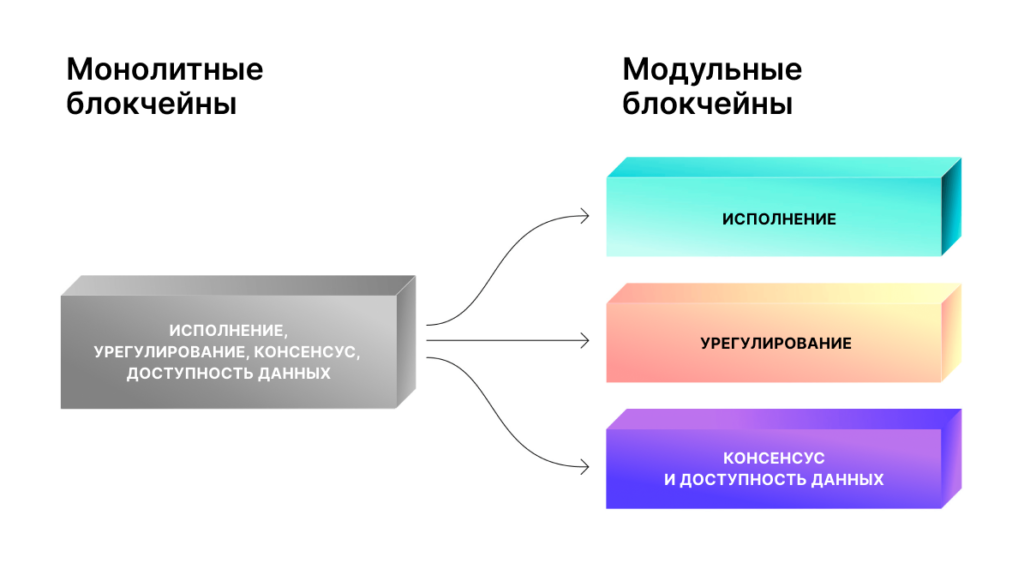
By contrast, monolithic blockchains have a single structure for the distributed system. In it, nodes are responsible for consensus, transaction execution and data availability. All these tasks are performed on one layer or within a group of tightly coupled chains (also operating on one layer).
Most blockchains in the crypto ecosystem are monolithic: Bitcoin and Ethereum (setting aside L2 solutions such as Lightning Network and rollups respectively).
“Previously, the crypto industry was constrained by an endless stream of new L1 smart-contract platforms, each of which sacrificed decentralisation and security to provide cheaper transactions. Web3 cannot scale within the constrained bounds of a monolithic structure,” said Celestia co-founder Mustafa Al-Bassam.
What is the data-availability layer?
Distributed systems are tasked with the following functions:
- execution. All nodes validate transactions against the rules of the consensus algorithm. In account-based blockchains (which typically support smart contracts), nodes execute transactions to compute the network’s new state.
- consensus. Nodes “agree” among themselves which transactions will be processed for new blocks and in what order.
- settlement or dispute resolution (settlement). This function guarantees the irreversibility of confirmed transactions and provides arbitration if their validity is contested.
- data availability. Every node holds a copy of the entire blockchain, storing every transaction. A peer in the network can request data from another node.
The last function is critical to the security of any blockchain. It ensures that validators publish and retain transactions, states and other information the network needs to operate. It also implies that any participant can audit the distributed ledger of transactions and verify it.
Users of monolithic blockchains typically have to download all data to verify availability—impractical given the volume. Modular networks such as Celestia address this by enabling verification of only a small part of each block via light nodes. The latter check only intermediate roots of the Merkle tree.


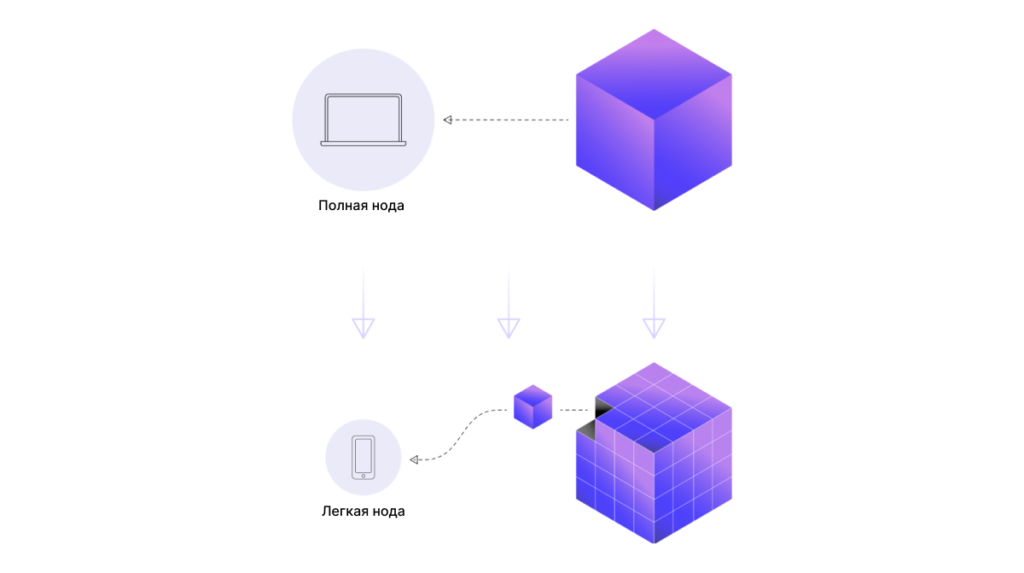
A method called data availability sampling (DAS) makes it possible to scale a blockchain “for millions of rollups” without compromising security.
With DAS, light nodes can also detect invalid transactions using fraud proofs.
What is the scalability trilemma?
The blockchain trilemma (or scalability trilemma) describes the core scaling problem for any distributed network: out of the three properties—decentralisation, security and performance—a blockchain can have only two.
Main avenues to address the trilemma include:
- second-layer solutions—overlays “on top” of decentralised networks that extend beyond on-chain activity. One example is Lightning Network, a micropayments network for Bitcoin;
- first-layer (L1) solutions—much harder to design and implement but with greater potential, introducing changes to the blockchain architecture itself.
Developers of different networks propose their own remedies for the trilemma: using multiple interoperable blockchains, sharding, new cryptographic methods, and so on.
What is Celestia?
Celestia is a data-availability-focused network that aims to solve the scalability trilemma through a modular approach.
The platform is built on a modified version of the Tendermint Core consensus algorithm and the Cosmos SDK framework. It provides developers with infrastructure to create and operate blockchains. Projects can use it for data availability and consensus layers.
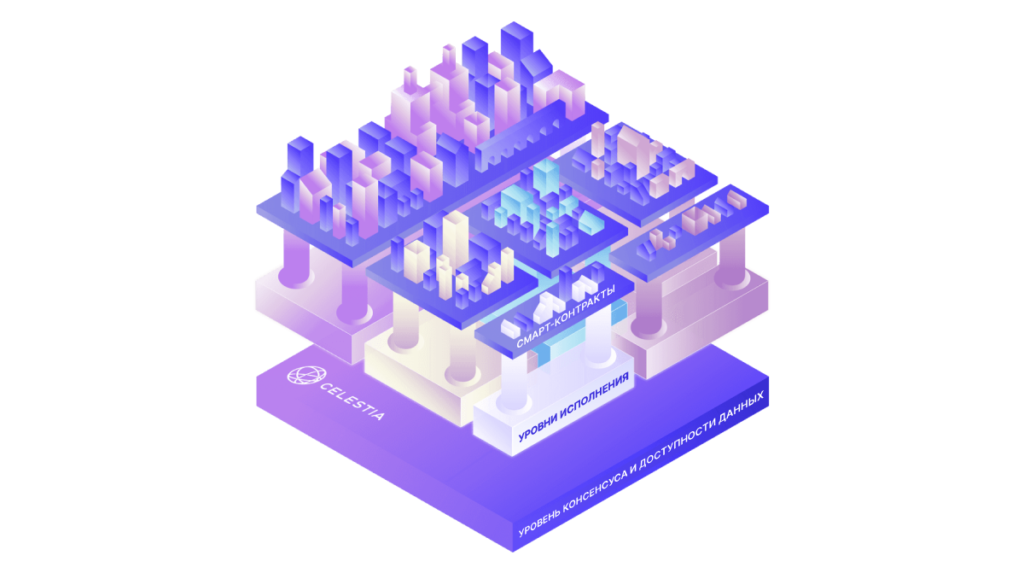
The modular network scales securely with user numbers, letting anyone launch their own blockchain without needing a separate set of validators.
“Rollups and L2 solutions use Celestia as a network for publishing and making transaction data available to all users. For them, the platform provides a high-throughput availability layer that can be easily verified with a light node,” the project website says.
Accordingly, the project’s approach to the scalability trilemma entails:
- modular architecture. By separating execution and consensus, Celestia provides greater flexibility and scalability;
- data availability sampling. This allows nodes to process only the operations relevant to their needs, reducing system load and improving efficiency;
- security and resource efficiency. Technologies such as DAS and fraud/validity proofs are used to ensure light nodes operate correctly and efficiently;
- an architecture focused on supporting large user numbers without sacrificing decentralisation and security.
In 2018, Mustafa Al-Bassam co-authored a research paper with Vitalik Buterin that introduced data availability proofs (DAP). This solution underpins Celestia’s technology.
DAPs assume that all data are very likely published to the network, while proofs are generated from only a small portion of a block.
Thanks to this, the platform can provide data availability for any chain built on top of Celestia. Using DAPs, validators can agree on and order incoming transactions, thereby achieving consensus.
Each rollup built on Celestia can run in its own virtual environment tailored to its needs. Support is planned for various programming languages, including Solidity, Rust and Golang.


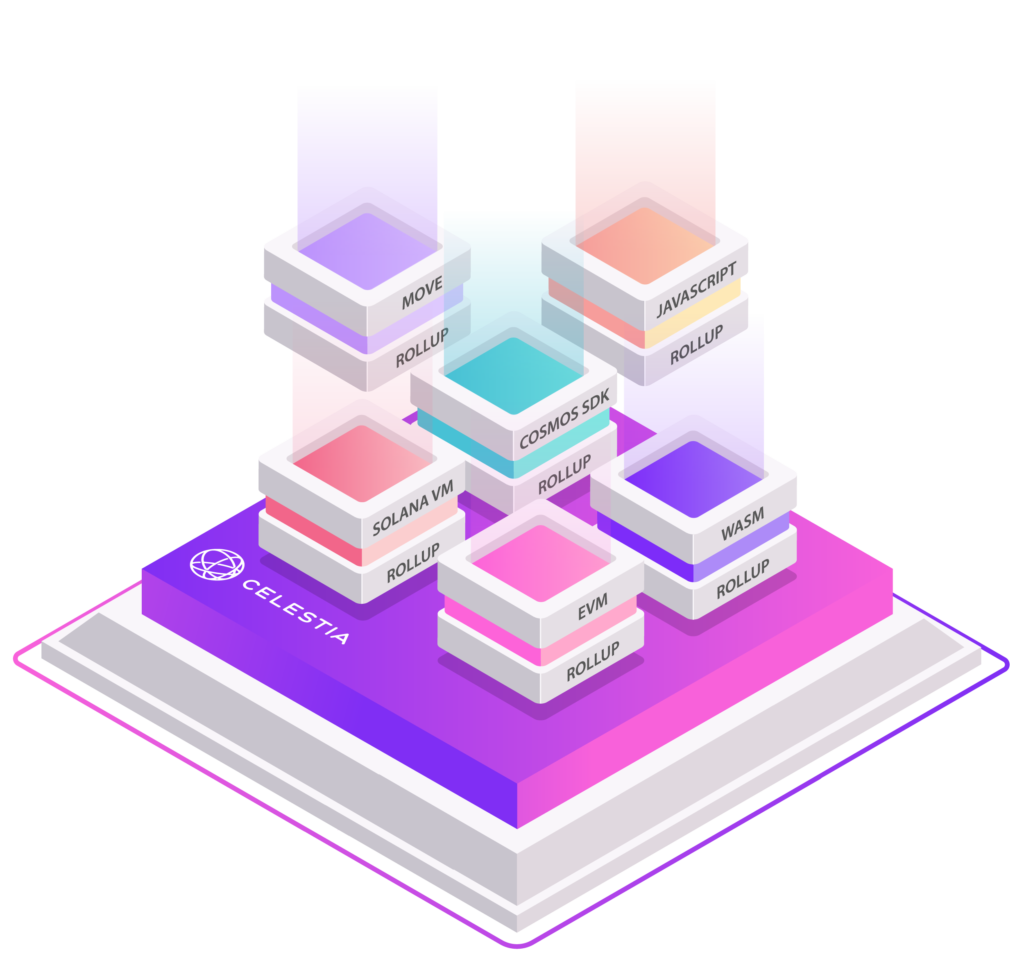
As the number of light nodes participating in DAS grows, the mechanism enables larger blocks (containing more transactions). The modular approach achieves this without undermining decentralisation.
The system supports block sizes from 2MB to 8MB, with a long-term plan to raise this to 1GB.
How is Celestia developing?
Celestia Labs (formerly LazyLedger Labs) was founded by Mustafa Al-Bassam, Ismail Khoffi and John Adler.
In 2013 the 18-year-old Al-Bassam and three other members of Lulzsec pleaded guilty to numerous cyberattacks. A court found them responsible for hacks of the websites of the CIA, SOCA, Sony, News International and Britain’s National Health Service.
The Celestia founder received a 20-month suspended sentence and 320 hours of community service. He then turned to researching distributed ledgers.
He worked on the Chainspace blockchain, which Facebook acquired in 2019. In 2016 the former hacker was included in Forbes’s “30 Under 30” list in the Technology category for work exposing government surveillance.
In 2019 Al-Bassam launched the LazyLedger project, which was renamed Celestia two years later.
Ismail Khoffi is a former lead developer at Tendermint and the Interchain Foundation. He is now CTO at Celestia Labs.
John Adler is a co-founder of Fuel, which bills itself as “the world’s fastest modular execution layer”. He previously worked on Optimistic Rollups and researched scalability at ConsenSys.
In March 2021 the Celestia project raised $1.5m in seed funding. The round was led by Interchain Foundation and Binance Labs, with participation from KR1, Maven11 Capital, Divergence Ventures and P2P Capital.
In May 2022 the platform launched the Mamaki testnet and introduced an API for developers of modular blockchains.
In October that year, Celestia Foundation raised $55m in a round led by Bain Capital Crypto and Polychain Capital. Other participants included Placeholder, Galaxy, Delphi Digital, Blockchain Capital, NFX, Protocol Labs, Figment, Maven 11, Spartan Group, FTX Ventures, Jump Crypto and several angel investors, including Balaji Srinivasan and Eric Wall.
On October 31st 2023 the developers launched the beta version of Celestia’s mainnet, called Lemon Mint. At the same time, several major exchanges announced listings of the native token, TIA.
What is the TIA cryptocurrency?
TIA is a crypto-asset that enables participation in network consensus, decentralised governance and staking.
“But the core of Celestia’s mission is to give anyone the ability to launch their own blockchain in minutes, simply by paying for blobspace with TIA,” the blog says.
To publish data on the network, rollup developers submit PayForBlobs transactions.
Teams building on Celestia’s data-availability layer can launch their own networks without immediately issuing their own tokens. TIA can play the same role that ETH does in Ethereum—an asset used for payments and gas fees.
Total supply is 1bn TIA.


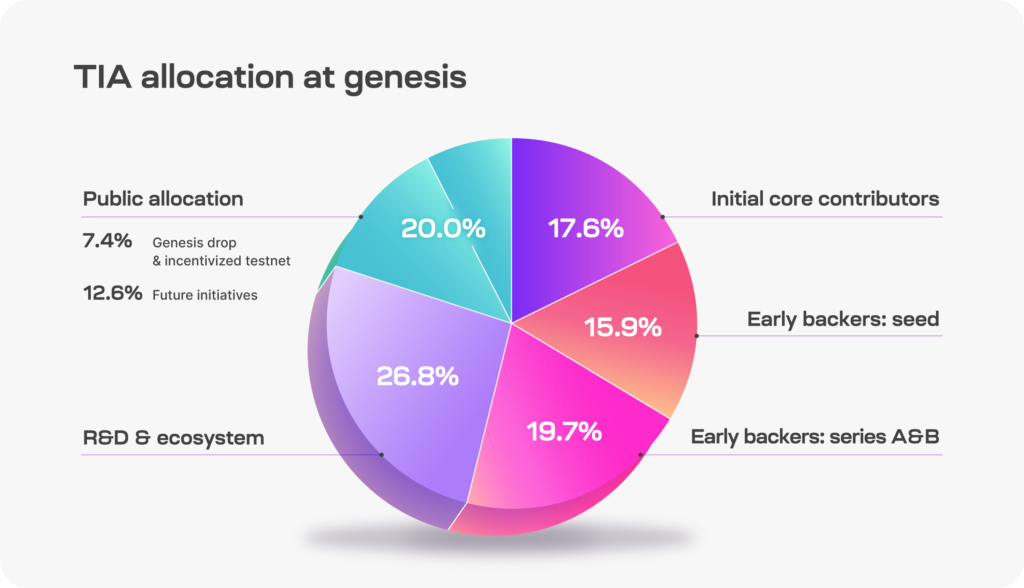
The table below shows the allocation scheme for the cryptocurrency:


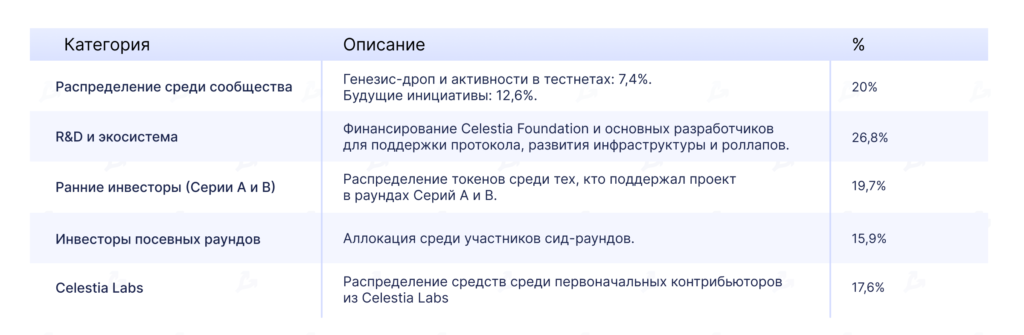
During the Genesis drop, the Celestia team distributed 60m TIA (6% of total supply) to 7,579 developers and 576,653 eligible on-chain addresses.
Analysts at X-explore concluded that roughly 40% of the tokens distributed in the airdrop went to airdrop hunters.
At the time of writing (January 21st), the crypto-asset trades around $17.2. From the October 31st 2023 closing price, the increase exceeds 650%.


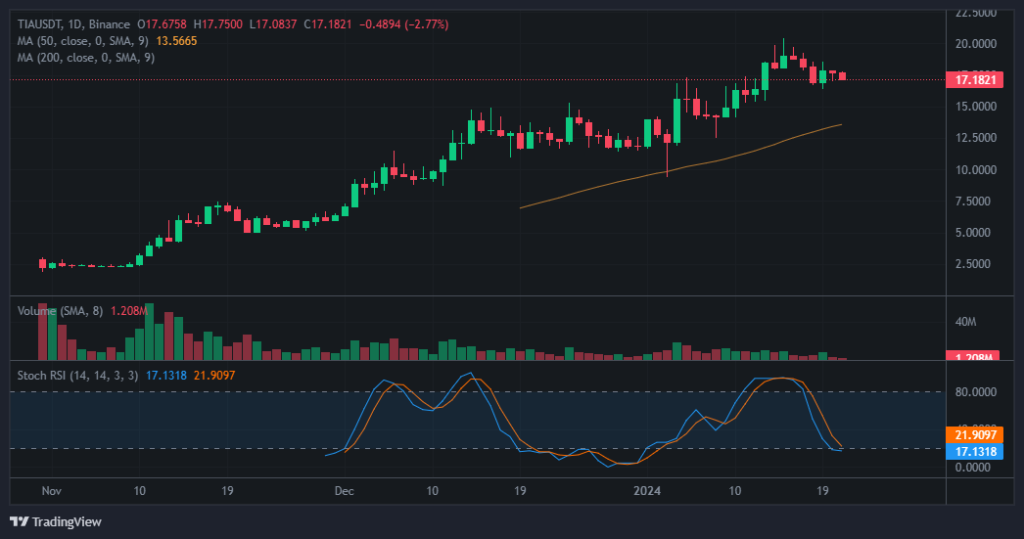
TIA’s market capitalisation is $2.73bn, according to CoinGecko (34th in the ranking).
The circulating supply is about 159m coins—just over 15% of total issuance.
The protocol’s baseline inflation rate for TIA is relatively high at 8%. A gradual reduction is planned—by 10% per year—to a long-term fixed level of 1.5%.
At the time of writing, the annual staking yield is about 15%.
According to Token Unlocks, 175.56m TIA are scheduled to unlock on October 30th (worth $3.18bn at the time of writing). That is 110.4% of the current market float.
Which projects does Celestia work with?
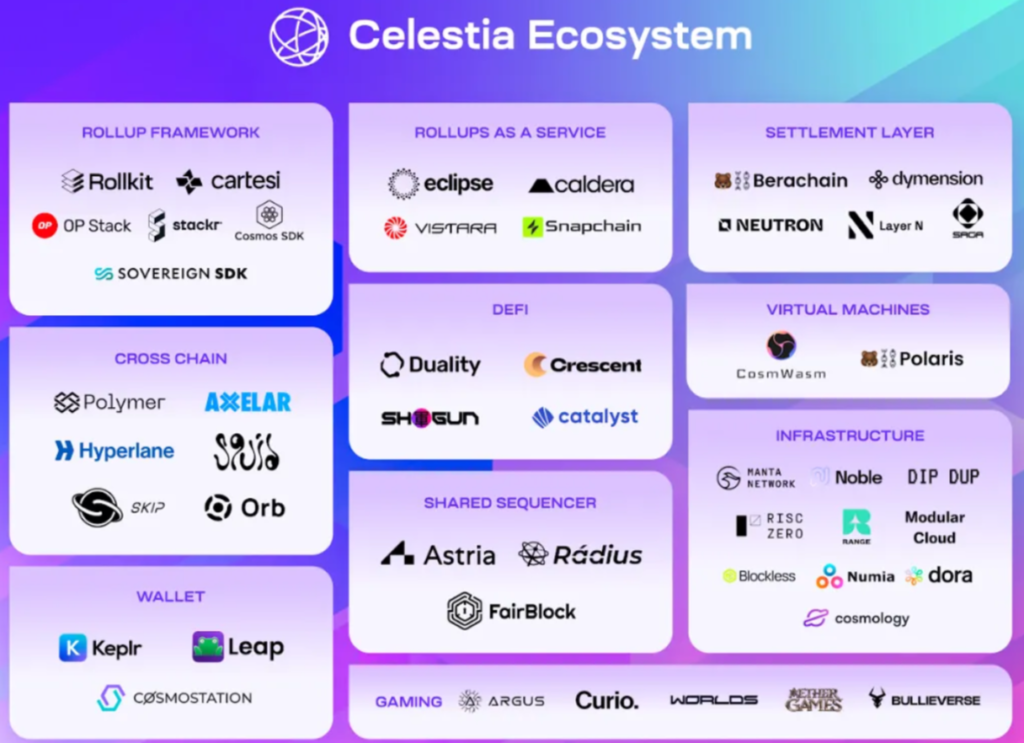
The start-up led by Mustafa Al-Bassam collaborates with many projects. For example:
- RaaS platforms such as Caldera, Conduit and Eclipse use Celestia’s infrastructure as a data-availability layer for rollups;
- the project works with Dymension, developing an EVM-compatible rollup appchain (RollApp) based on Cosmos’s IBC protocol;
- together with Optimism Labs, work is under way to enable other popular systems (including Bitcoin and Ethereum) to be used as a data-availability layer for launching rollups on the Optimism stack;
- as noted, Celestia co-founder John Adler is also a co-founder of Fuel, whose team is working on “the world’s fastest modular execution layer”;
- Rollkit, developed by Celestia Labs, provides a modular framework to support sovereign rollups on the Bitcoin blockchain;
- Manta Network’s L2 solution Pacific uses Celestia’s technologies for data availability and lower data fees. The project is billed as the first modular, EVM-native execution layer purpose-built for deploying ZK applications. The network is built with a modified OP Stack from Optimism.
The infographic below shows only a small slice of the expanding ecosystem.