


What are custodial and non-custodial crypto wallets?
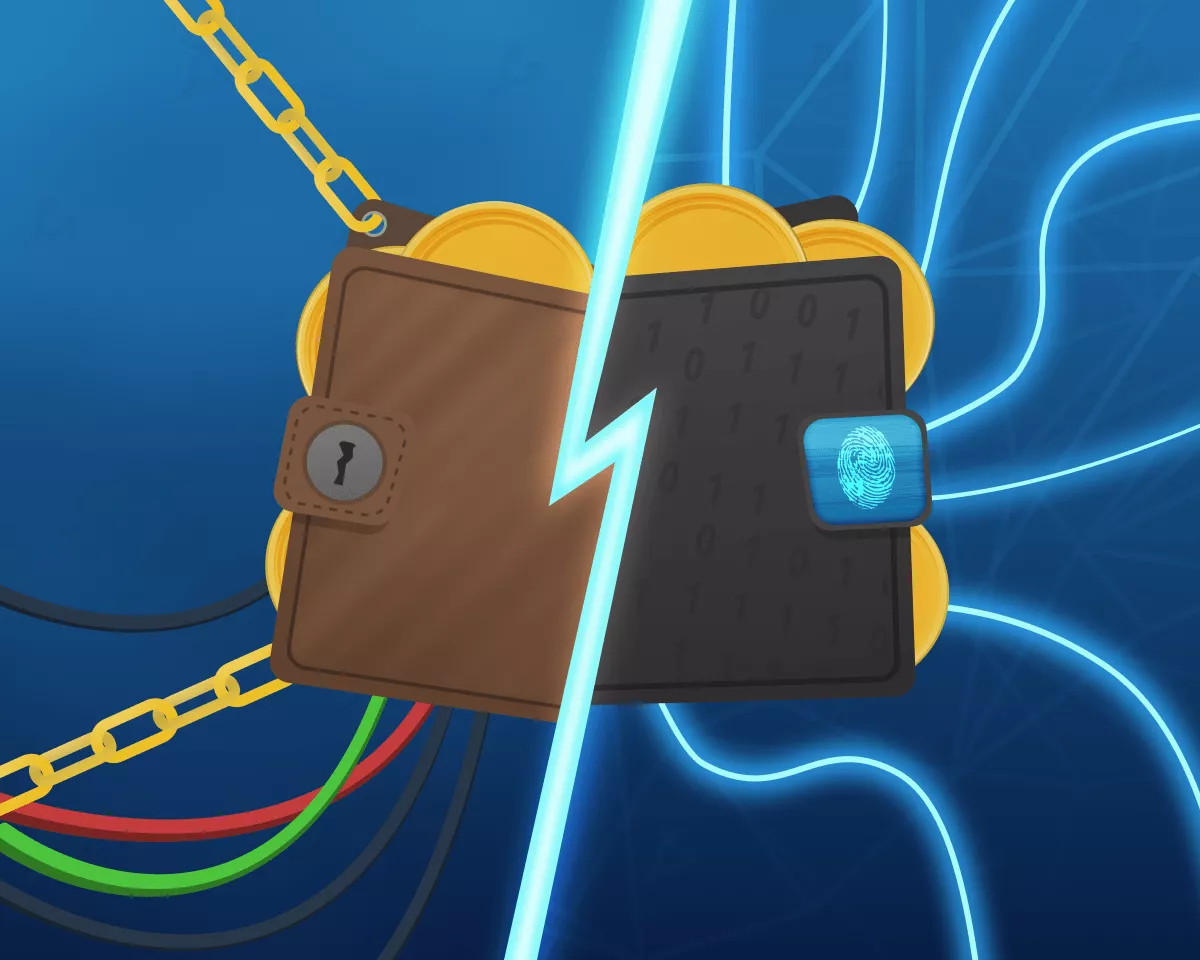
What is a cryptocurrency wallet?
A cryptocurrency wallet is a tool for interacting with cryptocurrencies on a blockchain. It lets you create and manage addresses for storing and transferring digital assets. In essence, it is an app with an interface and various functions for managing an address and the cryptoassets held there.
What are public and private keys in a crypto wallet?
When an address is created, the wallet generates keys—cryptographic identifiers, a kind of “identity card” that gives you access to the funds at your account (the address on the blockchain).
Each address usually has a pair of keys—public and private. They are linked to each other and tied to a specific address.
An address on the blockchain is a “compressed” version of the public key, which any other user can see. The private key is used to create digital signatures and verify transactions. It is known only to the address owner, as it grants access to their funds.
Keys are not needed to sign in to the crypto vault; that is handled by the login and password you set at registration.
What is a seed phrase for?
Today most wallets support another level of user authentication—a seed phrase. This is a unique sequence of 12 or 24 English words that serves as a password to restore access to an address or move it to another wallet.
A seed phrase, like a private key, is for the address owner only and must not be shared. If the seed phrase is lost or stolen, you may lose access to your funds.
Can you get by with a single crypto wallet?
A user can have any number of addresses and wallets. Typically, people use a personal wallet as well as built-in crypto wallets in various apps, such as on cryptocurrency exchanges.
What is a custodial crypto wallet and when is it needed?
A custodial wallet is an application for storing and transferring cryptocurrencies whose operator (the custodian) manages users’ addresses or has access to their private keys. In addition, clients of a custodian must pass identity verification (KYC).
Centralised crypto exchanges have built-in custodial wallets. Although each client has a separate account and balance, all funds are held on a small number of addresses managed by the exchange. This simplifies work with trading tools and allows users to avoid paying for transfers within the platform.
Individual clients rarely encounter custodial wallets outside specialised apps. Such solutions are often used by institutional investors—companies that handle large sums. They hand cryptocurrencies to a professional company for safekeeping with enhanced security and other services, such as insurance. Well-known custodians include Xapo, BitGo, Gemini and Coinbase Custody.
What are the drawbacks of custodial crypto wallets?
The main drawback of custodial crypto wallets is the custodian’s potential access to clients’ cryptoassets.
Exchange administrators hold the private and public keys to the addresses that store clients’ cryptocurrencies. Centralised storage of large amounts makes trading platforms frequent targets for hackers. As a result of breaches, some users may lose their cryptocurrencies.
Moreover, a crypto exchange is a legal entity that must comply with legislation and law-enforcement requests. On request it can both provide client data and freeze funds in a wallet—for example, in the case of sanctions or court-ordered asset seizures.
A further inconvenience can be temporary loss of access to your assets during maintenance, since a custodian can disable user access if necessary.
What is a non-custodial crypto wallet?
A non-custodial crypto wallet leaves full control with the address creator, since no one else is given the private keys. Such an app cannot freeze or manage users’ funds, but it also does not bear responsibility for their safekeeping.
Usually it is an application you can install on a PC, mobile device or in a browser. To create a blockchain address through a non-custodial app, you do not need to pass KYC.
Popular non-custodial wallets gain extra credibility from publishing their source code. This lets independent experts verify that the app is indeed secure. Such projects are also often supported by a community of developers.
Which is better to use—custodial or non-custodial?
Funds used for trading or investment (including staking) can be kept in a custodial wallet of a third-party app (for example, on an exchange). However, you should harden account security, notably by enabling two-factor authentication.
Idle digital assets are best held in your own non-custodial wallet, to which only you have private-key-level access.
What are “hot” and “cold” wallets?
All wallets fall into two types: “hot”, which exist only as software, and “cold”, which rely on a physical device.
A beginner will do fine with a hot, or software, wallet. They can be used on almost any platform and device.
One of the most popular hot wallets for Ethereum and EVM-compatible networks is MetaMask. ETH and ERC-20 tokens can also be stored in MyEtherWallet. For Bitcoin, a time-tested vault often used is Electrum.
There are also multi-currency wallets that support many blockchains at once, such as Exodus, Blockchain.com or Trust Wallet.
“Cold”, or hardware, wallets are devices about the size of a flash-memory card in which cryptoassets are stored offline. This offers maximum protection against hacks. To make transfers, a cold wallet needs to be synced with the blockchain via a computer connected to the internet.
How have non-custodial wallets affected the crypto industry?
This category of wallets gives users quick access to protocols of decentralised finance (DeFi), Web 3.0, as well as markets for non-fungible tokens (NFT). For example, the Uniswap trading protocol does not require registration or KYC and AML. Instead, a user connects to it through a browser wallet that supports the Ethereum network.
Are non-custodial crypto wallets safe?
Popular non-custodial crypto wallets are reliable, but they still have drawbacks.
If the private key and its recovery phrase are lost, the funds will also be irretrievably lost. Be especially careful with a “brainwallet”, that is, storing data in your memory or on paper.
From a security standpoint, hardware crypto wallets (Ledger, Trezor or KeepKey) are the best option, although they are not as easy to use and may have vulnerabilities in the code or be lost. They can also be stolen. “Cold” wallets are recommended for storing large amounts of cryptocurrency.
How to set up a non-custodial wallet?
Registering and configuring a crypto wallet takes a couple of minutes. Download the app to your mobile device or add it as a browser extension (for example, for Google Chrome). Then set a password and a name. The app will generate a seed phrase, which you should store in a safe place. After that, with rare exceptions, you can start using the wallet.
How to secure your crypto wallet?
- Make sure the secret recovery phrase (seed phrase) for your wallet is kept somewhere safe. Do not share it with anyone; write it down on paper or engrave it on a metal plate.
- Do not make a digital copy of confidential data such as the seed phrase or wallet password. It is unsafe to take a screenshot, email a copy of the secret phrase, or store it in an app on an internet-connected mobile device. Malware can steal such information.
- Beware of phishing. This is a type of fraud where scammers obtain a login and password by imitating the website of a popular crypto service. Phishing links look very similar to the real app’s URL but differ by one or two characters. Carefully double-check site addresses (better yet, bookmark them) whenever you enter credentials to access your funds.
- Be vigilant with emails. If you are asked for confidential wallet information, urged to visit unknown websites or send assets, do not click the link.
- Do not keep all your cryptocurrency in a single wallet. Decide in advance what you need assets for and separate your holdings. Those needed for quick operations can stay in a custodial wallet; those you plan to store are better kept in a non-custodial one.
If you decide to leave assets in an exchange’s custodial wallet, set up account security: enable two-factor authentication and complete verification via your phone number or email.
What else to read?
What formats do Bitcoin addresses use?
What are second-layer scaling solutions?
What are ERC-20 tokens?
What are sidechains?
What is the Lightning Network?
Рассылки ForkLog: держите руку на пульсе биткоин-индустрии!