


What are liquid restaking tokens (LRT) for?

What are liquid restaking tokens?
A Liquid Restaking Token (LRT) is a token designed to earn additional yield by restaking coins on a Proof-of-Stake consensus network.
LRT protocols combine the security and staking yield of the underlying asset with additional income opportunities via DeFi or Actively Validated Services (AVS), including cross-chain bridges, oracles and sidechains.
The LRT concept is akin to merged PoW mining (as with Dogecoin or Litecoin), where the same hardware secures two networks at once.
What are the advantages of LRTs?
One of the main ways to generate yield on ETH without reducing the liquidity of the underlying asset is to run your own validator, which is a complex and costly process.
The next stage in boosting staking returns was liquid staking tokens (LSTs) such as stETH from Lido Finance. But they are still constrained by validator yields. For example, the stETH yield at the end of April 2024 was 3.2%. Further uses for LSTs are largely confined to the DeFi market.
LRTs, in turn, allow the underlying asset’s yield to be increased further while preserving liquidity. For instance, the EigenLayer protocol offers options to earn by selecting AVS for restaking LSTs. A user can lock stETH again and receive a restaking token redeemable 1:1 for ETH.
By April 2024, EigenLayer already has nine active AVS proposals, with more than ten others being tested on Holesky.
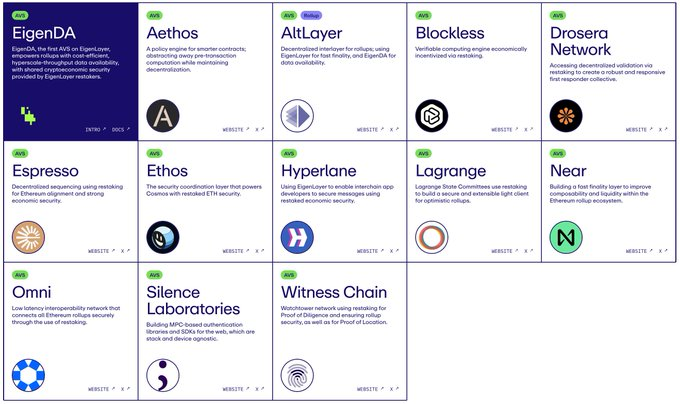
This approach increases Ethereum’s security by employing staked ETH in second-layer systems. For example, an AVS from AltLayer allows LRTs to validate operations in the Optimism and Arbitrum Layer 2 networks.
The market for additional-yield mechanisms is still forming. Fee distributions may come in the network’s base asset, as with LSTs, via retrodrops for providing liquidity, or in other tokens.
What risks do LRTs entail?
The higher yields offered by liquid restaking tokens bring not only opportunities for extra income and new investment strategies, but also risks inherent in building such multi-layered systems.
The complexity of these smart contracts and untested mechanics under extreme market conditions may expose unidentified or overlooked issues. The main ones include:
- liquidity. As synthetic assets, LRTs can suffer from a lack of liquidity during periods of market stress. For example, Renzo’s token lost its peg to ether after its tokenomics were revealed. On Uniswap, the price briefly fell by almost 80% versus ETH;
- multiple points of failure. A multi-layer ecosystem can create cascading failures if problems arise at even one layer or intermediary service;
- development and governance. Overall architectural complexity compounds the risks typical of traditional DeFi applications: code bugs, hacks and inefficient protocol governance.
How is the LRT market developing?
By the end of April 2024, according to data from DeFi Llama, the restaking sector had a TVL of over $16bn, led by EigenLayer (~$15.7bn).
This level was reached in just five months from December 2023, when the sector’s TVL was only $250m.
Part of the rapid growth reflects expectations of an airdrop from EigenLayer, said Glassnode analysts. LRT protocols were also noted by CoinGecko as a key driver for ETH in the first quarter of 2024. Analysts highlighted Ether.fi, Renzo, Puffer, Kelp, Swell and Mantle.
Google has also shown interest in the LRT market. In April 2024, the cloud divisions of Coinbase and Google Cloud joined EigenLayer as operators.
Experts also reckon that EigenLayer’s brisk growth may point to a potential yield crunch. In their view, the project is expanding too quickly relative to AVS supply. As a result, the protocol’s offered yields could shrink sharply, prompting an outflow of liquidity.
Рассылки ForkLog: держите руку на пульсе биткоин-индустрии!