



Key points
- Bitcoin’s NFT segment has boomed — since Ordinals launched, about 10 million “inscriptions” have been minted.
- The experimental BRC-20 standard, introduced in March 2023, sparked fresh debate in the community, including calls to “ban” digital artefacts via a “spam filter”.
- The surge in popularity of these new assets is spurring infrastructure development, materially affecting on-chain activity and laying the groundwork for a bitcoin-based DeFi ecosystem.
What are Ordinals?
Launched in January 2023, the Ordinals project made it possible to embed images and other types of data in the blockchain of the first and largest cryptocurrency by market capitalisation without using a separate token or sidechain.
The idea of non-fungible tokens on Bitcoin is not new — experiments began with solutions such as Colored Coins and Counterparty in 2012 and 2014 respectively. Only much later did the concept truly gain traction.
Ordinals NFTs have a markedly different architecture from their counterparts.
Created by developer Casey Rodarmor, the system uses satoshi numbering (serialisation) to write data into the witness section of a Bitcoin transaction.
The Ordinals phenomenon became possible thanks to Segregated Witness (SegWit) in August 2017 and the later Taproot soft fork. The latter, among other things, made transactions cheaper and more private.
Designed primarily to address scalability, SegWit changed block structure by separating signatures from transaction data. The upgrade also fixed transaction malleability and laid the foundation for Lightning Network.
As NovaBlock Capital partner Lior Shimron noted, SegWit increased Bitcoin’s block size from 1MB to 4MB. Taproot in turn loosened data limits, theoretically allowing an entire 4MB block to be filled with Ordinals NFTs.
Inscriptions enabled by Ordinals are presented as “digital artefacts”. They contain raw data written directly to the Bitcoin blockchain: images, audio, video, text and even applications such as a simplified version of Doom.
The Ordinals site states:
“Digital artifacts are perfect. An NFT that points to off-chain content on IPFS or Arweave is imperfect and, therefore, not a digital artifact.”
On-chain data attest to Ordinals’ popularity — since launch, ~10m inscriptions have been created (as of May 30, 2023).
What is the BRC-20 standard?
BRC-20 is an experimental standard for fungible tokens on the Bitcoin blockchain, created by a developer using the pseudonym domo in early March 2023.
An experiment into «brc-20’s» and fungibility on bitcoin with ordinals 1/x pic.twitter.com/9khKLbEPk6
— domo (@domodata) March 9, 2023
The name echoes Ethereum’s ERC-20. However, BRC-20 does not use smart contracts — tokens rely on the Ordinals mechanism. They are deployed by adding JSON text files to the blockchain, which define core parameters such as supply, mint limit and so on.
“BRC-20 are simpler and more limited than ERC-20 due to the intentionally limited programmability of the Bitcoin blockchain,” the Chainlink blog says.
The new tokens inherit the security and decentralisation of Bitcoin’s network. They can be sent to other users’ wallets like any other cryptoasset.
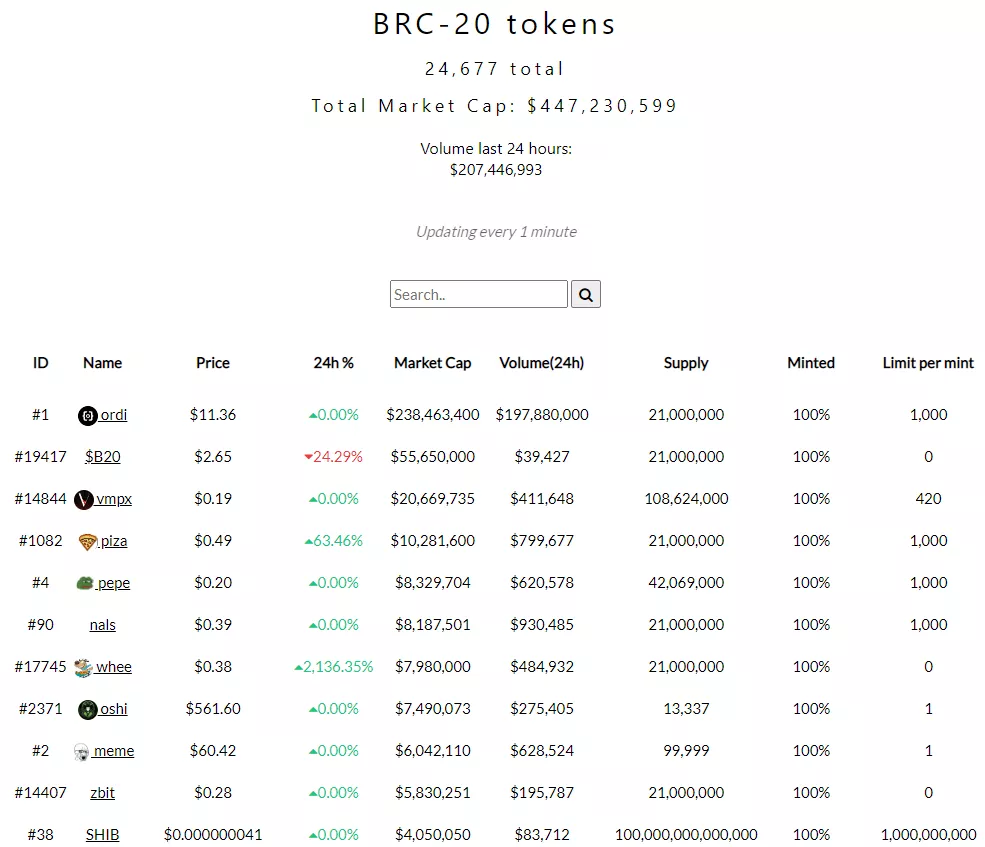
ORDI is the first token of the new standard. As of May 28 it trades just above $9, with a market capitalisation of $191m. The asset is listed on well-known centralised exchanges such as OKX, Gate.io and Huobi.
The combined market value of BRC-20 tokens is approaching $500m. ORDI dominates by capitalisation and daily trading volume.
Roughly 25,000 tokens of the new standard have already been created.


What are the use cases for BRC-20?
BRC-20 tokens can move freely between wallets like any other cryptoassets. Transaction fees are paid in satoshis.
New use cases are emerging. Soon after the standard appeared, the platform Ordinalswallet.com launched for trading BRC-20 and inscriptions.


These new assets could become a key building block of a Bitcoin-based DeFi ecosystem, whose infrastructure is already developing.
There are many potential applications. Tokens can be integrated into decentralised exchanges, lending protocols and yield farming platforms.
A crucial milestone for Bitcoin-based DeFi would be the development of cross-chain bridges linking “wrapped” tokens of BRC-20 to other blockchains.
Another obvious use case is tokenisation, where the BRC-20 standard could help issue equivalents of Tether’s USDT and other virtual representations of real-world assets.
How to buy Ordinals and BRC-20 tokens
There are several main ways to acquire Ordinals inscriptions and BRC-20 tokens:
- centralised exchanges such as Binance and OKX, among the first to add support for the new assets;
- NFT marketplaces (Magic Eden, DIBA);
- platforms in the emerging infrastructure (ordinalswallet.com).
Buying tokens on centralised marketplaces is similar to purchasing any other assets.
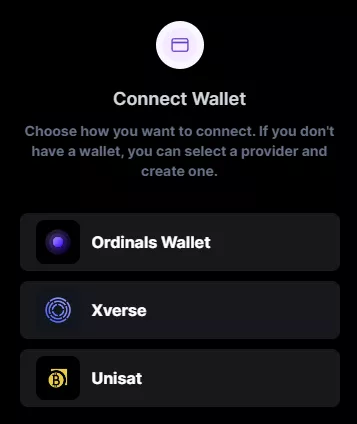
To use ordinalswallet.com, you need to create a compatible wallet and securely save the seed phrase.
After clicking Connect Wallet in the top-right corner, a window appears with options for connecting wallets to Ordinals Wallet:

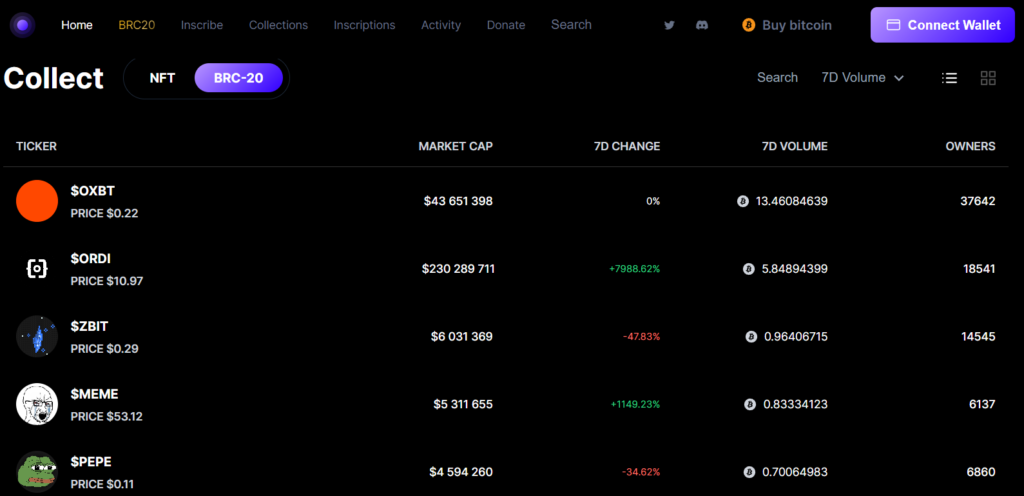
In the BRC-20 tab you will find a list of available tokens of the eponymous standard and key market data: capitalisation, seven-day price change, trading volume and number of holders.


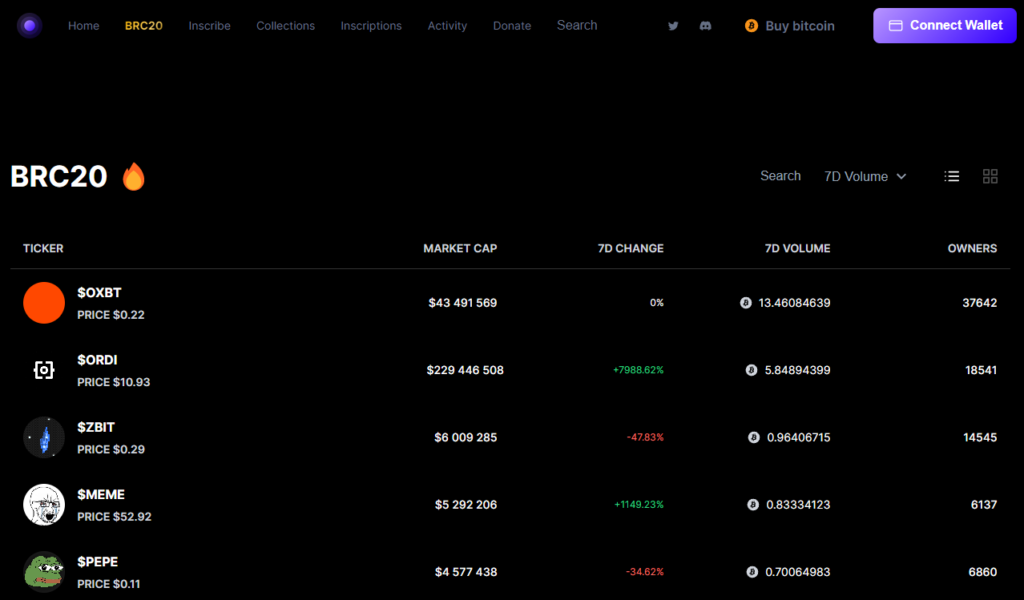
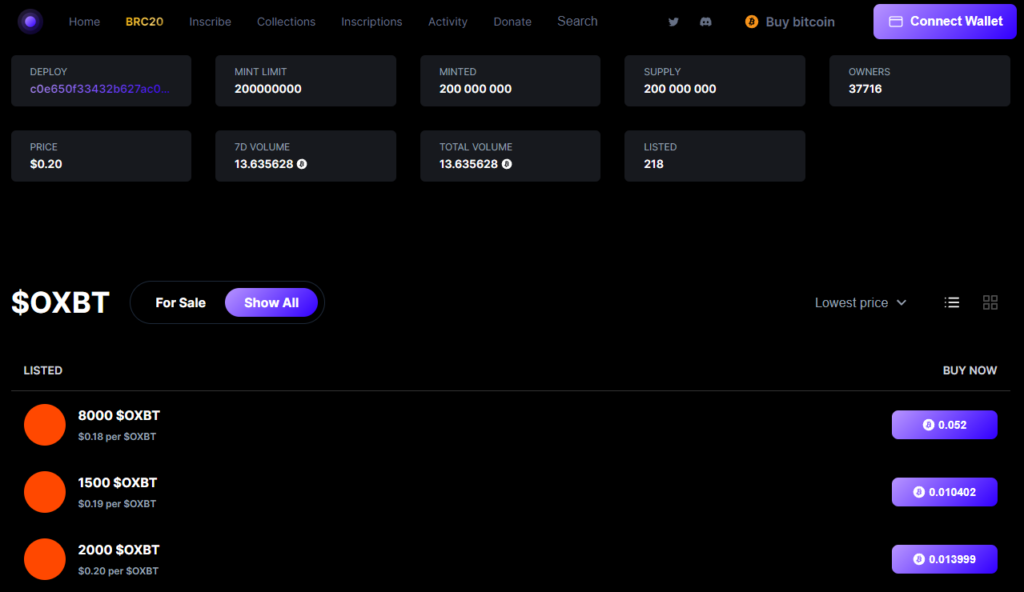
After selecting an asset, a page with price offers appears. To purchase tokens, click “Buy now” at the stated price in bitcoin.


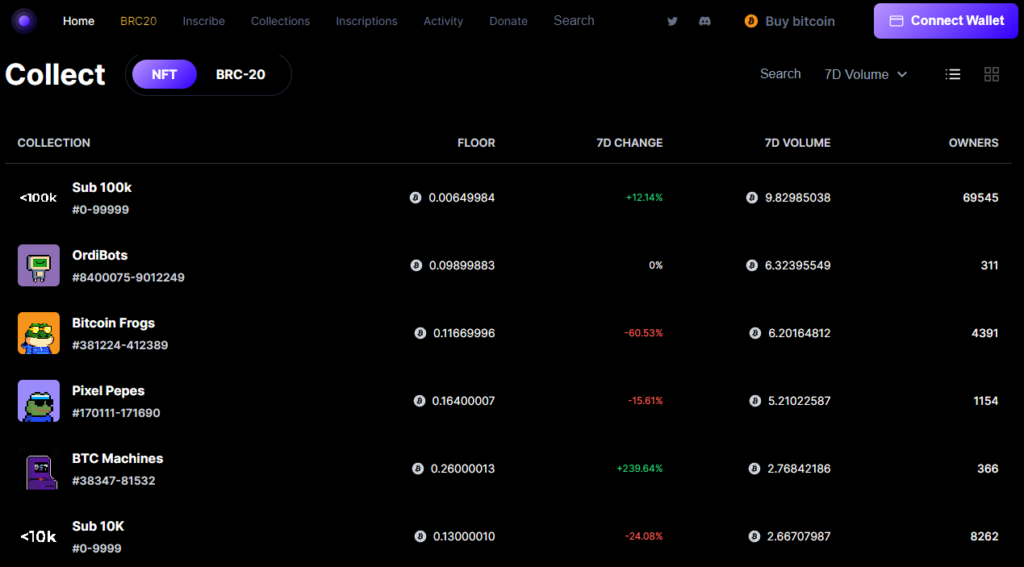
Buying NFTs on Bitcoin is similar to purchasing BRC-20. The corresponding functionality is available on the Ordinals Wallet home page.


There are other similar services:
- Xverse — a wallet created by Gamma.io that lets users create inscriptions without running a full Bitcoin node. Users can simply upload images and pay transaction fees;
- Hiro — this wallet has similar functionality. The platform was also created by the Gamma.io team.
Popular inscription collections include:
- Ordinal Punks, a nod to CryptoPunks on Ethereum;
- Ordinal Birds — a derivative of Moonbirds;
- Planetary Ordinals — a set of just 69 digital artefacts;
- TwelveFold — a collection of 300 Bitcoin NFTs by Yuga Labs;
- Bitcoin Frogs — once the segment leader.
Data on these and other collections can be explored on CryptoSlam.
How do Ordinals and BRC-20 affect the Bitcoin blockchain?
The frenzy around Ordinals and BRC-20 is materially affecting various on-chain metrics for digital gold: transaction activity, fees, mempool congestion, block fullness and more.
By mid-February the number of NFTs on Bitcoin had surpassed 100,000. A sharp rise was already visible in fees spent on inscriptions and per-block revenue, alongside wider use of Taproot signatures.
In early May, daily fees for minting NFTs exceeded $7m.

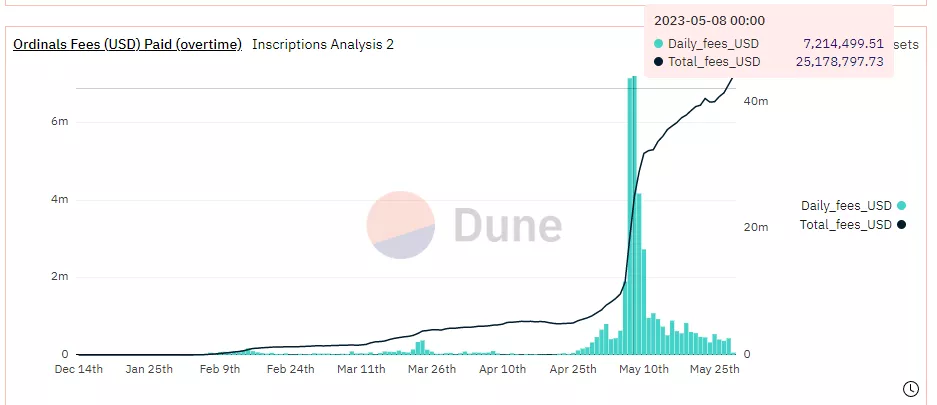
In total since the Ordinals protocol launched in January, users have minted 10 million Bitcoin NFTs and paid 1,575 BTC in fees (~$44.15m), as of May 29.


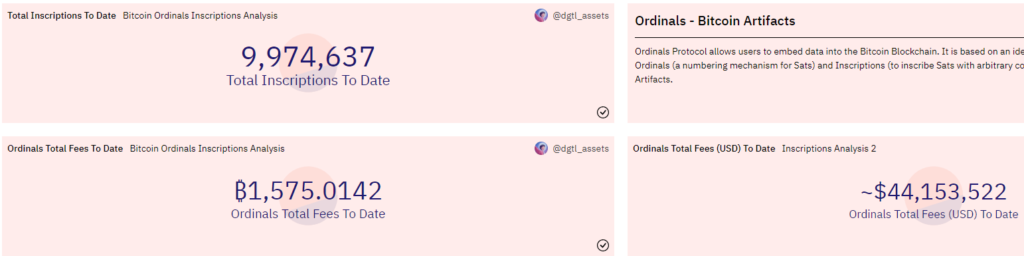
On May 1 the number of daily transactions on Bitcoin hit ATH at 685,711.
Despite higher on-chain metrics, active addresses fell to their lowest since July 2021 — 764,000. Analysts at The Block believe that, owing to high fees, “people are hesitant to transact” — the BRC-20 and Ordinals frenzy pushed up transfer costs.
The average fee per transaction over the year rose from roughly $2.5 to a peak of $16.08.


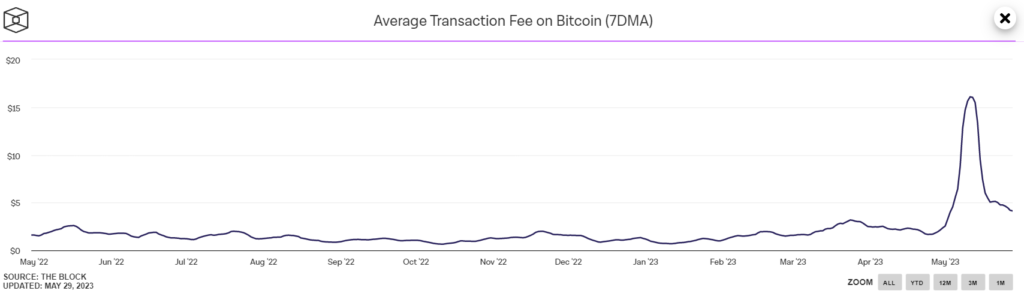
Before the “Ordinals mania”, blocks were only 25–50% full. In early March they were in the 80–90% range, equivalent to 3.2–3.6MB.
The hype around the new assets inevitably affected miner revenues and their composition — daily fee income per block exceeded the 6.25 BTC block subsidy for the fifth time in history. The previous instance was at the peak of the 2017 bull market.
Deploying BRC-20 involves adding JSON text files to the blockchain. Given the small data footprint of these inscriptions and the sizable fees users were willing to pay, miners were able to fill blocks with a record number of transactions.
Thanks to the 75% discount applied to SegWit data for creating BRC-20, the average transaction size fell to 405 bytes — near record lows. That contrasts with the Ordinals boom, when the metric was ~1.5 kilobytes.

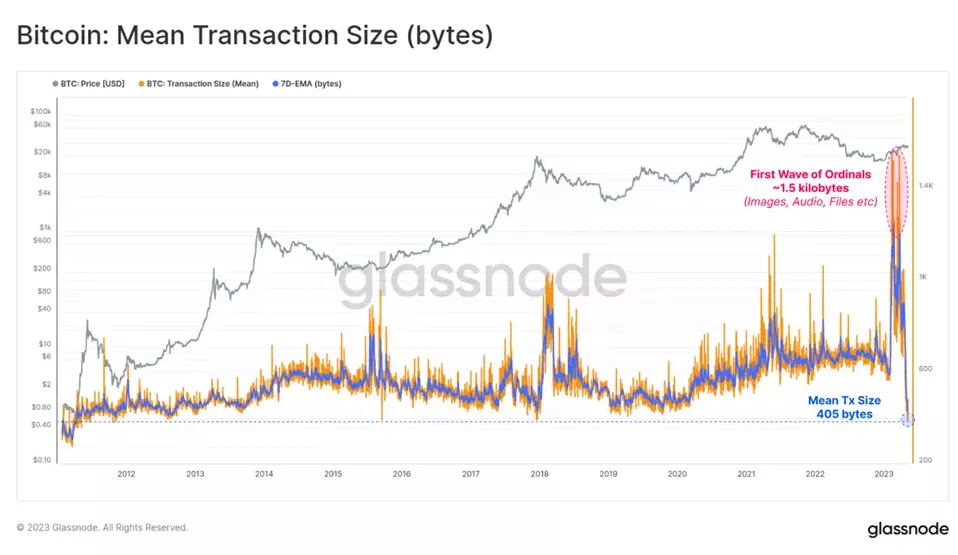
Glassnode analysts believe that growing activity in this new segment will lead to “consistently full blocks near capacity” and the predominance of an “incredibly dense data class”.
How does the crypto community view Ordinals and BRC-20?
Views on Ordinals and BRC-20 in the crypto community are far from uniform.
“Bitcoin purists” are convinced that digital gold was not created to store pictures on-chain. They argue that transactions with these new assets clutter blockspace to the detriment of “more legitimate financial operations”.
There are also many who are confident the new capability will benefit the ecosystem — and miners in particular.
For example, MicroStrategy founder Michael Saylor said the company not only knows about Ordinals but is interested in using the protocol to build applications. In his view, Bitcoin NFTs could foster innovation in the digital-asset market.
Saylor noted that the frenzy around Ordinals is necessary because “bitcoin miners need to benefit in the long term”. He added that building applications based on the functionality of the first cryptocurrency promotes wider adoption among influential people, companies and governments.
Analogues of Ordinals are appearing on other blockchains, including Litecoin. The first object inscribed after porting the protocol to the network of digital silver was the MimbleWimble white paper.
On May 27, 2023, the daily number of transactions on Dogecoin (DOGE) set a record at 2.08 million, far outpacing Bitcoin and Ethereum.
Some experts linked the activity of the meme cryptocurrency to the rising popularity of tokens under the DRC-20 standard, which allows new digital assets to be created on the blockchain.
Not everyone in the crypto industry is thrilled. For example, Bitcoin Core developer Luke Dashjr called assets based on Ordinals “garbage” and proposed “banning” BRC-20 and inscriptions via a “spam filter”.
“Measures should have been taken months ago. Spam filtering has been standard for Bitcoin Core since day one,” the programmer said.
The developer believes the filter can be implemented immediately as a “bug fix”, without waiting for a major release or a soft fork.
A similar appeal appeared in a subsequently deleted tweet by Blockstream CEO Adam Back, who called Ordinals-based assets “crap”.
Adam Back used to sell T-shirts with RSA code printed on them, to fight the US government’s attempts to censor free speech
Now he’s encouraging miners to censor jpegs because he thinks they’re “crap” pic.twitter.com/eha4Zxrwyc
— Udi Wertheimer ?♂️ (@udiWertheimer) January 29, 2023
In contrast to the “Bitcoin purists”, supporters of Ordinals and BRC-20 argue that the new assets improve the fee market and increase miner revenues. Consequently, the growing popularity of such tokens makes the Bitcoin network more secure.