


What Are Quantum Supremacy, Utility and Advantage?
What Is Quantum Supremacy and When Was It Achieved?
Theoretical physicist John Preskill coined the term “quantum supremacy” in 2012. In scientific terms, it marks a fundamental computational threshold: the point at which a quantum device solves a specific task in acceptable time while a classical supercomputer, though in principle capable, is so inefficient that the result would take years, centuries or even millennia.
Early demonstrations were strictly laboratory exercises because devices were highly susceptible to computational noise (errors). To prove the technology’s viability under such conditions, engineers turned to synthetic algorithms — for example, sampling from random quantum circuits (RCS).
These tests had no direct commercial value, but they served a critical purpose: they recorded quantum architecture’s superiority over classical machines in a narrow niche and opened the industry’s path toward useful applications.
In 2019, Google’s research team first claimed quantum supremacy. Its 53-qubit superconducting Sycamore processor completed an RCS task in 200 seconds. The researchers said the then-most-powerful classical supercomputer, Summit, would have needed about 10,000 years.
IBM disputed the announcement. The company said Summit could handle the task in just two and a half days. By efficiently leveraging not only processors but also the supercomputer’s vast RAM and disk storage, IBM argued, one could sidestep the apparent exponential complexity.
Chinese research teams later reported crossing the threshold on two different physical architectures: the photonic quantum computer Jiuzhang, which uses photons for boson sampling, and updated superconducting systems with a QPU, Zuchongzhi 3.0. In March 2025, the system generated one million samples in just a few minutes. According to the Chinese team’s estimates, exact simulation of this specific process would take Frontier, the world’s most powerful classical supercomputer, about 6.4 billion years.
While tasks like RCS lack practical or commercial utility, they play a vital role: they prove that as the number of high-quality qubits grows, quantum power becomes insurmountable for the von Neumann classical architecture.
What Is Quantum Utility?
At the stage of quantum utility, quantum computers stop being laboratory record-setters and become tools for scientific research. They don’t yet outpace supercomputers across all metrics, but they can already probe physical problems at scales inaccessible to direct classical simulation.
Quantum utility is the ceiling for the NISQ era. For the next stage — FTQC — engineers prioritize suppressing errors (error mitigation) over merely adding qubits. The method extracts accurate results from “noisy” systems before they lose their quantum state.
Error mitigation must be strictly distinguished from full-fledged hardware error correction, the hallmark of the next historical phase.
The concept was proposed and demonstrated by IBM in 2023, effectively launching the period of quantum utility, which continued in 2026. In the experiment, the 127-qubit Eagle processor modeled properties of complex magnetic materials. Using noise-mitigation techniques, the processor produced results that could not be computed exactly by classical methods.
To realize quantum utility, teams often deploy hybrid architectures that use a QPU, a CPU and a GPU together — a balance that efficiently allocates workloads.
In May 2026, IBM, Cleveland Clinic and Japan’s RIKEN, using such heterogeneous computation, simulated a giant protein–ligand complex of 12,635 atoms. The task ran on two quantum computers and two classical supermachines.
What Is Quantum Advantage?
The media often uses “quantum supremacy” and “quantum advantage” as synonyms, but in scientific and business contexts they mark different stages in the technology’s evolution.
Supremacy is a laboratory proof of quantum hardware’s fundamental computational power. Advantage is broader: it is achieved when a device solves a concrete applied task faster, cheaper or more accurately than the best classical supercomputer.
The key criterion is practical and economic viability. A business doesn’t need a complex, expensive QPU if a conventional cluster can simulate a molecule for a new drug or calculate the properties of a super-strong alloy in comparable time and budget.
Achieving quantum advantage, alongside FTQC, is a primary goal for leading technology companies and startups over the next three to four years.
Examples from roadmaps:
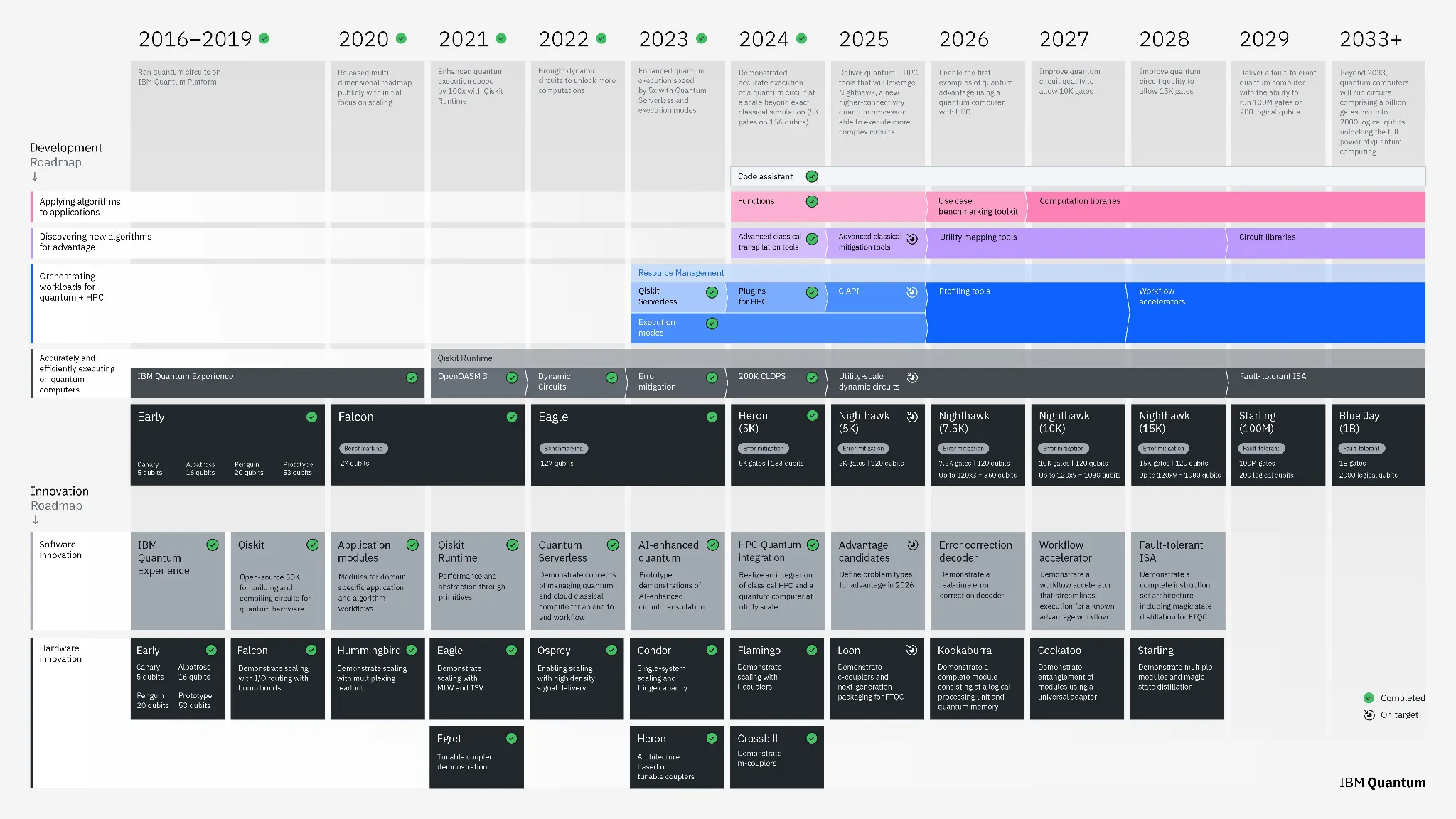
- IBM. By the end of 2026, the company will demonstrate “the first examples of practical quantum advantage” using the Nighthawk processor. It will be able to run deep circuits of 7,500 gates in tight hybrid coordination with classical supercomputers. By 2029, developers aim to release a full-scale FTQC system operating 200 logical qubits — Starling;
- QuEra Computing. The neutral-atom specialist plans to ship a system with 100 fault-tolerant logical qubits in 2026. Engineers estimate this will be enough to begin tackling the first commercially meaningful problems in chemistry and materials science that are out of reach for classical computers;
- Quantinuum with Microsoft. The company intends to hit business targets by 2030. Its main bet is the fifth-generation Apollo quantum computer. The trapped-ion system is slated to deliver hundreds of logical qubits with deep error correction, integrated with AI platforms and Microsoft Azure Quantum cloud infrastructure;
- Google Quantum AI. After presenting the 105-qubit Willow processor in late 2024, the company made progress in error mitigation. The goal is to complete a large-scale quantum computer with hardware error correction, capable of reliably processing data for commercial tasks, by the end of this decade.
Where Are Quantum Computations Most Effective?
The first real results are emerging in disciplines that require simulating complex quantum-mechanical systems. Classical processors are inefficient at calculating molecular interactions: each additional electron drives exponential data growth. By contrast, quantum devices model molecular structures natively, following the laws of quantum physics.
The industry is moving from lab tests to solving the toughest problems of the physical world. Key application areas where quantum utility is expected or being tested:
- chemistry and industrial catalysis. Today, fertilizer production consumes about 2% of all generated energy. Quantum algorithms are used to model the nitrogenase enzyme to create new, revolutionary catalysts. That would enable ammonia synthesis at room temperature, radically cutting global energy use;
- materials science. Leading corporations are applying quantum computing power to discover new chemical structures. Core goals include lightweight, ultra-dense solid-state batteries for EVs and high-temperature superconductors that could transmit electricity with zero loss;
- pharmacology and biophysics. Drug discovery could avoid lengthy, costly blind screening. In theory, quantum technology will enable targeted protein design and ultra-precise prediction of how a new molecule binds to a target virus or cancer cell in the human body;
- fundamental science. Quantum systems are already used in theoretical physics. Researchers simulate the behavior of exotic states of matter, wormholes and materials at the quantum level — work that could lead to discoveries classical science doesn’t yet foresee.
Where Are Quantum Computations Hard to Achieve?
Business is preparing for the quantum era: major logistics operators such as DHL and financial conglomerates including HSBC and JPMorgan are testing process-optimization algorithms.
But in the scientific community these fields are officially recognized as the most challenging and farthest from real quantum advantage. For most combinatorial problems — the classic traveling-salesman problem or portfolio optimization — the best quantum algorithms (QAOA or Grover’s algorithm) deliver only a quadratic speedup. Beating silicon would require millions of ideal, fault-tolerant logical qubits.
Other areas where marketing outpaces scientific progress:
- quantum machine learning. For a quantum neural network to process a dataset (say, a million images or a terabyte of text), the data must be converted from classical “0” and “1” into a superposition of amplitudes. This requires quantum random-access memory (QRAM). The problem is that an efficient technology does not yet exist. Loading massive datasets into qubits takes so long (growing linearly or even superlinearly) that it kills any quantum speedup at the outset;
- working with databases. Today’s QPUs run at frequencies thousands of times lower (kilohertz or megahertz) than CPUs. Because of this huge gap, Grover’s quadratic speedup only becomes useful when the database size is truly astronomical. But such a database can’t be loaded into a quantum computer due to the QRAM problem;
- cybersecurity threat. To crack a standard RSA-2048 key, a quantum computer needs roughly 4,000 logical qubits with FTQC. According to most major project roadmaps, that result may be reached sometime in the 2030s.
Рассылки ForkLog: держите руку на пульсе биткоин-индустрии!