



Key points
- Ethereum Classic is a smart‑contract blockchain. The project’s native cryptocurrency trades under the ticker ETC.
- The network emerged from a split in the Ethereum community after a hard fork prompted by The DAO hack in 2016.
- Its hallmark is preserving Ethereum’s original architecture, notably the Proof‑of‑Work consensus algorithm.
Who created Ethereum Classic, and when?
The Ethereum Classic network is the product of a contentious Ethereum hard fork carried out after The DAO was hacked in June 2016. Hackers made off with about $50m in cryptocurrency. Developers, backed by Ethereum co‑founder Vitalik Buterin, opted for a hard fork to return the stolen funds. Part of the community objected, insisting on the blockchain’s integrity and immutability.
After weeks of debate and preparation, Ethereum proceeded with the hard fork. The split into two separate chains occurred on 20 July 2016. Those opposed to the decision continued the original chain, naming it Ethereum Classic.
In August 2016 the “Ethereum Classic Declaration of Independence” set out the main objections to Ethereum’s hard fork and defined the network’s guiding principles: censorship resistance, the inviolability of the transaction ledger and adherence to the “code is law” principle.
What are Ethereum Classic’s key features?
Ethereum Classic is an open‑source blockchain using the Proof‑of‑Work consensus algorithm, designed to deploy and run smart contracts executed by the Ethereum Virtual Machine (EVM).
Ethereum Classic developers track the “parent” network’s progress and periodically implement updates. According to Mantis employee Stevan Lohja, the community cannot ignore the industry’s evolution and should borrow innovations from Ethereum. Accordingly, Ethereum Classic maintains EVM compatibility to ease the migration of smart contracts between the two networks.
Ethereum Classic uses Proof‑of‑Work. New blocks are produced via mining, which requires specialised hardware. Transactions are processed using the native cryptocurrency ETC, which miners receive as a reward for finding a block.
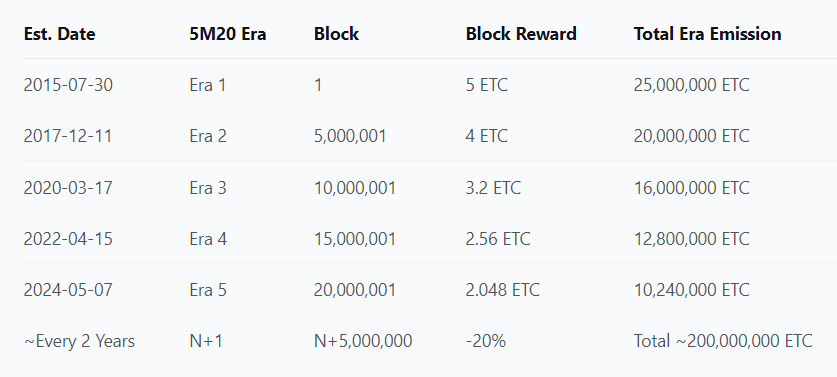
ETC issuance is capped at 210.7m coins. Ethereum Classic follows a deflationary schedule: roughly every two years, mining rewards are reduced by 20% until the maximum supply is reached.


What are the main milestones in Ethereum Classic’s development?
Despite its shared history with Ethereum, the Ethereum Classic community has implemented a number of important changes to advance the goals set out in the Declaration of Independence. The main milestones include:
Removing the “difficulty bomb”
In mid‑2018 the mechanism intended to transition the original Ethereum to Proof‑of‑Stake was removed. The difficulty bomb was designed to encourage a move from Proof‑of‑Work to Proof‑of‑Stake by making PoW mining untenable over time. The Ethereum Classic community rejected changing the algorithm and decided to keep the existing one.
Capping ETC supply
In the first half of 2017 the Ethereum Classic network capped ETC issuance at 210.7m tokens and reduced the block reward. The initiative’s authors argued that such monetary policy would balance the long‑term interests of investors, developers and businesses.
Changing the mining algorithm
From January 2019 to November 2020, Ethereum Classic suffered a series of attacks that led to chain reorganisations. Developers implemented protocol upgrades to improve security. Among the changes was a new mining algorithm, Etchash, which replaced Ethash used in Ethereum.
How will the Ethereum 2.0 upgrade affect Ethereum Classic?
A similar codebase and mining algorithm in Ethereum and Ethereum Classic prompted assumptions that the second‑largest cryptocurrency’s move to Proof‑of‑Stake would drive miners to migrate to other networks.
Researchers believe idle Ethereum mining capacity will be redeployed to other Proof‑of‑Work chains. Ethereum Classic is the closest—though not the only—candidate. Other suitable projects include Grin, Ravecoin, Beam and others.
According to Ethereum founder Vitalik Buterin, Ethereum Classic is “a very good chain” for proponents of PoW mining.
Institutional investors have also shown interest. The Ethereum Classic Trust (ETHC) is the third‑largest fund of the American company Grayscale Investments. As of 19 August 2022, the trust held nearly 12m ETC, equivalent to $485m.
JPMorgan analysts think activating Proof‑of‑Stake will benefit Ethereum’s PoW competitors, but only in the short term. Among the main beneficiaries they name Ethereum Classic miners, in part because of the profitability of mining ETC. Huobi noted that Ethereum’s hard‑forked network has the highest hashrate and market capitalisation compared with other PoW blockchains.
What is in the Ethereum Classic ecosystem?
The Ethereum Classic blockchain cannot compete with Ethereum in the number of live applications and assets or in liquidity. According to the Ethereumclassic website, fewer than 40 active applications were running on the network at the time of publication. According to DeFi Llama, the total value locked in Ethereum Classic’s DeFi segment amounts to just over $1.3m.
Despite the lack of a developed ecosystem of applications and services built on Ethereum Classic, the project is promoted by large investment companies.
One of them is Grayscale Investments, a subsidiary of Digital Currency Group headed by Barry Silbert. According to Grayscale’s documents, up to a third of the Ethereum Classic Trust’s income may be directed to developing the ETC ecosystem via investments in the Ethereum Classic Cooperative.
AntPool, a mining pool affiliated with Bitmain, announced $10m of investment in the Ethereum Classic ecosystem. The AntPool CEO also said they plan to increase investment in future. The Cardano developer Input Output Hong Kong (IOHK) has also participated in ecosystem development.
What else to read?
What is Ethereum (ETH)?
What is Ripple and the XRP cryptocurrency?