




Key points
- Etherscan is a block explorer and analytics platform for the Ethereum blockchain. It was launched in 2015 by a team of developers from Malaysia. The project is independent and not funded by the Ethereum Foundation.
- The service helps users navigate public network data: it tracks transactions and displays results much like a search engine.
- The platform provides detailed information on addresses, smart contracts, blocks, network status and other on-chain indicators.
- In 2021 the Etherscan team rolled out similar services for BNB Chain, Fantom, Huobi Eco Chain, Optimistic Ethereum L2, Polygon, Hoo Smart Chain, Arbitrum, Moonbeam, Moonriver and Avalanche.
How can you use Etherscan?
Etherscan is a source of blockchain information and a database for smart contracts. It does not store private keys, take part in any of the transactions it displays, or fix failed transactions.
Its core functions include tracking network status and transactions, and searching for information on assets held at public Ethereum addresses.
The homepage highlights key metrics: the coin’s price, market capitalisation, transaction count, average gas price and data on Ethereum’s mining difficulty.


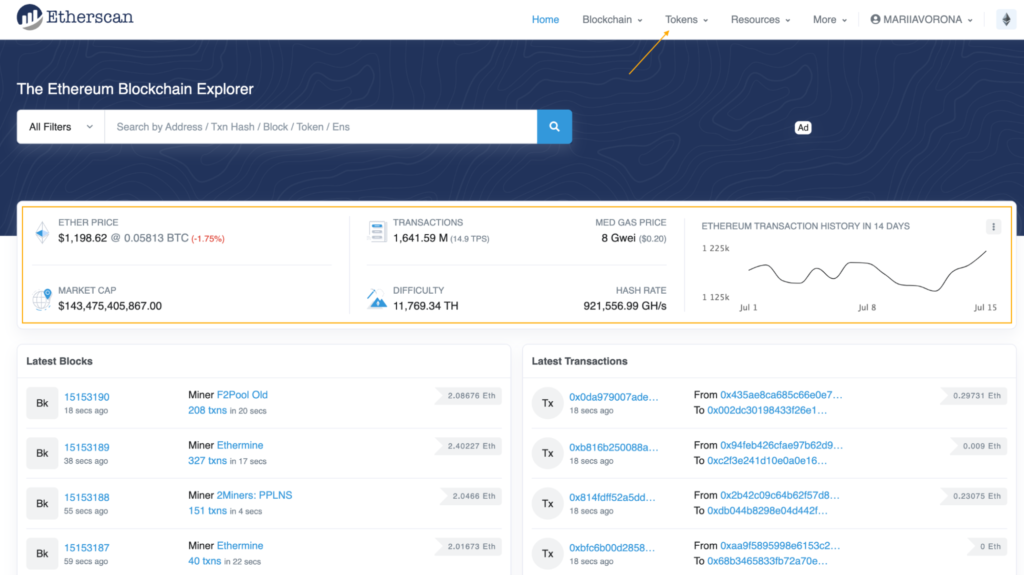
Beyond this, Etherscan aggregates data on blockchain activity and tokens. The Resources section offers various metrics and statistics for top-level analysis: daily ETH price charts, market capitalisation, circulating supply and more.
The Tokens menu lists up-to-date information on ERC-20, ERC-721 and ERC-1155 tokens: price, percentage change, trading volume, market capitalisation and the total number of addresses holding the asset.
The service shows transaction details on Ethereum, including failed or pending ones.
For instance, if funds have not yet reached the recipient’s wallet, you can check the transfer’s progress using the transaction ID (TXID). The service will display an estimated confirmation time and other details.
What else can Etherscan do?
- View assets linked to a public wallet address, and track portfolio data and transaction history.
- Find the details and status of any transaction using a TXID, wallet address or an ENS domain name.
- Inspect any smart contract. The service indicates whether the project’s source code has undergone a security audit.
- Watch transactions and blocks in real time.
- Estimate gas fees and mining profitability;
- Use the directory of Ethereum-related resources.
It also flags addresses linked to suspicious activity. For example, the address associated with the Lazarus group carries a warning banner.
Do you need an Etherscan account?
Registration is optional but brings extra benefits: tracking watchlist addresses and setting transaction alerts, private notes and access to developer tools.
How to view transaction details?
Suppose you sent 1 ETH to another user’s public address and want to make sure the transaction succeeded.
Enter the Ethereum wallet address or the transaction ID into Etherscan’s search bar. In 2021 Etherscan added support for the distributed domain-name system Ethereum Name Service (ENS). If the address owner uses ENS, you can enter the associated domain name instead of the blockchain address (0x…).
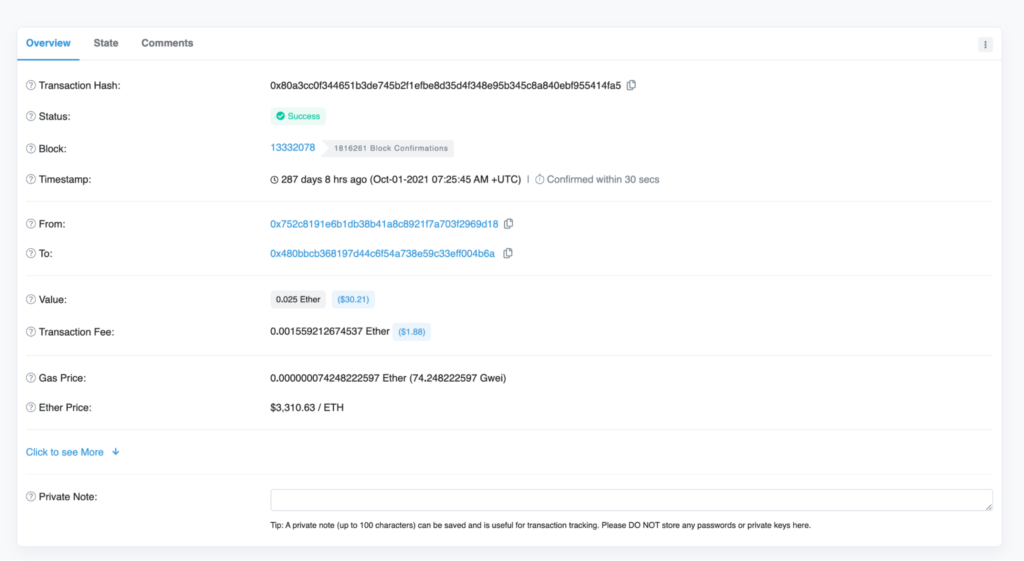
If you search by TXID, the page will show details including the hash and status, block number and time, sender and recipient addresses, the amount transferred and the fee, gas price, and Ethereum’s market price. Registered users can attach a private note to a transaction.
Another way to check the status is to browse transactions on the recipient’s wallet page.


Where to find wallet information?
Enter a public address or domain name into Etherscan’s search bar. At the top of the page you will see the wallet’s key information: balance and amount of ETH. The Token menu lists the owner’s assets and non-fungible tokens (NFTs).


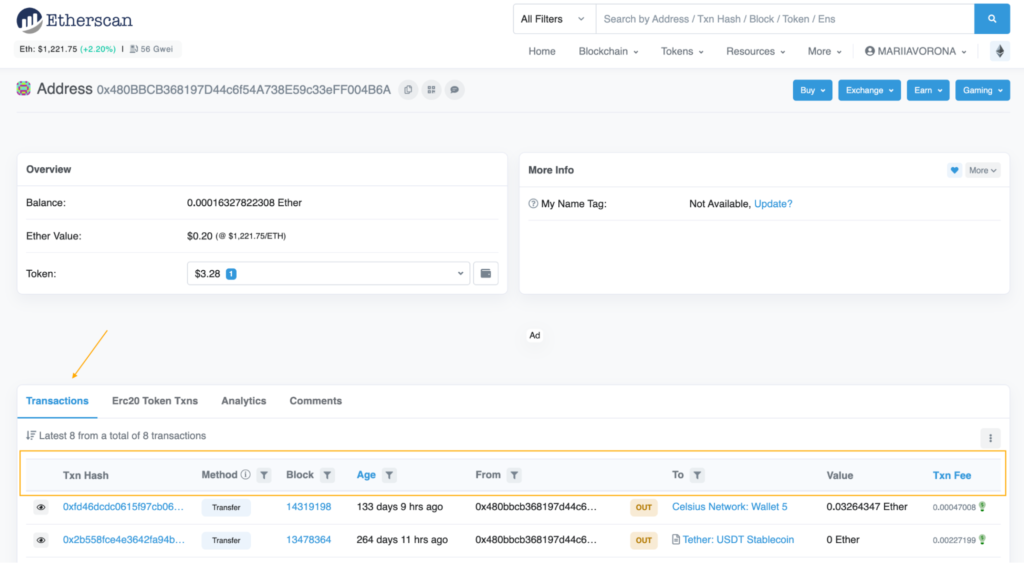
The lower part of the page lists all transactions linked to the wallet, analytics and comments.
In the Transactions section you will see, in order, the transaction hash, method, block number, date, sender, recipient, amount of ETH and the fee. Incoming transactions are marked In, outgoing Out.
What to read next?
What is Ethereum (ETH)?
What are ERC-20 tokens?