



What is Fantom?
Fantom is a high-performance, scalable decentralised platform for smart contracts built on a DAG (directed acyclic graph). It is compatible with the Ethereum Virtual Machine and supports smart contracts and decentralised applications written in Solidity.
Thanks to easy migration and fast, inexpensive transactions, an extensive ecosystem has formed on Fantom, spanning dozens of blockchain projects, including decentralised exchanges, DeFi protocols for lending and NFT marketplaces.
In autumn 2021 the Fantom ecosystem broke into the top ten blockchain platforms by total value locked, and the number of unique addresses on the network exceeded 1m.
Who created Fantom, and when?
Fantom Foundation Ltd was registered in early 2018 in South Korea. The project’s founder and CEO was An Byung Ik, known domestically for creating the restaurant-rating app SikSin. He is also president of the Korea Food-Tech Association and has close ties with his alma mater, Yonsei University, South Korea’s oldest.
The initial Fantom Foundation team consisted mainly of South Korean developers, and its first partnerships were in the local food-tech industry.
Later the Fantom Foundation moved to the Cayman Islands and its leadership became international. Australian Michael Kong became CEO and IT director, and Andre Cronje, known for yEarn Finance, became lead DeFi developer.
The seed and two private investment rounds took place from February to May 2018, during which the project attracted backing from a number of venture funds, including Hyperchain Capital, Signum Capital, 8Decimal, Obsidian Capital, Arrington XRP Capital, Bibox Fund, Link VC, Nirvana Capital, JRR Crypto and others.
Fantom’s public token sale in the ICO format was held in June 2018. The project positioned itself as “the world’s first DAG-based smart-contract platform that solves the problems of scaling and transaction confirmation speed”.
According to the white paper, Fantom was slated for deployment across sectors including telecommunications, food tech, finance, logistics, smart-city development and more.
Across private and public sales the team sold 40% of 3.175bn FTM tokens, raising about $39.65m.
Fantom was developed in Rust, Golang and Java. The team initially advertised throughput of up to 300,000 TPS, later revised to 4,500 TPS.
The testnet launched in December 2018, and mainnet followed a year later, on December 27th 2019.
Today the Fantom Foundation oversees development and network governance with support from the community and validators. In time, governance is to pass to FTM tokenholders.
How does the Fantom blockchain work?
DAG architectures are used by projects such as IOTA, Nano, Dero, Coti and others. Fantom was the first to implement smart-contract support on top of a directed acyclic graph.
Fantom’s core is the Lachesis aBFT (asynchronous Byzantine Fault Tolerance) consensus mechanism, with several key features:
- asynchrony, meaning transactions can be processed independently by different nodes;
- leaderless operation;
- Byzantine fault tolerance, maintaining liveness even with up to one-third faulty or malicious nodes;
- rapid finality — confirmations within 1–2 seconds.
Each Lachesis node stores its own local DAG of event blocks containing transactions. Nodes do not relay blocks to one another to reach consensus as linear blockchains do. Instead, validators periodically exchange transactions and events, synchronising them within epochs that last a few minutes.
Lachesis is fully compatible with the Ethereum Virtual Machine (EVM) and can integrate with the Cosmos SDK. Developers can port existing Solidity smart contracts and applications to Fantom in minutes, cutting the cost of launching new products.
How does the FTM token work?
FTM is the native token of the Fantom network. It circulates in three blockchains in parallel:
- an ERC‑20 token on Ethereum;
- a BEP‑20 token on Binance Smart Chain;
- the native FTM coin on Fantom.
All three are linked by cross-chain bridges Multichain.xyz, AnySwap and SpookySwap to allow liquidity to move freely between networks. In addition, users can use the exchange Binance, which supports FTM deposits and withdrawals on all three networks.
Native FTM tokens can be stored in the PWA Wallet from the Fantom Foundation. The network is also supported by MetaMask, Trust Wallet, Coinbase Wallet and others.
FTM is used to pay transaction fees, to secure validator nodes and, in time, for project governance.
Transactions on Fantom can be tracked via FTMscan, functionally similar to Etherscan for Ethereum.
Fees vary with network load. With 600,000–800,000 daily transactions they range widely — from $0.01 to $0.1.
Fantom uses a Proof‑of‑Stake consensus mechanism to validate transactions and secure the network. Processing is handled by 59 validators. Running a validator node requires at least 1m FTM and a dedicated server with specific technical characteristics or a comparable VPS from a cloud provider.
Validator income is about 13% per annum. It comprises transaction-processing rewards and 15% of the rewards earned by delegates who chose that validator.
Any FTM holder can delegate coins to a validator and earn staking rewards. Staking yields depend proportionally on the chosen lock-up period: from 4% per year with withdrawal at any time to 13% per year with a 365‑day lock.
What partnerships has the Fantom Foundation signed?
Since its founding in 2018 the Fantom Foundation has worked actively to attract partners worldwide to implement blockchain technology across companies and government agencies.
Initially the project focused on partners in South Korea. It went to its ICO claiming partnerships with SoftBank Korea and Oracle Korea. Thanks to management’s close ties with the Korea Food‑Tech Association, early agreements involved firms in South Korea’s food‑tech industry. They did not progress further.
In August 2018 the Fantom Foundation signed a strategic partnership with POSBANK, a POS‑terminal operator, to build a table‑booking and delivery platform for 5,000 South Korean restaurants.
In October 2019 the Fantom Foundation began collaborating with Denmark’s Danfoss, a maker of building-systems and renewable‑energy equipment. The agreement covered testing distributed‑ledger technology for IoT infrastructure.
In 2020 the Fantom Foundation expanded cooperation with Afghanistan’s government on several fronts. Together with the Ministry of Industry and Commerce, it planned to build a blockchain platform to digitise archives and move the ministry’s document flow and business registry on‑chain. With the Ministry of Health and startup Chekkit it launched a pilot to track pharmaceutical supply chains. However, the rise to power of radical Islamists wiped out these gains.
In April 2021 Tajikistan’s Ministry of Industry and New Technologies signed an agreement with the Fantom Foundation to use its blockchain solutions in e‑government infrastructure. In September 2021 the Fantom Foundation announced a partnership with one of Tajikistan’s oldest banks, “Ориенбанк”, to develop a central‑bank digital currency (CBDC).
That same month, in Pakistan, the Fantom Foundation signed an agreement to start a pilot introducing distributed‑ledger‑based software to optimise the Punjab Prisons Department.
In April 2021 the Fantom Foundation received an additional $15m investment from HyperChain Capital, which had participated in the first private round in 2018.
How is the Fantom ecosystem developing?
The Fantom Foundation’s biggest strides have been in decentralised applications. Developer interest, especially in DeFi, picked up in spring 2021. By autumn, several dozen blockchain projects, including Aave, Curve, С.R.E.A.M, yEarn, were using the network.


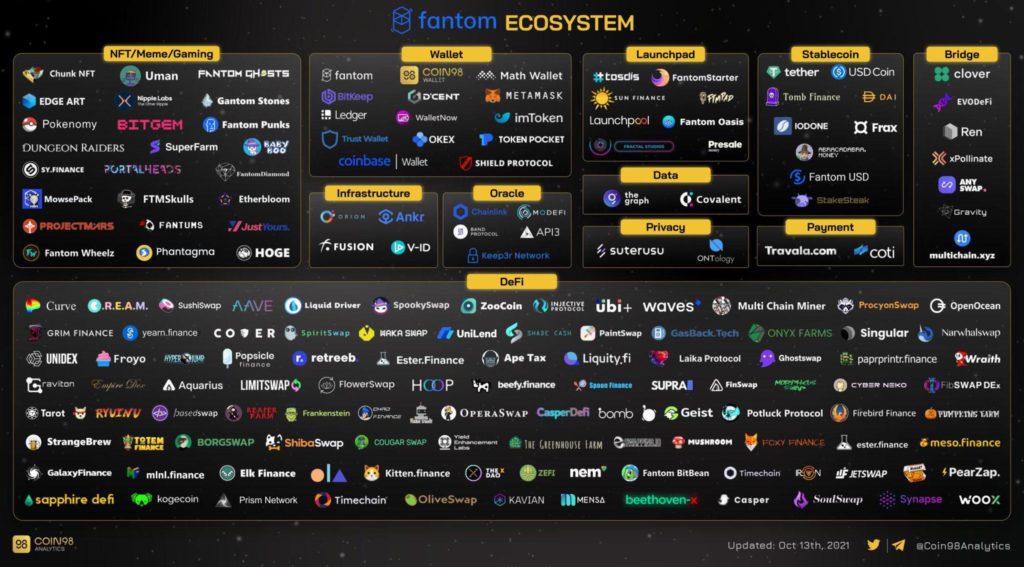
Two factors drove the surge: the launch of cross‑chain bridges to migrate liquidity from Ethereum and Binance Smart Chain, and a Fantom Foundation campaign to support and incentivise developers.
In June 2021 the first grants programme launched, with nine participants including SpookySwap and SpiritSwap.
In August 2021 the Fantom Foundation announced a new incentive programme for DeFi teams. It allocated 370m FTM, worth about $300m at the time. Depending on TVL, projects receive 1m–12m FTM, paid in equal monthly instalments over a year and usable for any purpose. In October 2021 the incentives programme was extended to GameFi projects.
Soon after, the number of DeFi projects on Fantom surged. Aggregate TVL in October 2021 topped $5bn, pushing the ecosystem into the top ten.
In October 2021 TrueUSD announced it would use the Fantom network to issue the fully USD‑backed TUSD stablecoin.
At the start of 2022 the Fantom Foundation planned to launch a new Fantom Virtual Machine (FVM) to achieve higher performance and security while retaining full compatibility with Ethereum smart contracts. The FVM is being developed with Yonsei University and the University of Sydney.
Links:
Website Fantom Foundation