




Key points
- Lido Finance is a service for liquid staking of cryptocurrencies.
- The protocol lets users deposit coins into a staking contract and receive an equivalent amount of “derivative” tokens that preserve the liquidity of the locked assets. This allows users to keep deploying cryptocurrencies locked in the staking contract for financial operations—for example, by providing them to liquidity pools.
- The most popular asset among Lido users is ETH, for which one receives the token stETH. The latter is supported by many popular decentralised exchanges.
- Lido is governed by a decentralised autonomous organisation (DAO) using LDO tokens. The service also supports staking of several other cryptocurrencies.
Who created Lido, and when?
The project was founded by Konstantin Lomashuk and Vasiliy Shapovalov. Lido was first tested on the Goerli testnet. The staking service launched on 19 December 2020. At the project’s start, LDO governance tokens were issued for voting.
In December 2020 the project raised $2m. Investors included Semantic Ventures, ParaFi Capital, Terra, Stakefish, Staking Facilities, as well as MakerDAO founder Rune Christensen, Aave head Stani Kulechov and Synthetix founder Kain Warwick.
Subsequently, Paradigm invested 15,120 ETH in Lido, receiving 70m LDO. The investment was approved by a DAO vote. In March 2022 the service raised $70m from Andreessen Horowitz.
ETH was the first crypto-asset available for liquid staking via Lido.
What problems does Lido solve?
The Ethereum network is gradually moving to the Proof-of-Stake consensus algorithm. A key stage was the rollout of the Beacon Chain, which began in December 2020. The network allows users to stake funds.
ETH holders can become validators, enabling them to propose blocks and earn rewards. However, running a node requires infrastructure and computing resources. ETH owners can earn passive income by delegating funds to validators.
The launch of Ethereum 2.0 is unfolding in stages, requiring tokens to be locked for a long time. Funds were expected to remain inaccessible until the end of 2022. During that period, validators had no ability to claim rewards.
Stakers can only enable or disable a node. If a node’s liveness is not maintained, validators may be subject to slashing and other penalties.
Causes of malfunction can include non-standard software or loss of connectivity. These factors raise the risks of staking, since early withdrawals are impossible.
The Beacon Chain requires validators to lock amounts in multiples of 32 ETH. This is insignificant for large investors. However, holders of smaller capital, for example 16 ETH, cannot become validators. Those with less than 64 ETH cannot use a significant portion of their funds for staking.
Lido addresses these issues. The service delegates ETH to reputable validators, allows deposits of any size, and enables the use of derivative financial instruments.
How does Lido work?
With Lido, users lock ETH in a smart contract and receive stETH in return. Market participants can deposit any amount of coins, bypassing the 32 ETH threshold.
stETH is compatible with DeFi decentralised applications, providing access to additional sources of yield. The coins can be added to liquidity pools, used as collateral to obtain loans, and traded on the open market.
The token has high liquidity. It serves as a link between Ethereum 1.0 and 2.0.
The staking service delegates funds to large validators. Income is distributed among stETH holders daily. This adjusts users’ balances to account for rewards and penalties.
Lido charges a fee of 10% of earned income. Users will reclaim their deposited ETH and rewards once transactions on the Beacon Chain become possible. At that point, stETH will be retired.
How is Lido structured?
Lido is built on two components: a staking pool and an oracle.
The staking pool is implemented via smart contracts on Ethereum. Participant interactions follow the scheme below:


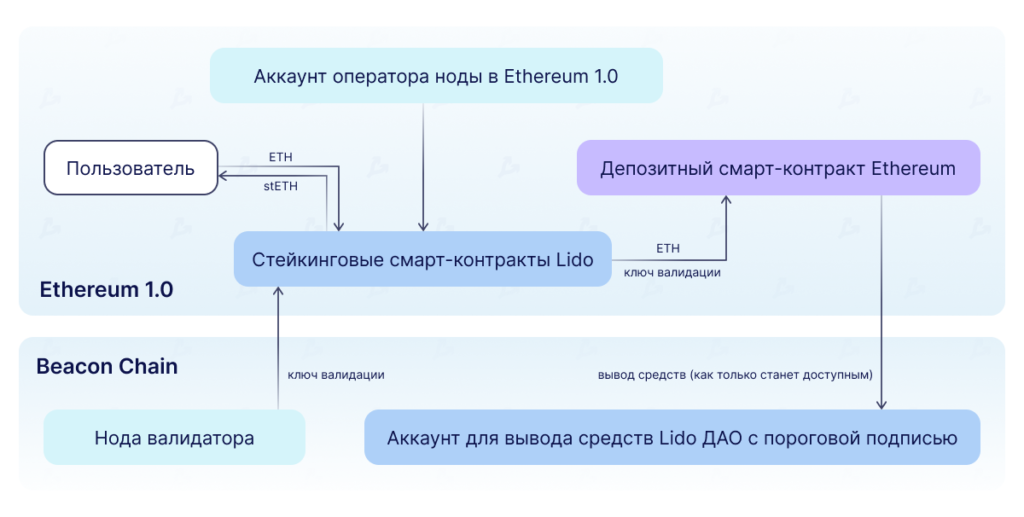
Users deposit funds by sending ETH to the relevant address. Smart contracts mint and burn stETH. They delegate funds to nodes running on the Beacon Chain. Coins are sent to active validators in 32 ETH tranches.
The DAO adds and removes validator addresses from the list. A smart contract that contains their details is used to coordinate node operations.
Validators must generate keys on the Beacon Chain and pass them to Lido. They must also create a dedicated smart contract to receive staking funds.
Once withdrawals become available, assets will be sent to users’ addresses on Ethereum 1.0 or 2.0. In the latter case, Lido uses an account controlled via a threshold signature. The DAO decides how withdrawals are routed.
The oracle tracks validator balances on the Beacon Chain. Interactions on Ethereum 1.0 are implemented via smart contracts, as shown below.
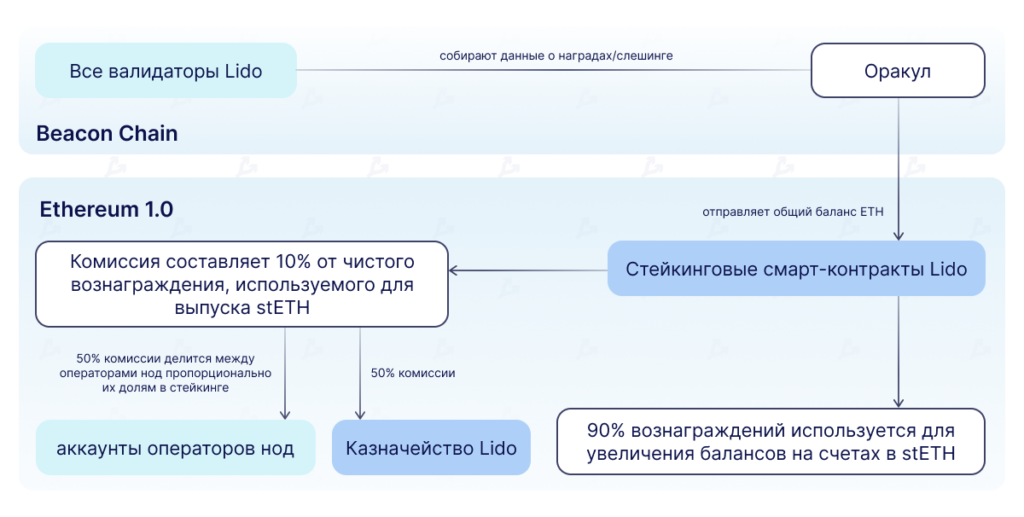
Balances increase as rewards are paid and decrease when penalties are applied. The oracle collects data daily, enabling users’ balances to be updated every day. After validators receive rewards, additional stETH is minted.
Coins are distributed among all participants, with users receiving 90% of income. The remainder is split equally between the Lido treasury and node operators. Thanks to smart contracts, the staking service does not require trust between parties.
How does Lido’s tokenomics work?
The staking service uses LDO, stETH, and “derivative” tokens on other blockchain platforms such as Polkadot (stDOT) and Solana (stSOL).
stETH (Lido Staked ETH) is an ERC-20 token on Ethereum. The current supply reflects the value of assets owned by holders. New tokens are issued after ETH is deposited and when validators earn rewards.
LDO (Lido DAO Token) is an ERC-20 token for governing Lido. The maximum supply is 1bn. The staking service’s founders received 64% of that amount. Early participants received an airdrop of 0.4% of the maximum supply.
At the time of writing, more than 290m LDO are in circulation. The founders’ tokens are locked for one year. Over the following year the coins vest to their owners. Accordingly, all tokens are unlocked over two years.
Who governs Lido?
Lido is governed by a DAO, allowing parameters of the staking service to be adjusted flexibly. The organisation sets fees and approves updates and improvements. The voting mechanism itself can also be changed. In polls, users employ LDO tokens; voting power is proportional to the number of coins held.
Autonomous governance helps avoid failures typical of centralised organisations and reduces risks for users. The DAO can develop the project using funds from the treasury, which held 35% of the maximum LDO supply.
Service users or other parties can submit proposals on the use of tokens. The DAO may conduct additional issuance to raise funds or for marketing purposes.
Who holds Lido’s assets?
To stake ETH, one must specify an Ethereum 2.0 address used for withdrawals. For the service to work correctly, a private key is required for account access. Its storage and use must be controlled by the DAO.
To address this, Lido uses a threshold signature. The latter is split into 11 shares, each belonging to a particular party. Access to funds requires the consent of six or more participants.
This solution removes the need to trust a single person or company, though a majority of address holders must be trusted. The threshold signature is a temporary measure, driven by the specifics of Ethereum 2.0.
Among the address holders are many well-known figures and organisations. Signatories included: Chorus One, Staking Facilities, Certus One, Argent, Banteg of yEarn Finance, Alex Svanevik of Nansen, Anton Bukov of 1inch, Mikhail Egorov of Curve, Rune Christensen of MakerDAO, Will Harborne of DeversiFi and Mustafa Al-Bassam of LazyLedger.
The threshold-signature key ceremony took place between 13 and 16 December 2020, after which the account holders ensured secure data storage. Once technically possible, Lido intends to abandon this arrangement.
Which cryptocurrencies does Lido support?
As of June 2022, in addition to Ethereum the protocol supports liquid staking for several other coins:
- Solana (SOL);
- Kusama (KSM);
- Polygon (MATIC);
- Polkadot (DOT).
Until May 2022, Lido also allowed issuance of derivative tokens collateralised by Terra (LUNA), but the project removed this asset from the supported list after its swift collapse. Subsequently, the Lido DAO voted against integrating the Terra 2.0 network into the protocol.
How is Lido evolving?
Lido remains one of the most popular solutions for staking ETH, and by total value locked the protocol ranks among the top five.
The staking service began collaborating with Chainlink. Developers added a price feed for the stETH token. The tool will enable the coin’s use in DeFi protocols. According to the developers, the price feed can be used in Aave, Compound and Enzyme.
Lido’s developers contribute to Ethereum. In April 2022 the project allocated $6m to develop the ecosystem and implemented distributed validator technology for Ethereum 2.0.
Analysts at Goldman Sachs concluded that the Terra collapse caused “contagion” in the stETH token and heightened systemic risks to Ethereum, since Lido accounts for roughly a third of all ETH locked in the staking contract.