



On 12 June the Moscow Exchange and the National Clearing Centre (NCC) were added to the sanctions list of OFAC. The next day the venue halted trading in the dollar and the euro.
ForkLog examined how the sanctions have affected Russia’s crypto P2P market and why digital assets have become more attractive to local investors.
What are the consequences of the sanctions?
The restrictions have effectively isolated the Russian market from the Western currency system. The central bank began calculating quotes using various banking statistics and over-the-counter indicators.


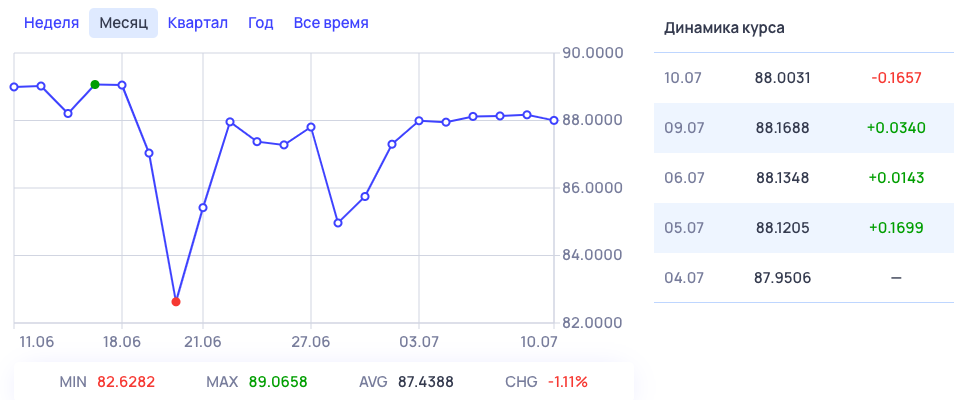
Since the sanctions were introduced the rouble has been highly volatile. From 18 to 20 June the dollar rate dropped sharply from 89 to 82 roubles. It now stands at about 88 roubles (per the central bank rate).
Meanwhile commercial banks also began setting their own quotes, often with wider spreads. According to MyFin, on 10 July Alfa-Bank bought dollars at 84 roubles and sold at 92, Sber at 83/90, and T-Bank at 85.3/88.8 roubles.
Alongside the restrictions, banks ran into problems with FX swaps in dollars and euros. This had been the main hedging tool for financial institutions.
A significant volume of such deals was done on MOEX—4.5 trillion roubles in dollars and 2.67 trillion roubles in euros over the one and a half months before trading was halted.
After the sanctions were imposed it became impossible to settle trades in foreign currency, so the NCC recast them in roubles (likely at the central-bank rate). This created a mismatch between banks’ FX assets and liabilities.
“Sanctions have practically had no effect on the economy and currency operations in the Russian Federation, since the dollar was almost completely excluded from circulation [in the country] anyway. Trading simply stopped, which means there is no regulated currency market. But in fact it remained, because buying and selling the dollar persisted, including via USDT from Tether. The market simply moved to a different state,” said Dmitry Machikhin, founder and CEO of the BitOK service, in a comment to ForkLog.
How is P2P adapting?
Sergei Mendeleev, CEO of Indefibank, agreed that sanctions have had little impact on Russia’s economy. In the short term, he said, the currency restrictions created only “temporary inconveniences”.
“As for the cryptocurrency market, it turned out to be the most prepared for the situation. In the first couple of days all traders were fixing on Garantex and ABCEX, since these were the only platforms with open data where the real exchange market rate was displayed,” the speaker noted.
After the sanctions, USDT quotes on the P2P market diverged markedly from the central bank’s figures. At times the spread was about 7 roubles.
At the time of writing the stablecoin from Tether on the Bybit and OKX exchanges is bought on average at 91.5 roubles versus the official rate of 87.9 roubles.
The situation was noted by entrepreneur and Satoshkin founder Dmitry Stepanin; he did not, however, see a serious threat to the crypto market.
“Sanctions against MOEX almost did not affect the P2P segment. In the first days spreads widened, but soon returned to usual values. The P2P rate has always differed somewhat from the official one, because P2P is a market of the rouble to USDT, not to the dollar, and it is served mainly by retail and fiat,” the expert said.
Stepanin added that the P2P rate is determined by real supply and demand for USDT, so he considers these quotes “much more adequate than the values set by officials from the central bank”.
According to Mendeleev, various mechanisms for forming the exchange rate exist now, but there is no single consensus yet. He clarified that P2P market participants set their own quotes, and as soon as a spread appears it is “immediately arbitraged by flows of cryptocurrency or fiat”.
“It turns out the market regulated itself,” Machikhin stressed.
Are sanctions a spur to regulation?
Stepanin believes the restrictions are already significantly speeding up lawmaking on cryptocurrencies and will likely continue to do so. The sanctions have also forced many citizens to get to grips with digital assets and start using them, especially for cross-border transactions.
“Mass adoption of cryptocurrencies is coming from where it was not expected,” noted the founder of the Satoshkin project.
Some Russian officials have already called for faster regulation of the cryptocurrency market. The Bank of Russia’s deputy chairman Alexey Guznov said the authorities intend to allow the use of stablecoins for international settlements.
Andrei Lisitsyn, director for financial policy and financial markets at the РСПП, proposed creating a crypto fund for cross-border operations under sanctions. Settlements with counterparties, he said, would be effected by a claim right to digital assets via the issuance of ЦФА.
At the end of June the Bank of Russia’s first deputy chairman Vladimir Chistyukhin called for all possible measures to solve the problem of international transfers.
“We must do everything so that the wheels keep turning. What seemed to us yesterday’s day, unpopular—well, I don’t know, swaps, some clearing systems, the use of crypto—everything must be tested, everything must be tried and as quickly as possible. If there are no normal settlements for products in foreign economic activity, for our export- and import-dependent country that is simply it, that is doom,” he said.
What has changed?
Dmitry Machikhin took the opposite view on how currency blockades affect lawmaking. In his opinion, the new restrictions will not speed up crypto regulation, since previous sanctions packages failed to provoke changes.
Even so, he noted a higher level of acceptance of digital assets among citizens. This is reflected in the growing popularity of stablecoins for paying for various services, transferring money abroad and other settlements.
“Entry into the market has become easier; there are many platforms that work with the rouble. I think the trend of growth [in the adoption of digital assets] will continue, whether regulation comes or not. The only problem is that there is not enough infrastructure yet. Not everyone knows how to work properly with KYT, KYC and AML. There is a lot of dirt in the market, and because of this blocks occur from time to time. But the segment is growing,” stressed the CEO of BitOK.
Mendeleev argues that “neither sanctions nor anything else, except direct intervention by the president,” can speed up regulation. In his opinion, the current situation “suits everyone one way or another”.
“The central bank forbids us to use cryptocurrency, we supposedly do not use it. Meanwhile the turnover of the crypto market in the Russian Federation has long been measured in billions of dollars a day without taking into account futures trading on foreign exchanges. […] In the end they draw some ЦФА in a vacuum and allow ВЭД to be conducted with their help, provoking only laughter from professional participants in the real market,” noted CEO Sergei Mendeleev.
He added that various “tapalki” influence cryptocurrency adoption far more than sanctions and stablecoins. Experienced players have long used the potential of crypto payments in their work, while the central bank has been writing “some unfathomable regulation on working with digital assets” for a third year, the expert concluded.
Conclusion
Sanctions have undoubtedly sped up the uptake of cryptocurrencies among Russians, but this is not yet mass adoption. The market remains in a grey zone, and trading in digital assets is not codified in law. The authorities are in no hurry to regulate the sector, and that trend looks set to persist for the foreseeable future.