


What is pump-and-dump?

1
What is pump-and-dump?
Pump-and-dump is a manipulative scheme that drives up a cryptocurrency’s price before a sharp collapse. Large holders artificially “pump” the price so they can later “dump” at the highest possible levels to small traders. The result is a falling price and losses for investors.
The scheme long predates cryptocurrencies, having emerged in the securities market. The first documented case was the British South Sea Company affair in the early 18th century, which inflated its share price with false promises of profit and led to the South Sea Bubble.
Later, pump-and-dump was widely used in America’s market for “junk” or “penny” stocks during the Great Depression of the late 1920s and early 1930s. Brokers sold cheap shares to one another to create the appearance of demand and rising prices, then dumped them on the public market. Such practices were later outlawed in the United States. On the stock market, the heyday of pump-and-dump peaked in the early 2000s.
In almost unchanged form, pump-and-dump migrated to crypto, helped by a lack of regulation. There are now around two thousand “junk” cryptocurrencies. Messaging apps and social networks offer vast audiences, making the scheme highly popular in crypto.
Over crypto’s short history there have been tens of thousands of pumps. By the estimates of researchers at Imperial College London, at least two such scams are carried out daily, yielding organisers average monthly profits of about $7m.
2
How does pump-and-dump work?
After choosing an exchange and a coin, organisers quietly buy up tokens in small tranches to avoid triggering an early price move. These are usually obscure, low-cap cryptocurrencies—so‑called “shitcoins”. Sometimes relatively large coins are used too.
Once accumulation is done, the pump begins. Messaging apps, news feeds, social networks and exchange chats tout an imminent price surge and name the trading venue. There, the organisers’ bots place and pull large buy orders to lift quotes. This is the first wave of the pump.
Most big bitcoin exchanges restrict such activity and their listed coins rarely suit the scheme. But some popular venues list more than two hundred coins—and those attract fraudsters first.
False talking points about partnerships, investments or technological upgrades are used to stoke buyers. Paid “experts” join the disinformation push. “Sensational” tidbits spread mainly via Telegram channels, many of which openly advertise a pump and promise profits.
Investors then assume that, armed with advance notice, they can profit. In reality they are already victims; some even pay for subscriptions to such pump channels.
If the promotion succeeds, a second wave follows as outside investors pile in and propel the price further. Amid the frenzy, organisers sell at inflated levels, after which the price typically returns to where it started.
3
What types of pump-and-dump are there?
Crypto pumps are classed as short-term or long-term.
- A short-term pump lasts a few hours or even minutes and targets little-known, low-cap coins. Prices rocket, hold for seconds, then collapse just as fast. Organisers’ costs are relatively modest—on average, pumping takes about 50–60 BTC.
- A long-term pump targets top‑20 cryptocurrencies. It typically lasts several days, with multiple stages of rises and pullbacks. Such operations require substantial capital and are run by large players or trader communities.
4
What are the hallmarks of pump-and-dump?
- A sudden pick‑up in trading activity (large buy and sell orders) and rising prices without positive news;
- No comparable price move on other exchanges where the coin trades;
- Heavy promotion in exchange chats, forums, social networks and/or Telegram channels.
5
Can you make money from a pump-and-dump?
Profiting from a short-term pump is virtually impossible: organisers capture the gains and ordinary traders cannot react in time. There is little point subscribing to Telegram pump channels with audiences of several thousand.
Profiting from a long-term pump is theoretically possible, but even then a trader has only minutes to place an order. The odds of losing are about the same as the odds of winning.
Most pumps share one predictable feature: after the first collapse there is often a brief rebound as retail investors join the fray. After selling at a loss during the crash, a trader can buy near the bottom and sell into the second bounce.
Do not buy during that second upswing—it is a near‑certain loss. Secondary peaks are typical only for fairly large coins with market capitalisation of at least $1m.
6
Examples of pump-and-dump
ParallelCoin
On the night of November 5, 2019, the price of ParallelCoin jumped in a matter of hours from $1.60 to more than $2,200, prompting talk of a “new bitcoin”. Within hours it fell back to around $2.
Ladies & gentlemen.. we have the new Bitcoin 😂
But, seriously. Does anybody know what ParallelCoin is?$DUO pic.twitter.com/AX1Owa41hw
— Crypto Godfather 教父 (@CryptoGodfatha) November 5, 2019
LINK
LINK’s rally was preceded by Twitter posts about partnerships. On June 13, 2019, Chainlink announced a partnership with Google Cloud, which confirmed the news. The LINK price rose from $1.19 to $1.93.
On June 26, Chainlink said LINK had been listed on Coinbase; the price climbed to $2.24. On June 28, a pump began: several addresses bought large amounts of LINK on Binance and routed them through a series of front addresses. By June 29, LINK hit $4.45. Commentators argued that Binance’s daily trading volumes for Chainlink in late June were artificially inflated. With a market capitalisation of just $1.4bn, reported volume reached $863m. The price chart looked unnatural, some said, especially as one of the green candles showed volumes on the sell side. There was a chance unknown parties sought to trigger FOMO but failed to achieve their goal.
On July 2, the dump phase started: the addresses that had bought began offloading, again funnelling coins through chains of front addresses. From July 2 to July 15, one address alone sold 4.2m LINK. On the first day of the dump, July 2, the price dropped to $3.73.
On July 6, the project’s Twitter page posted a hiring notice that, in the view of some commentators, signalled a dump. A chart then circulated on social media showing presumed sales of 700,000 LINK on each bounce after the late‑June peak. After passing through short address chains, these tokens were sold on Binance. Some believed the hiring message was merely an attempt to conceal large‑scale liquidations.
By July 15, LINK was down to $2.79 and the slide continued. As of September 16, it traded at $1.61—almost back to mid‑June levels.
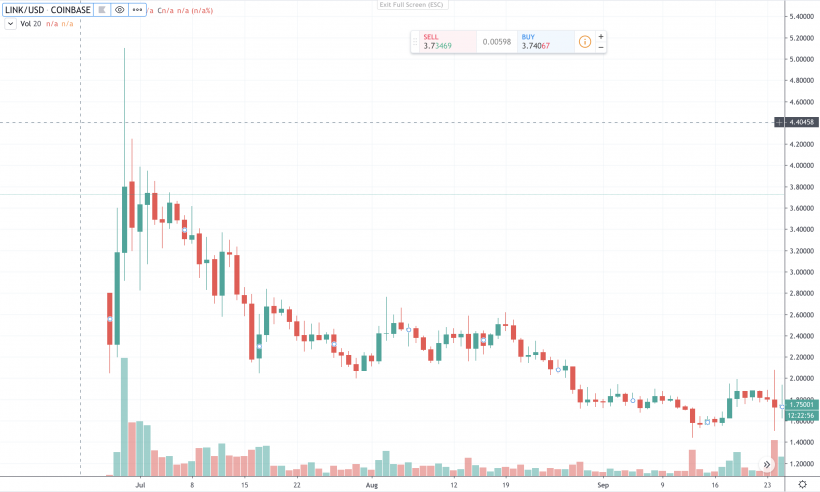
TradingView data
E-Coin
On February 6, 2018, the little‑known E-Coin (ECN) jumped from $6 to $290 within hours—up 4,700%. Its market capitalisation hit $1.5bn and the token entered CoinMarketCap’s top 20. Within a day the price fell sixfold, to $45.
Another surge took ECN to $228 (up 400%). A subsequent dump drove it down to $5. Over the next day the price again leapt from $5 to $65 (up 1,200%). At the time, the project did not even have a working website.
Subscribe to Forklog on YouTube!
Рассылки ForkLog: держите руку на пульсе биткоин-индустрии!