


What is the blockchain trilemma?
What is the blockchain trilemma?
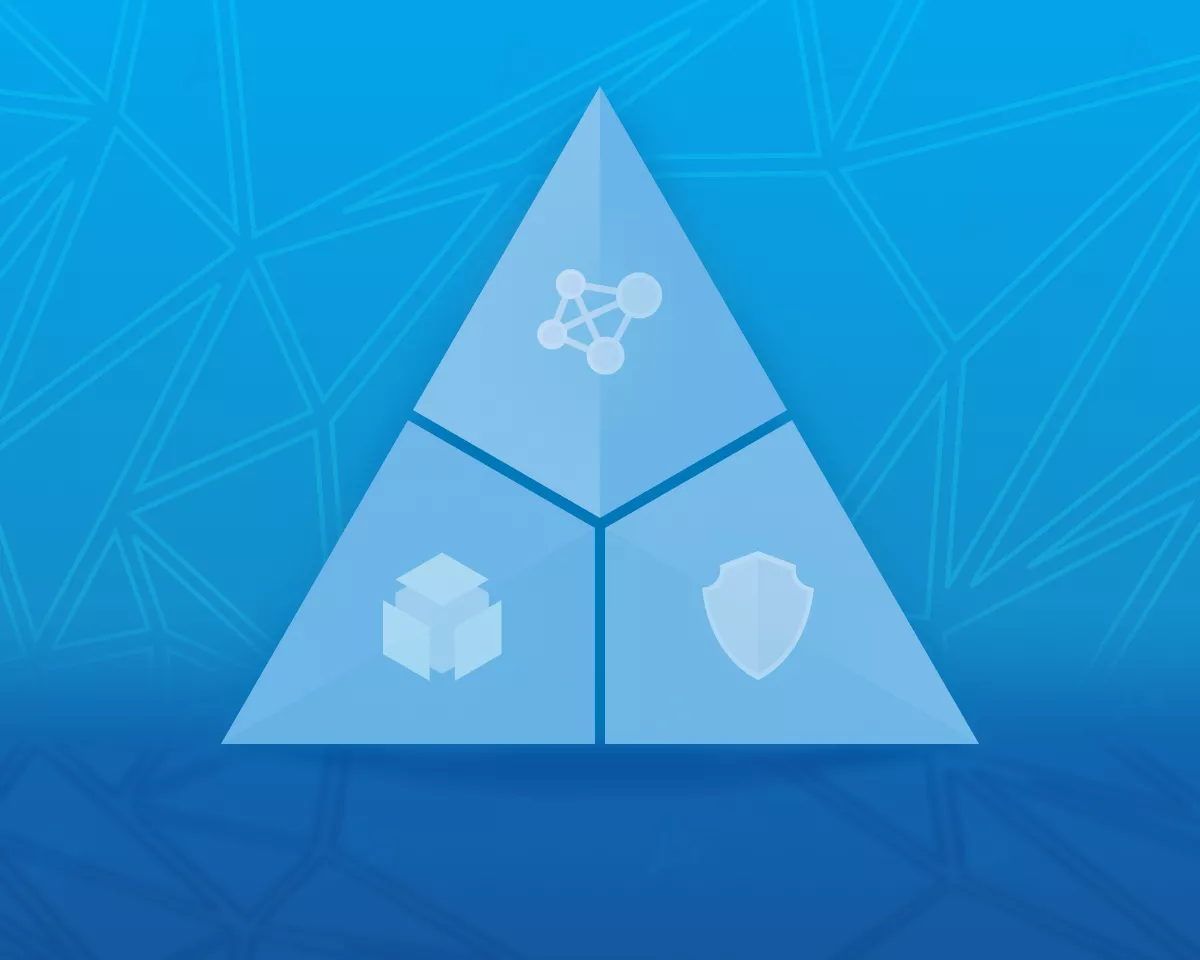
The blockchain trilemma, or scalability trilemma, is a theorem that frames the central problem of scaling any distributed network. It holds that of the three core attributes—decentralisation, security and performance—a blockchain can achieve only two.
How did the blockchain trilemma arise?
Back in the 1990s, the scientist Eric Brewer developed the so‑called CAP theorem. According to it, a decentralised database (which includes blockchains) can have only two of three core properties—consistency (Consistency), availability (Availability) and partition tolerance (Partition).
Thus the theorem poses a dilemma: designers of a decentralised database must sacrifice one of the three properties to attain an adequate level of the other two. That threatens the long‑term expansion of the database.
The theory was later adapted to blockchains. The creator of Ethereum, Vitalik Buterin, popularised the “blockchain trilemma”. His project was the first full‑fledged platform for decentralised applications. As such apps envisage unbounded user growth, Ethereum’s throughput must increase without forfeiting other vital characteristics of a blockchain.
After Ethereum, many other projects offered their takes on the trilemma: EOS, Solana, Cosmos, Polkadot, Near, Avalanche, Terra, Everscale, Algorand and others. There is, however, no consensus approach yet.
What does the blockchain trilemma entail?
Any blockchain has three principal properties:
Scalability. The network can increase throughput, that is, process a growing number of transactions per unit of time.
Decentralisation. The network operates without validation by one or several trusted parties. Put simply, there should be no reliance on a node or group of nodes that cannot be joined using an ordinary computer.
Security. A blockchain can withstand a potential attack by a significant portion of nodes (ideally 50% of all nodes in the network, though anything above 25% is a good level).

There are three sets of examples that illustrate the rule in different ways:
- Traditional blockchains: Bitcoin, Ethereum or Litecoin. Each participant runs a full node that verifies every transaction. Such networks are highly secure and decentralised, but have low throughput.
- High‑speed blockchains, including networks that use Delegated Proof‑of‑Stake. They rely on a small set of nodes (10–100). Each typically faces high requirements—expensive server hardware or a large stake in native tokens. These networks are performant and secure, but insufficiently decentralised.
- Multichain systems, in which applications tie into different blockchains that interact via cross‑chain communication protocols. This is an example of a decentralised and scalable set‑up, but not a secure one. To attack, it may be enough to capture a majority of nodes in just one blockchain in the system, to “break” the usual structure and trigger adverse effects for all other participants.
How can the blockchain trilemma be addressed?
Two avenues for avoiding the forced trade‑off are typically cited.
Layer‑two solutions
These are add‑ons built “on top of” decentralised networks, extending beyond on‑chain activity. One example is Lightning Network—a micropayments network for Bitcoin.
Routine transfers on Bitcoin can be costly and slow, making small transactions uneconomic. Lightning Network was devised for small P2P payments and commerce. Users open channels; transfers between such channels are cheap and complete in seconds. Verification occurs first at the application level rather than on the blockchain. Layer‑two is viewed as a halfway house and does not fully meet blockchain’s aims.
Layer‑one solutions
These are much harder to design and implement, but they have greater potential and modify the blockchain’s architecture itself.
Developers of various networks propose their own ways to address the “blockchain trilemma”—using several interoperable blockchains, sharding, new cryptographic methods, and so on. Yet this does not mean the theorem’s proponents are necessarily right or that the “blockchain trilemma” must be solved at all. In the end, it is an abstract construct, not a physical law.
Further reading
What is a cryptocurrency airdrop?
What is a DAO (decentralised autonomous organisation)?
Рассылки ForkLog: держите руку на пульсе биткоин-индустрии!