


What is Validium, and how does it help scale Ethereum?

What is Validium?
Validium is a type of scaling solution that processes data off-chain while using on-chain validity proofs. This “lightly centralised” approach boosts throughput and efficiency in blockchain systems.
“Although off-chain data availability entails trade-offs, it can significantly improve scalability (such solutions can process ~9,000 or more transactions per second),” the article on Ethereum.org says.
Like ZK-rollups, Validiums publish zero-knowledge proofs to verify off-chain transactions. This prevents invalid state transitions and strengthens the chain’s security guarantees.
“Correctness proofs” can take the form of ZK-SNARKs or ZK-STARKs. Users’ funds are controlled by a smart contract on Ethereum.
As with ZK-rollups, Validium enables near-instant withdrawals.
How does Validium work?
Users submit their transactions to a node responsible for execution in the Validium chain. An operator batches them and checks their correctness.
The Validium state is stored as a tree whose root is recorded on the Ethereum blockchain. The operator updates the root after executing transactions and submits the new state for verification.
To move funds into Validium, users deposit into a dedicated contract. To return assets to Ethereum, network participants send requests to operators, who verify and approve them. Validity proofs are then submitted for verification, after which the Validium state on the blockchain is updated.
Validium data are stored off-chain, reducing load on Ethereum and lowering fees. However, this creates a risk of data unavailability if operators behave dishonestly.

Some projects appoint trusted groups (DAC) that keep copies of information. Staking can be used to incentivise honest behaviour, with funds confiscated if participants cannot prove data availability.
This setup lets anyone who posts collateral store information off-chain. It reduces centralisation and improves security by using economic incentives to deter fraud.
How does Validium interact with Ethereum?
Validiums are scaling protocols built on top of the existing Ethereum network. Although transactions are executed off the main chain, Validium is governed by a set of smart contracts deployed on mainnet.
Core components:
- verifier contract — checks the validity of proofs provided by the operator when updating state. This includes proofs attesting to the correctness of off-chain transactions and to data availability, confirming the presence of transaction data off-chain;
- main contract — stores state commitments (Merkle roots) provided by block producers and updates the Validium state after on-chain confirmation of a validity proof. This contract also handles deposits and withdrawals.
Validiums also rely on the Ethereum mainnet for the following:
Settlement
Transactions executed on Validium cannot be finalised until the parent chain verifies their validity. All operations ultimately settle on the main chain.
The Ethereum blockchain also provides “settlement guarantees” for users, meaning off-chain transactions cannot be reversed or altered once they are posted to the base chain.
Security
As the settlement layer, Ethereum also guarantees the correctness of state transitions on Validium. Off-chain transactions executed on the Validium chain are verified via a smart contract on the base layer.
If the on-chain verifier contract deems a proof invalid, the transactions are rejected. This means operators must satisfy Ethereum’s validity conditions before updating the Validium state.
Where is Validium used?
Like ZK-rollups, Validium is mostly suited to simpler use cases such as token swaps and payments. The approach can also be applied in gaming and NFTs.
Performance is optimised because there is no need to store the full data set on Ethereum. This enables fast processing of many transactions at minimal cost.
Using Validium for complex smart-contract operations is challenging and requires substantial computational power. That significantly limits the range of potential use cases.
Some projects try to work around this by compiling EVM-compatible languages such as Solidity and Vyper into a special bytecode optimised for efficient proof generation. However, this approach has limitations: such a language may not support all features of the standard Ethereum programming environment.
According to ZKsync developers, Validiums are well suited to enterprise applications that require a balance between verifiability and privacy. In particular:
- companies can manage the availability of their data, “ensuring compliance with internal audits and regulatory requirements”;
- by controlling access to transactional information, firms can protect sensitive data from unauthorised access.
Validiums are also effective for privacy-oriented platforms:
- users can transact on a public blockchain without disclosing sensitive data;
- companies and individuals can maintain a higher level of security and control over the details of their transactions.
Validium implementations:
- StarkEx by StarkWare — an L2 solution based on validity proofs. It can operate in ZK-rollup or data-availability modes;
- zkPorter by Matter Labs — a layer-two solution that uses a hybrid approach (rollups and sharding).
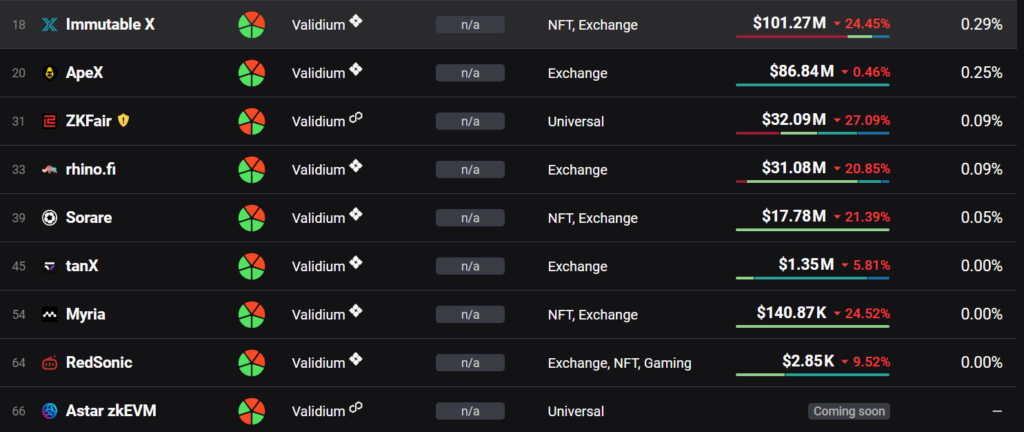
What are Validium’s advantages and drawbacks?
Using Validium offers several benefits that make these solutions attractive for certain blockchain applications:
- lower gas costs: by avoiding publication of all data on Ethereum’s layer one, Validiums deliver lower transaction fees;
- enhanced privacy: off-chain processing offers extended privacy features, making Validiums suitable for applications requiring a high level of data confidentiality;
- fast withdrawals: rapid verification of validity proofs on Ethereum enables near-instant withdrawals, improving user experience.
Despite these advantages, Validiums also have drawbacks:
- data-availability risks: custodians responsible for data storage could behave abusively, potentially preventing users from accessing their funds;
- reliance on trust and incentives: unlike ZK-rollups, Validiums’ security model partly depends on the reliability and economic incentives of data custodians, not solely on cryptographic proofs.
Accordingly, despite the innovation, users should carefully assess the risks when using Validiums, especially for long-term storage of large sums.
Рассылки ForkLog: держите руку на пульсе биткоин-индустрии!