




For all of BestChange’s 18-year history, the creator of the crypto-exchanger monitor stayed out of the limelight. This is the first public interview with Denis Malkov.
In a conversation with ForkLog, the developer spoke about a cyberattack on his first exchange and competition with other aggregators. We asked which coins are most popular with BestChange users, whether the service shares information with authorities, and how it operates under Russia’s ban on crypto advertising.
The making of BestChange
ForkLog (FL): Why give a public interview now?
D.M.: I never hid my identity, but saw no point in publicly proclaiming that I created BestChange. Over the years the project’s reputation has become more valuable than my own.
I did consider the risks of too much publicity, but from the site’s launch there was always information about me to be found. Deliberately hiding would have been pointless.
I am now speaking openly about my role for the first time, not to seek popularity but to answer questions from those who genuinely care.
Besides, the project is entering a phase of active development: the brand’s social channels already show a new design that will migrate to the site this year, along with long-awaited elements that will greatly improve quality and usability, and strengthen the international version.
FL: Tell us about yourself. How long have you been in crypto? What did you do before BestChange?
D.M.: I was born in Kazakhstan, lived in Russia and am now based in the UAE, where our head office is. I’ve been into development since school: I wrote simple programs in Delphi and built sites in PHP. In my third year at university, I created the first version of BestChange in a couple of weeks—this was 2007. No one had heard of cryptocurrencies then, and I had no idea how important and prominent my exchange aggregator would become a few years later.


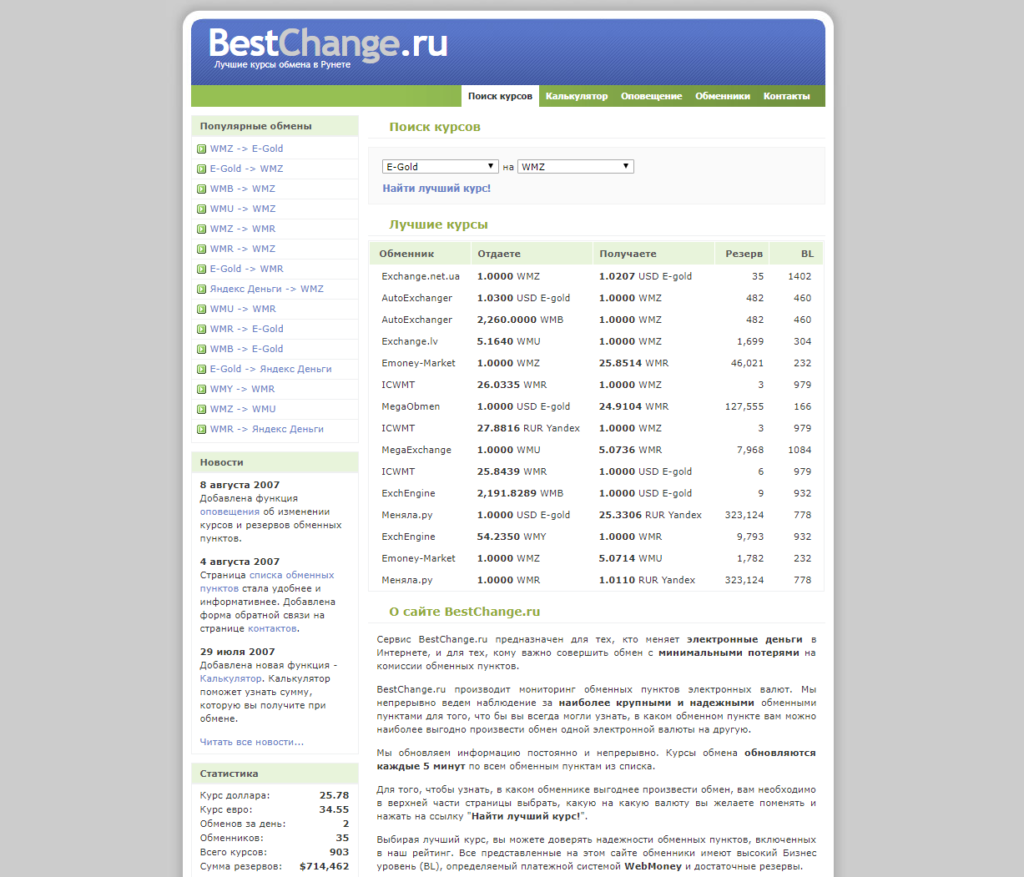
I’ve always been interested in electronic money, though I discovered bitcoin much later. Initially the site tracked exchange rates for electronic payment systems such as WebMoney and E-gold. I added cryptocurrency to BestChange only in 2012, when the first exchangers working with bitcoin appeared.
Development was gradual; for the first years most income was reinvested in promotion. Everything changed in 2016–2017 with the first serious crypto boom—people were searching en masse for where to buy bitcoin. As one of the few trusted services, BestChange found itself at the epicentre.
FL: When and how did the idea for an exchange aggregator emerge?
D.M.: Back in my student days I got interested in electronic currencies when I stumbled on online exchange points. There were few of them, and the commission looked attractive enough to try it myself. My first experience was as an administrator of an exchange, so I understand from the inside how it should work.
But I can’t say the experience was successful. Due to a technical vulnerability in the engine, one day attackers managed to rob a number of exchanges, including mine.
At the same time I noticed aggregator sites growing fast; their business model reduced risk and expanded the audience without large staffing costs. That is how the monitor appeared—modelled on the well-known services of the time. Many competitors later shut down, and BestChange became the oldest still in operation.
Gradually I stepped back from programming and focused on managing the team. We now have professional development, marketing, moderation and integration departments.
FL: How does the service make money?
D.M.: On user traffic: people look for the best rates and honest reviews of exchangers, and we earn a small commission on deals they complete on exchange sites.
FL: In which country is the legal entity registered?
D.M.: Our headquarters is in the UAE, but the original office in Russia also continues to operate. We distribute resources between countries—it is easier to work with counterparties and regulators under different laws. We do maintain two independent teams: the Russian office serves clients in Russia and the near abroad, and we created a separate unit for the international market, which is now our head office.
We can register in other jurisdictions if needed for the project’s well-being, but we do not particularly need additional offices; our staff work from anywhere in the world.
Millions choose USDT
FL: Share user statistics for BestChange?
D.M.: At the moment about 1.1m people use our site every month, 15% more than last year’s average.
FL: Which assets are most popular with users from Russia?
D.M.: Country breakdown is hard because many use VPNs. But if we take global statistics across the Russian-language segment, three assets have long topped demand: USDT, bitcoin and the Russian rouble.
Audience favourites are Tether on Tron and Sber. But even for these two, the share of interest in a given pair does not exceed 5% of all exchanges across the 40,000 trading pairs the monitor tracks. Popularity is therefore very relative; demand is spread roughly evenly across a hundred assets.
FL: How many exchangers are currently listed on your platform?
D.M.: It’s a dynamic figure. In the Russian-language segment 548 exchangers are listed, of which just under 500 are active. For the English-language segment there are 404, around 380 of them active. Many overlap—the two versions together have 571 unique active services.
Listing on BestChange matters to exchangers, so they keep applying, though we do not add everyone. We vet each service carefully to reduce risks for users.
FL: How does an exchanger get into your aggregator? What are grounds for removal?
D.M.: See the details on our site, and if questions remain, write to the integration team via the contact form.
Grounds for removal include any suspicious activity that poses risks to users, or systematic rudeness and a cavalier attitude to obligations.
Business in Russian realities
FL: What do you attribute heightened attention from Roskomnadzor to?
D.M.: It’s an observer’s illusion—blocks of our site actually happen less often than law enforcement request through the courts. In a sense Roskomnadzor is just an executor; it does not initiate blocks, so it’s inaccurate to speak of special interest in us.
Law enforcers at various levels often do not want to spend time studying each site they seek to block, so mistakes happen. As for why they happen, our site ranks at the top of search results for many crypto-related queries.
FL: Does your service fall under the definition of a crypto platform?
D.M.: We are a simple information resource—we do not advertise exchange services or promote cryptocurrencies on our site. We merely perform a function akin to Yandex, which also collects information about other resources that may work with crypto, while we do not touch crypto ourselves.
How courts and regulators will interpret a rather framework law is hard to predict.
FL: How do you assess current regulation of crypto platforms in Russia?
D.M.: Unfortunately, it is far from perfect—it looks as if the regulator is trying to ban everything it has not yet taken the time to understand.
Although there are still no rules for operators of digital-currency exchanges, no relevant OKVED codes, there is also no ban on circulation, which is good.
Our team is always open to dialogue with lawmakers and would be glad to help make the market convenient and regulated.
FL: What about crypto advertising in Russia? Has it become harder for BestChange to promote its services?
D.M.: In short, it is effectively banned, so we removed any mention of the brand in connection with cryptocurrencies from our ad campaigns. It has become harder, but only bureaucratically—our marketers now have to double-check what and where they publish to avoid breaching prohibitions.
We have strong brand recognition and a base from SEO that help us maintain a leading position.
FL: How do you assess the state of the crypto market in Russia? Have sanctions affected the use of digital assets?
D.M.: Sanctions did not go unnoticed. Because direct money transfers between countries became problematic and paying abroad in the usual ways was impossible, demand for exchange services rose, although the industry itself has not changed much in recent years.
We see overall growth in interest and literacy among users, but no conceptual changes either before or after sanctions.
FL: In your view, will the central bank chief’s proposal to allow crypto deals only for highly qualified investors affect trading activity?
D.M.: Cryptocurrencies for investment will remain accessible, since over-the-counter trading exists even under regulatory bans. At worst, such operations become riskier and more expensive. We hope it does not come to that, and lawmakers do not ban buying crypto outside the country.
The latest central-bank proposals concern buying crypto via official brokers, so this is less a restriction for others than an additional opportunity for large investors. I do not think the initiative will hurt exchangers.
Tighter controls and new features
FL: In 2022 media reported an increase in blocks of transactions conducted by services listed on BestChange. After that the aggregator’s team said it planned to “change the logic of operations in light of new risks”. What steps did you take?
D.M.: To clarify: expanding AML checks is neither our initiative nor the exchangers’ need; these are rules imposed by regulators via the market’s largest players. Specifically, BestChange has:
- raised user awareness: all exchangers have added brief AML requirements to their sites and a mandatory user-consent checkbox when creating an order;
- improved oversight and deepened our own expertise: our monitoring specialists scrutinise every AML case and, where there are no grounds to freeze funds pending KYC, seek alternative ways to resolve disputes;
- tightened control over exchanger reputations to ensure the cleanliness of assets they send to clients. In particular, we introduced a rule requiring compliance with FATF standards;
- prepared an AML tool for rollout that will allow users to run their own checks before sending funds.
FL: Did services listed on BestChange face problems after the Garantex asset freeze?
D.M.: Minor issues arose for some users in the Russian segment a few years ago, when analytics services marked exchange wallets as sanctioned.
Since then people have avoided the exchange even via intermediaries, so by the time of the actual freeze I don’t think any exchangers were working with such a “toxic” source of funds.
FL: How are relations between the aggregator and listed exchangers structured legally? What is BestChange responsible for to users?
D.M.: As for legal liability for transactions conducted on third-party sites, for obvious reasons it does not exist. We do not touch clients’ money, just like familiar aggregators such as Aviasales or Booking. Essentially we are a catalogue of links to other sites, with no legal ties to them.
Another matter is that over the years we have assumed a kind of moral responsibility to users. We are constantly enlarging the moderation team to support users in disputes and to monitor exchanger integrity. It is simple human decency, and that is what people value.
FL: Are there any restrictions on using BestChange for citizens of certain countries? Any limits on deposit/withdrawal methods?
D.M.: No—we are a maximally apolitical information service. We share the view of many global experts that access to information should be available to everyone, everywhere.
In 2022 a small share of exchangers listed with us began refusing service to citizens of certain countries. We offered a compromise: exclude directions with specific national currencies from monitoring. That resolved the issue.
Today any client who needs national currencies works only with services ready to provide them, regardless of the user’s citizenship.
FL: Is it possible to make a fully anonymous transaction via exchangers listed on BestChange?
D.M.: Briefly, yes. But we do not encourage such practices, so we do not highlight these services. Nevertheless, a few listed services still allow fully anonymous work, even without registration or a temporary email.
Most exchangers have long followed the global trend towards de-anonymising risky crypto operations.
After the EU’s Fifth Directive, the vast majority of large custodial services began implementing the Travel Rule and AML checks for all transfers, requesting additional information from counterparties; in some cases exchangers pass these requirements on to users.
FL: Does BestChange cooperate with law enforcement or regulators in any countries? Have you received such requests over the life of the aggregator?
D.M.: We do not store personal data, and all visit information is registered not on the server but on the user’s browser side. In specific cases, when we receive official requests from state bodies, we can share small fragments of data, such as a log journal.
Under the laws of the jurisdictions where the project operates, we can transmit any data only within the country. As an information intermediary, we are responsible for ensuring the confidentiality and protection of transmitted data. Therefore, for law enforcement from other states we must propose sending official requests to the authorities in the UAE, or using Interpol’s legal instruments. From 2025 the agency introduced a Silver Notice, used to track and return illicit funds, including those related to virtual currencies.
Such requests are rare—once every few months, for example when a victim mentions our service among the sites visited before transferring cryptocurrency to fraudsters.
FL: BestChange recently refreshed its branding. What other updates are planned this year?
D.M.: We have updated the visual concept in social media. The actual site rebrand will follow soon. It’s hard to promise dates, but I really hope the updated design will delight users by year-end.
In addition, we plan to launch several convenient ways to interact with the monitor. I’ll only hint that it will relate to the predominant platform people use to visit our site. Follow our official announcements.
Interview by Lena Jess.