




At the end of 2022, the chatbot ChatGPT appeared, becoming the fastest-growing service in history. Just two months after launch, the number of users of the hype-driven AI tool reached 100 million.
The buzz around neural-network-based web applications could not fail to leave its mark on the crypto industry — a multitude of tokens linked to artificial intelligence began to appear (at least, according to developers).
- In early 2023, prices of most AI tokens posted impressive gains. In January–February, the ‘x’s delivered even for long-forgotten, low-cap coins that had appeared on the market years earlier.
- Many experts link the hype in the new crypto segment to the excitement around tools such as ChatGPT and DALL-E 2.
- Some well-known figures in the community doubt the prospects for blockchain integration with AI, viewing the trendy coins as ‘meme tokens’.
Chronicles of the AI-token hype
Interest in artificial intelligence has grown substantially in recent years. Many view AI-based solutions as disruptive, capable of fundamentally changing many industries, including the crypto industry.
Enthusiasts see the technology as a key component of the next-generation ecosystem. It is therefore not surprising that many digital-finance projects position themselves as closely linked to AI.
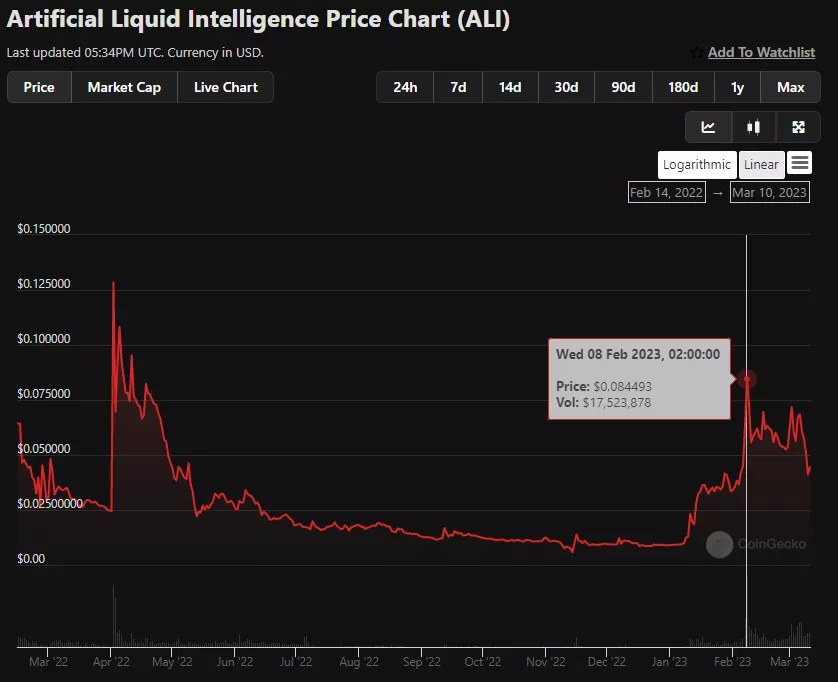
Such tokens surged in early 2023. For example, on January 8, the crypto asset Artificial Liquid Intelligence (ALI) traded around $0.009955. A month later, on February 8, the token traded at $0.084 — a rise of about 744%.


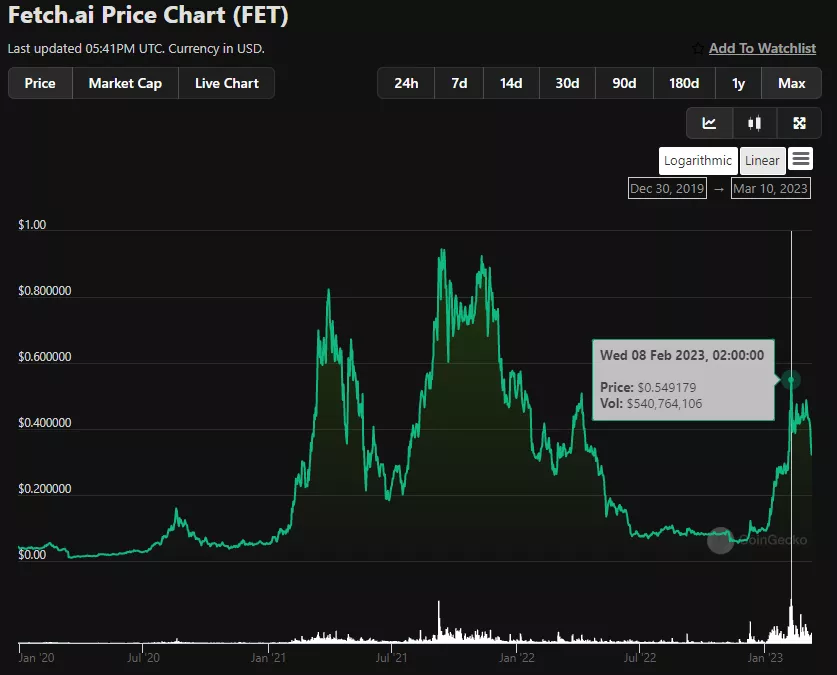
Ahead of the ChatGPT launch in November 2022, the Fetch.ai (FET) asset price stood at about $0.06. On February 8, 2023, the token reached a local high of $0.549, promising almost tenfold returns on timely invested capital.

In early March, amid Bitcoin trading below $20,000 , the hype around AI tokens cooled. Nevertheless, the aggregate market capitalization of segment assets at the time of writing exceeds $1.4 billion, according to data from CoinGecko and CryptoRank.


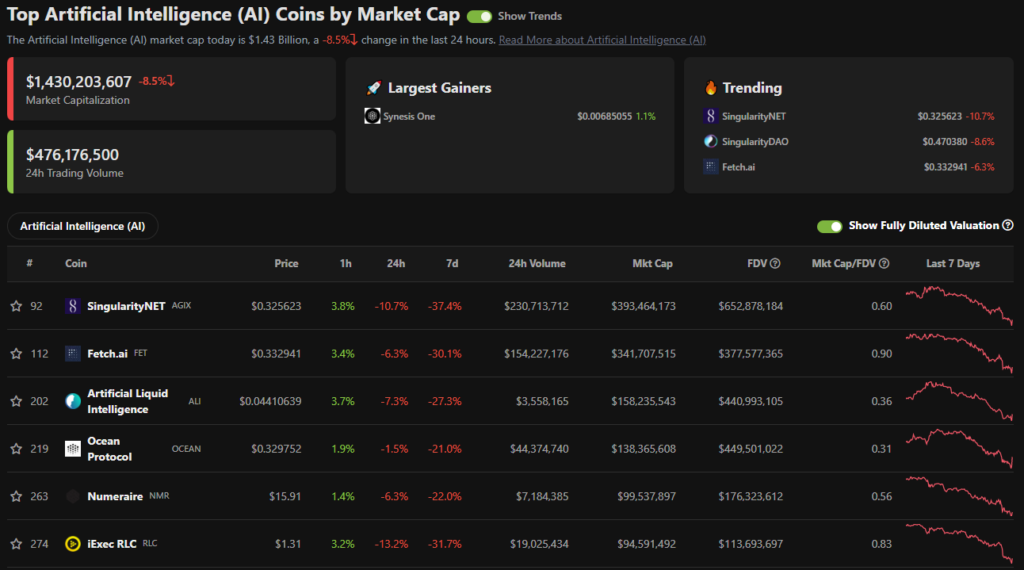
The rankings of the aforementioned analytics services are led by SingularityNET (AGIX). The total market value of the platform’s coins on the market is approaching $400 million (as of 10.03.2023).
“SingularityNET is a leading decentralised AI marketplace operating on the blockchain,” the site says.
The platform enables developers to publish, exchange, and monetise their algorithms. The objective is to create an open, transparent AI market accessible to all.
The British blockchain startup Fetch.ai is developing technology for Autonomous Economic Agents (Autonomous Economic Agent, AEA).
AEA are autonomous systems based on machine-learning algorithms, acting on behalf of their owners in various economic activities. For example, agents can seek favourable deals on the cryptocurrency market, buy tickets to concerts, or book hotel rooms.
The product lineup includes: the decentralized exchange Mettalex, the social network Resonate, the MOBIX micro-mobility ecosystem, and the Fetch Wallet.
The crypto-asset FET is used to pay for services and resources on the Fetch.AI network.
Artificial Liquid Intelligence (ALI) — a utility token of the AI Protocol and the decentralized applications built on its basis. The ecosystem is supported by the AI research studio Alethea AI, which in 2021 raised $16 million to “build scalable infrastructure for an AI-based NFT market.”
“Alethea AI has managed to create AI-based avatars with NFT protection. It is a whole platform for interactive entertainment,” commented Mark Cuban, who participated in the token sale.
Outlook for AI tokens and market participants’ views
In the early months of 2023, the hype was so strong that many community members saw in the new segment a powerful driver for another rally in the crypto market.
In addition to the aforementioned blue chips, prices of even long-forgotten tokens from earlier years revived significantly, such as Big Data Protocol (BDP) and Measurable Data (MDT). Both projects specialise in data monetisation and secure data exchange.
“There is, indeed, some hype around AI’s intrusion into the crypto space. We are seeing innovative and compelling use cases,” expressed optimism by Frontier founder Ravindra Kumar.
Dragonfly partner Hasib Kureishi is also full of hope. He is convinced that artificial intelligence and cryptocurrencies will become more closely interconnected over time, and that it is time to “fasten the seatbelt.”
AI and crypto will be intertwined in a way that will become more clear over the next decade.
For now, buckle in.
The future is going to get weird.
— Haseeb >|< (@hosseeb) January 9, 2023
Yet not all in the crypto community are enthused by the new trend — many remain skeptical of most AI tokens.
“I’m sure the current trend remains quite speculative. It has driven price surges in tokens like OCEAN, ALI, AGIX,” noted Aditya Handuri, head of marketing at Biconomy.
According to him, some such crypto assets “lack real technology,” and the segment itself faces many unresolved issues.
“Suppose an AI tool attracts 250 million users. Then what will its infrastructure look like? How will people use it? How will training [data interpretation] occur? Where can the token be used?,” Handuri asks.
Many are wary of what is happening.
“As the market begins to pick up, new trends appear out of nowhere. And not all of them are as convincing as one would hope,” said economist Valentina Drofa in an interview with CoinDesk.
In her view, there is a risk that the trend may turn out to be “false hype” — many speculators will use trendy coins for short-term schemes like pump-and-dump.
“The entire industry will face long-term consequences, taking another hit to its image. Such cycles become quite tiresome and sad; they are observed again and again,” Drofa predicted.
Skepticism toward the trend is also voiced by Andre Cronje, co-founder of the Fantom Foundation. He believes AI and blockchain cannot complement each other.
Please stop asking Fantom about AI.
AI and Blockchains don’t mix.
— Andre Cronje (@AndreCronjeTech) February 8, 2023
The host of the Bankless podcast, David Hoffman, shares a similar view.
Let’s make something clear
There is no material integration between AI and Crypto.
You cannot put AI ‘into a blockchain’.
AI tokens are meme tokens.
— DavidHoffman.bedrock ????_? (@TrustlessState) February 8, 2023
“There is no material integration between artificial intelligence and cryptocurrencies. You cannot put AI ‘into a blockchain’. AI tokens are meme tokens,” emphasised him.
Former Securitize Capital CEO Wilfred Day linked the current hype around new coins directly to the ChatGPT frenzy in a Bloomberg article: linked.
“This phenomenon could continue as long as similar sentiments persist,” he noted.
Founder of the CryptoSavingExpert project under the nickname That Martini Guy believes that most AI-related projects in the crypto industry are “useless junk.”
“Speculators will leave when the hype subsides and prices fall. If you’ve made money, lock in profits,” he wrote.
A regulatory uncertainty around the cryptocurrency market could pose a substantial obstacle to the new trend’s development. Additionally, some AI projects may prove too complex for many participants.
Recently, the US Federal Trade Commission urged entrepreneurs to keep AI claims under control.
According to the agency, product descriptions often use the phrase “AI-based” and variants thereof without justification.
“One thing is certain: this is a marketing term. […] Some advertisers will not be able to resist overusing and abusing them,” the commission said.
The agency warned that such statements may be considered “false or unfounded.”
Conclusions
Within a short span, the capitalization of the AI-token segment breached the $1 billion mark, a notable milestone. Riding the hype, even long-forgotten coins rose from the ashes.
The new segment is highly sensitive to the broader market — price corrections of fashionable tokens are clearly visible as Bitcoin hovers around the key level of $20,000, and due to ongoing concerns about the USDC stablecoin following the closure of Silicon Valley Bank.
There are many potential use cases for blockchain and AI. For example: secure and private token exchange between various “smart” devices, monetising algorithms, generating images for NFTs, or crafting trading strategies on non-custodial platforms.
Yet investors should remain prudent, recognising that many AI tokens lack fundamental value, are propped up by marketing, and do not bring significant innovations to the industry.