




Decentralised finance on bitcoin (BTCFi) no longer looks like an enthusiasts’ fantasy — it is a fast-developing, promising segment.
Over the past year the segment’s TVL has surged by roughly 2,400%, from $0.3bn to a peak of $7.47bn (December 2024), putting the nascent ecosystem in the top five on DeFi Llama rankings.
BTCFi signals a shift in how “digital gold” is used. If bitcoin was once chiefly a savings vehicle, it is now edging into DeFi proper with use cases from staking and crypto lending to yield farming. Today BTCFi may be one of crypto’s most underrated niches, given bitcoin’s trillion‑dollar market capitalisation, vast stores of “sleeping” liquidity and an as‑yet untapped L2 potential.
A real “Ethereum killer”?
In this cycle bitcoin’s dominance index has been climbing steadily: capital is flowing into the first cryptocurrency faster than into the rest of the market combined.


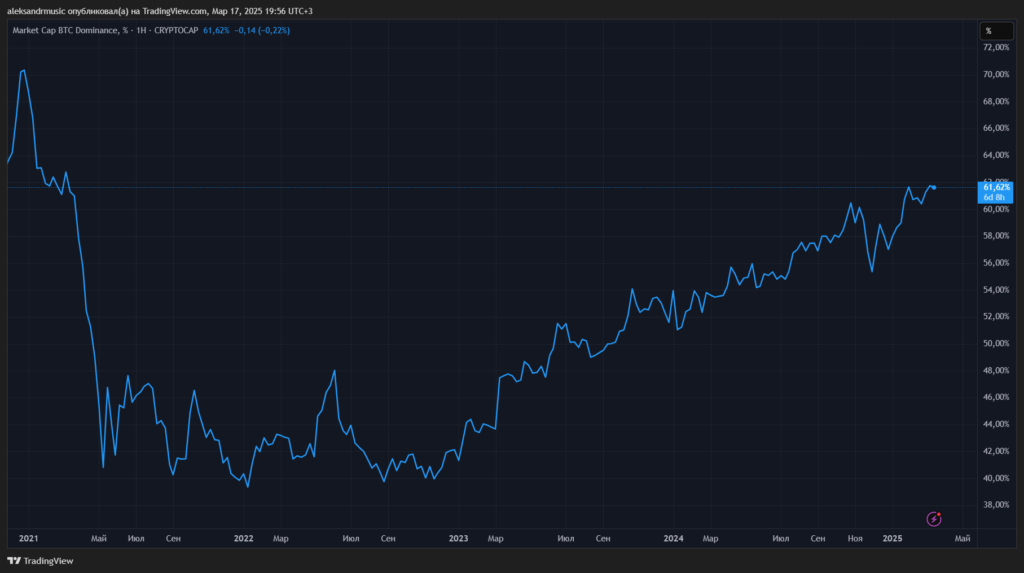
This reflects active accumulation by hodlers and retail investors, tighter integration of the first cryptocurrency with TradFi, and a Lindy effect at work.
A successful debut of spot bitcoin ETFs in the United States has given asset-management giants such as BlackRock direct access to digital gold; companies and even states increasingly see crypto as a dependable financial reserve.
“As the amount of BTC across different market segments grows, the desire to make these assets more productive will only intensify — similar to how traditional financial instruments like Treasuries and gold are used in financial markets,” said analysts at Binance Research.
They reckon regulatory change could speed the trend. As a positive example, the experts cited the repeal of SAB 121 in the United States, which had effectively barred banks from holding digital assets.
Simpler paperwork and further build‑out of financial plumbing could unlock more of bitcoin’s potential — from everyday payments to use as collateral and components of structured products.
How good is HODL, really?
There is a flip side to whale demand, active accumulation and maximalists’ gospel of “HODL forever”: a large share of coins drops out of circulation, ceasing to function as a medium of exchange and earning their owners no yield.
The chart below shows that more than 60% of bitcoins have not left their wallets for over a year — and the share keeps growing. The trend points to more long‑term holders following a passive accumulation strategy.


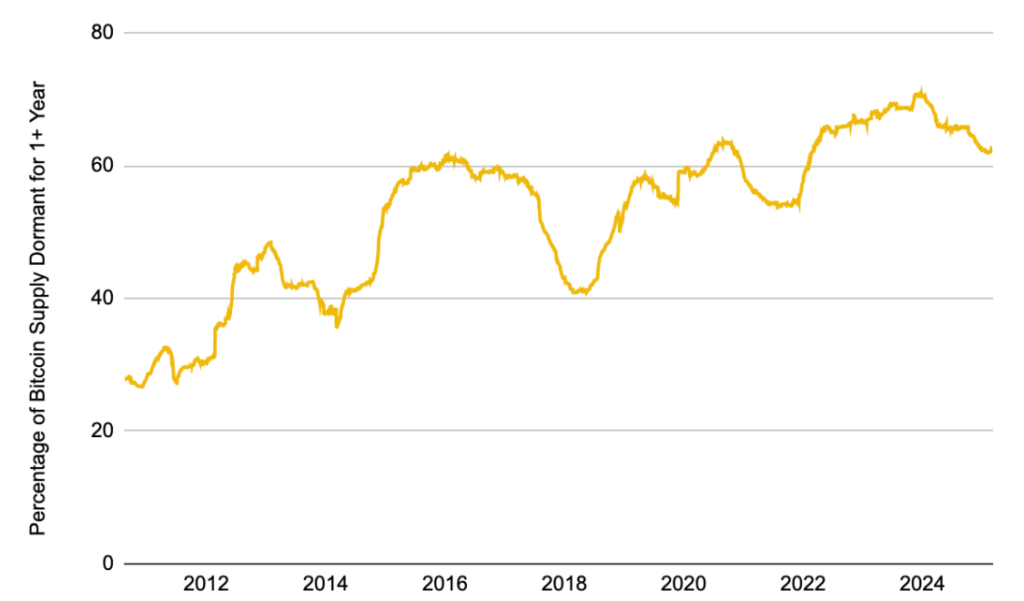
“The rise in idle BTC is primarily because bitcoin has already established itself as a store of value. But it also reflects limited avenues for more productive use of coins,” Binance Research observed.
The experts say the main obstacle to unlocking bitcoin’s potential for years was the “lack of accessible financial instruments”.
“When users lack native ways to earn yield on BTC, they simply have no incentive to put coins into economic circulation,” the specialists noted.
In their view, “unlocking even a small fraction of underused coins” could materially lift bitcoin’s capital efficiency — turning it from a passive store of value into a more active financial instrument and opening new avenues for “value generation”.
BTCFi’s untapped field
Bitcoin’s penetration into DeFi remains low. By Binance Research’s count, only 0.79% of total supply is locked in smart contracts of decentralised applications.
“A significant portion of assets remains under centralised control — via ETFs, sovereign reserves or corporate treasuries,” the researchers stressed.


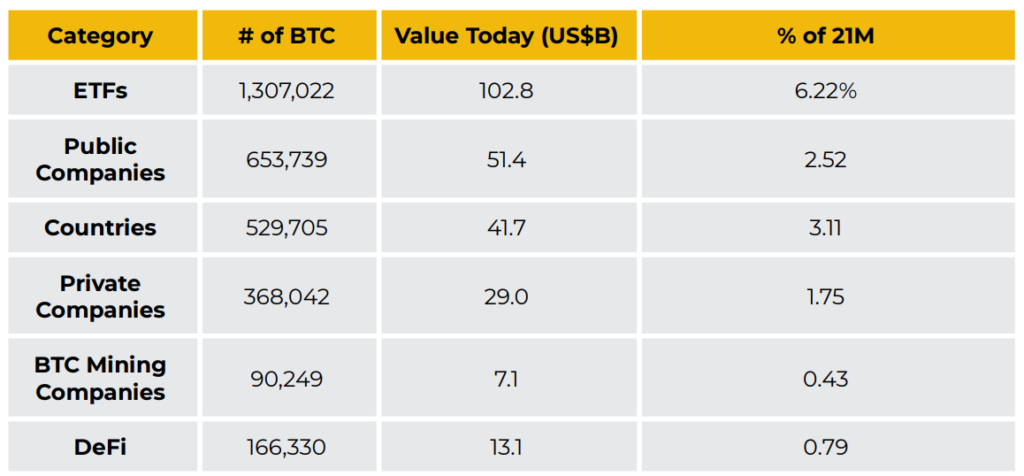
One big reason: bitcoin was not designed for complex financial applications. Unlike platforms such as Ethereum, the first cryptocurrency lacked built‑in programmability.
Hodlers were left with a narrow menu of “advanced” use cases, such as borrowing against digital gold at custodial services or using wrapped tokens on other chains. Each option carries risks, including meagre yields, centralisation and security concerns.
That contrasts with Ethereum, where ETH and ERC‑20 holders can seamlessly and non‑custodially stake, lend, provide liquidity and use a wide range of intricate “financial LEGO” tools.


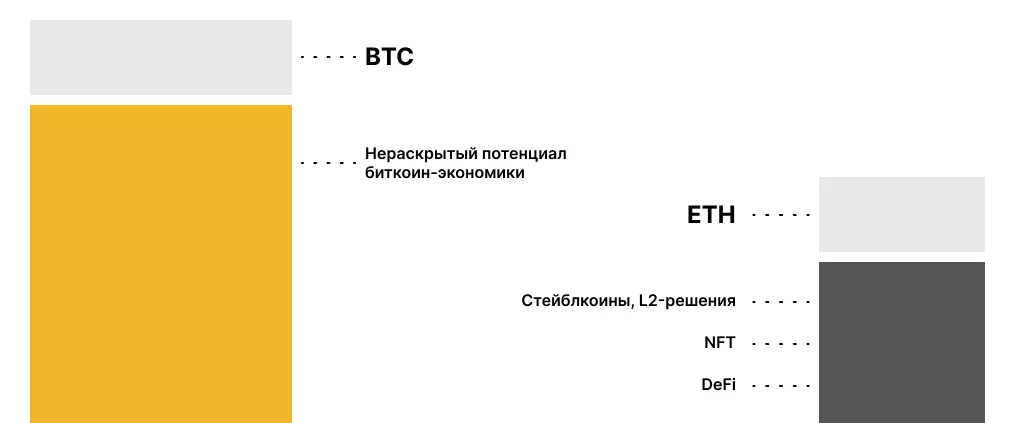
Despite a market value north of $1trn, bitcoin remains among the least active blockchains. The chart below, comparing TVL-to-market‑cap ratios across leading platforms, shows as much.


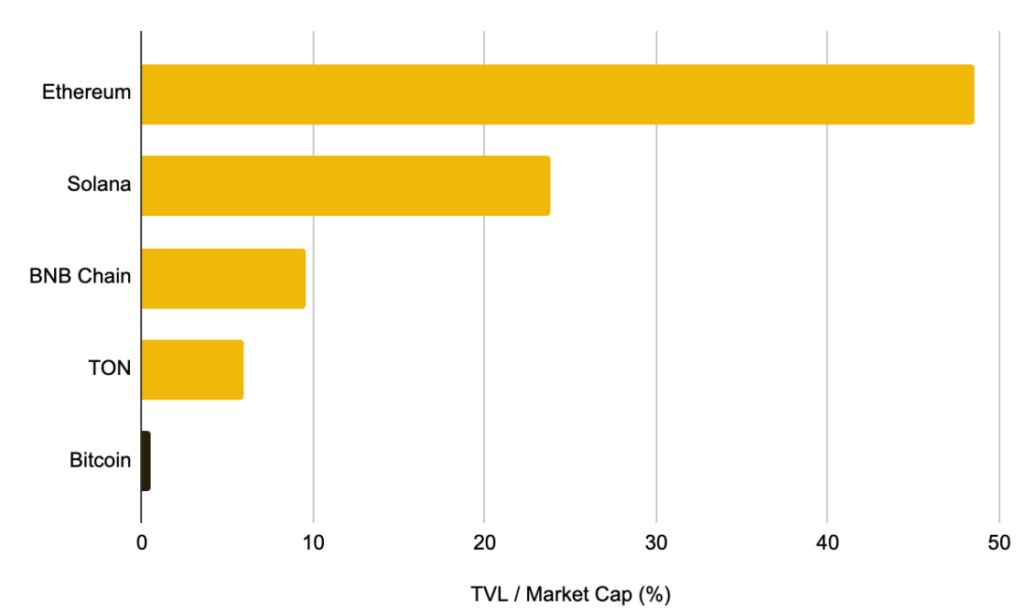
For digital gold the figure is about 0.32% (with TVL of $5.65bn and a market cap of $1.7trn as of March 20). The corresponding value for Ethereum is 48.6%, for Solana 23.8%, BNB Chain 9.5% and TON about 5.9%.
“If just 10% of bitcoin’s market capitalisation were activated, it would add over $150bn to TVL — more than the combined value of the entire DeFi ecosystem across all blockchains today,” the Binance Research team emphasised.
The lay of the land
The BTCFi sector is gathering pace, yet most BTC deployed in DeFi still takes the form of wrapped tokens on other blockchains.
| BTC in DeFi | Number of BTC | TVL |
| Wrapped BTC in DeFi protocols’ smart contracts | 253,234 | $21bn |
| Native BTC in staking protocols | 59,252 | $4.9bn |
| BTC in DeFi via L2 | 44,559 | $3.7bn |
A large share of the first cryptocurrency is used as collateral in lending protocols or for yield farming.
“Yet BTCFi’s native infrastructure is still at an early stage: most activity clusters around staking protocols such as Babylon,” Binance Research noted.
The screenshot below shows the top five bitcoin‑based protocols by TVL, per DeFi Llama. The first four spots are taken by restaking projects led by Babylon.


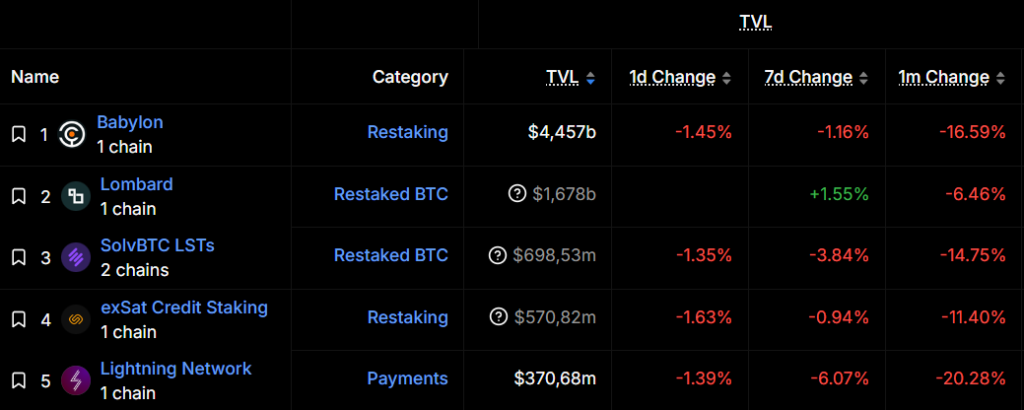
According to Binance Research, user activity in BTCFi closely tracks bitcoin’s market cycles and prevailing conditions.
In strong upswings demand rises for bitcoin‑based financial services — especially lending and staking — as participants seek yield without parting with their coins.
Native bitcoin applications add further momentum: both active BTCFi wallets and on‑chain transaction volumes are increasing.
The researchers stressed that the race to become the dominant execution layer is still on — no L2 platform has yet secured broad backing.
“An analysis of activity distribution across networks shows Core currently leads BTCFi, accounting for 25.2% of all active projects. […] Rootstock and Bitlayer are second and third, with 13% each. They are followed by Merlin Chain with a 9.9% share,” Binance Research said.
Among other notable participants, the experts highlighted:
- BOB (8.4%);
- BSquared (6.9%);
- Stacks (6.1%);
- BEVM (5.3%);
- BounceBit (3.1%);
- MAP Protocol (3.1%).
The last three are gradually gaining ground “thanks to more specialised offerings”.
The infographic below shows the key building blocks of the emerging BTCFi ecosystem, including scaling solutions, wrapped tokens, stablecoins, wallets, staking/restaking services and more.


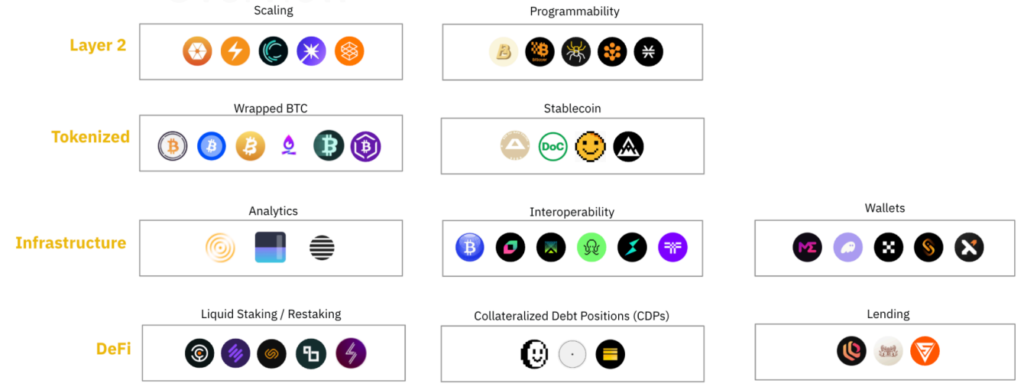
Although WBTC commands 60% of the tokenised‑bitcoin market, custodial and other TradFi‑style risks are fuelling demand for alternatives. Native BTCFi has clear advantages — it relies directly on bitcoin’s security and largely removes custody risk. Much WBTC still sits in lending venues such as Aave and Maker, suggesting DeFi‑inclined hodlers are most interested in lending protocols.
“BTCFi’s ability to compete with wrapped‑BTC markets depends on whether native credit protocols can (1) offer higher yields as demand for borrowed BTC grows and (2) provide sufficient stablecoin liquidity for lending,” Binance Research said.
Investor interest and prospects
Investor appetite for BTCFi is rising, evident in growing fund flows and venture activity.


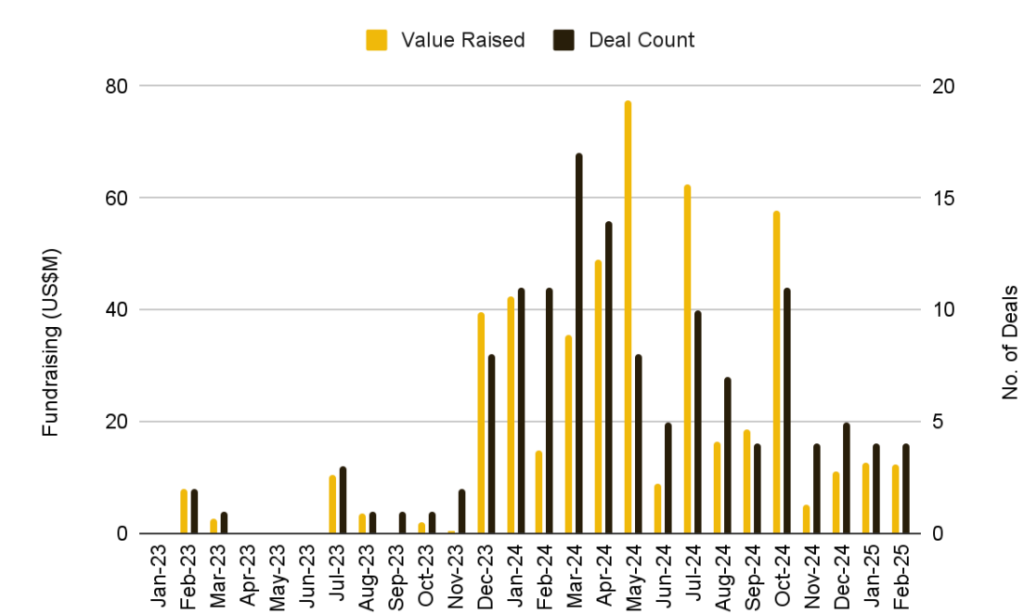
According to Binance Research, demand is being stoked by the expansion of native bitcoin use cases, including Ordinals, BRC‑20, Runes and more.
The ecosystem — from infrastructure and L2 solutions to DeFi projects — is drawing capital. Over the past two years the number of deals has climbed from 19 to 115, with aggregate funding topping $491m. More than 86% of funds have been raised after 2024.
As the ecosystem — and L2 in particular — matures, investor attention is gradually shifting from infrastructure to native bitcoin applications “capable of unlocking on‑chain liquidity and financial activity”.
“Product launches expected in 2025 will likely fuel investor interest — BTCFi continues to cement itself as an integral part of the evolving financial ecosystem around bitcoin,” the Binance Research experts predicted.
In their view, if BTCFi follows the trajectory of wrapped bitcoin such as WBTC, the segment could grow to $31.9bn.


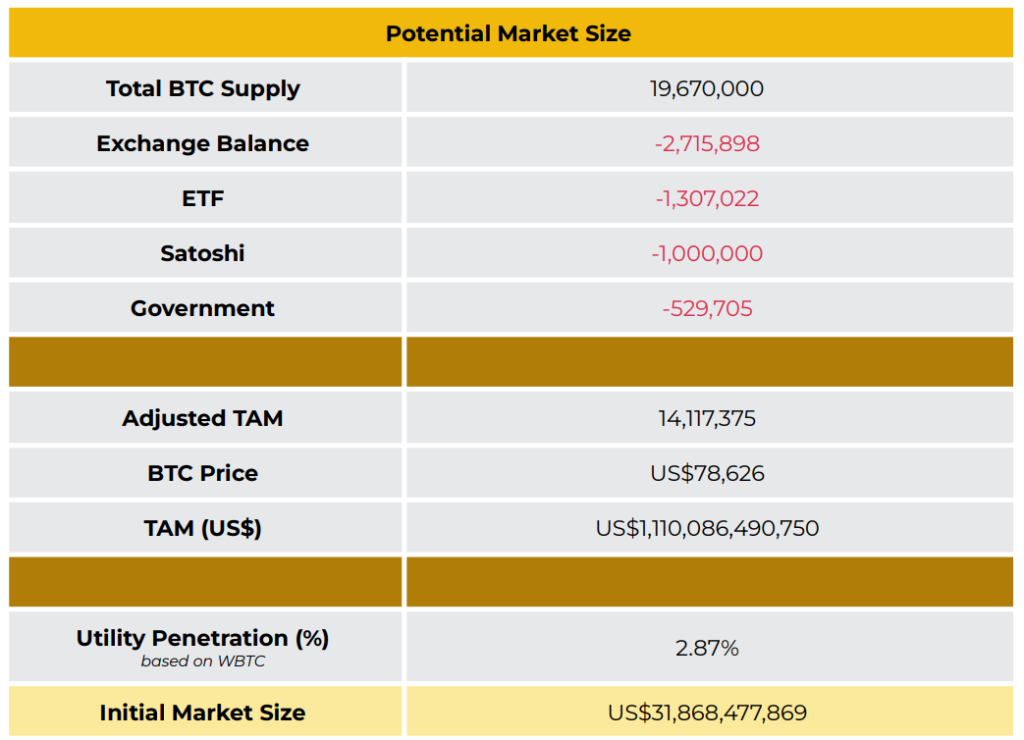
“However, it is worth noting that the total addressable market for BTCFi extends beyond the current WBTC user base. The key difference is that wrapped‑token solutions target a narrower group of bitcoin holders, as many long‑term investors prefer to keep their coins in native form,” the specialists underlined.
“Wrapped” digital gold entails “limited access” and extra security risks, making it less attractive to users — especially those who favour cold storage.
“By contrast, BTCFi is built directly on bitcoin’s own infrastructure, removing such barriers and widening the pool of potential participants,” Binance Research explained.
Caveats
Developing bitcoin L2s is crucial not only for BTCFi — by bringing smart‑contract functionality — but also for improving the network’s programmability and scalability overall.
Bitcoin’s UTXO model is optimised for simple transactions, the researchers note; it “lacks the flexibility needed for complex DeFi operations”.
Unlike Ethereum’s account-based system, bitcoin’s scripting language is not Turing‑complete, limiting its ability to manage complex states handled by smart contracts. A restricted block size and slower block production reduce scalability, raise L2 data‑storage costs and curb throughput versus DeFi‑oriented chains.
“Developers also face infrastructure hurdles, as bitcoin lacks a full toolkit for deploying financial applications, unlike mature development ecosystems such as Ethereum or BNB Chain,” Binance Research noted.
Existing approaches such as statechains or sidechains involve trade‑offs, as they “do not always inherit the strong security model of the first cryptocurrency”. That, in turn, creates extra risks that can erode user trust.
Until bitcoin L2s reach sufficient maturity, such constraints will continue to hold back BTCFi’s growth and usability.
There is hope
Happily, L2 innovation is advancing, working around structural limits while delivering scalability and better smart‑contract capabilities. The emergence of BitVM and other trustless solutions has focused attention on bitcoin’s native programmability.
Different second‑layer designs strike different balances between decentralisation, security and scale, yet all are key to the “next phase of financialisation” of the first cryptocurrency.
BTCFi could raise transaction‑fee revenue, partly offsetting the effect of periodic block‑reward cuts. Progress here would preserve miners’ economic incentives to secure the network.
Conclusions
A stagnant market needs new narratives — as with ICOs, institutionalisation, DeFi and NFTs in past cycles. The industry is waiting for the next spark.
BTCFi is gradually turning bitcoin from a “sleeping” store of value into a core component of decentralised finance, where vast potential lies. Building the infrastructure will lay the groundwork to unlock tens of billions in liquidity.
Bitcoin’s limited programmability and scalability complicate its fit with the “financial LEGO” compared with Ethereum and other popular platforms. Yet innovation is steadily removing those hurdles, bringing safer, more rewarding alternatives to wrapped tokens without sacrificing decentralisation.
The new segment’s success hinges on the maturity of L2 solutions, which will both enhance bitcoin’s functionality and support miners through higher fees.
Clearing technical and regulatory hurdles could turn BTCFi into a powerful driver of genuine mass adoption of digital gold — and a sturdier upswing for the broader market.