


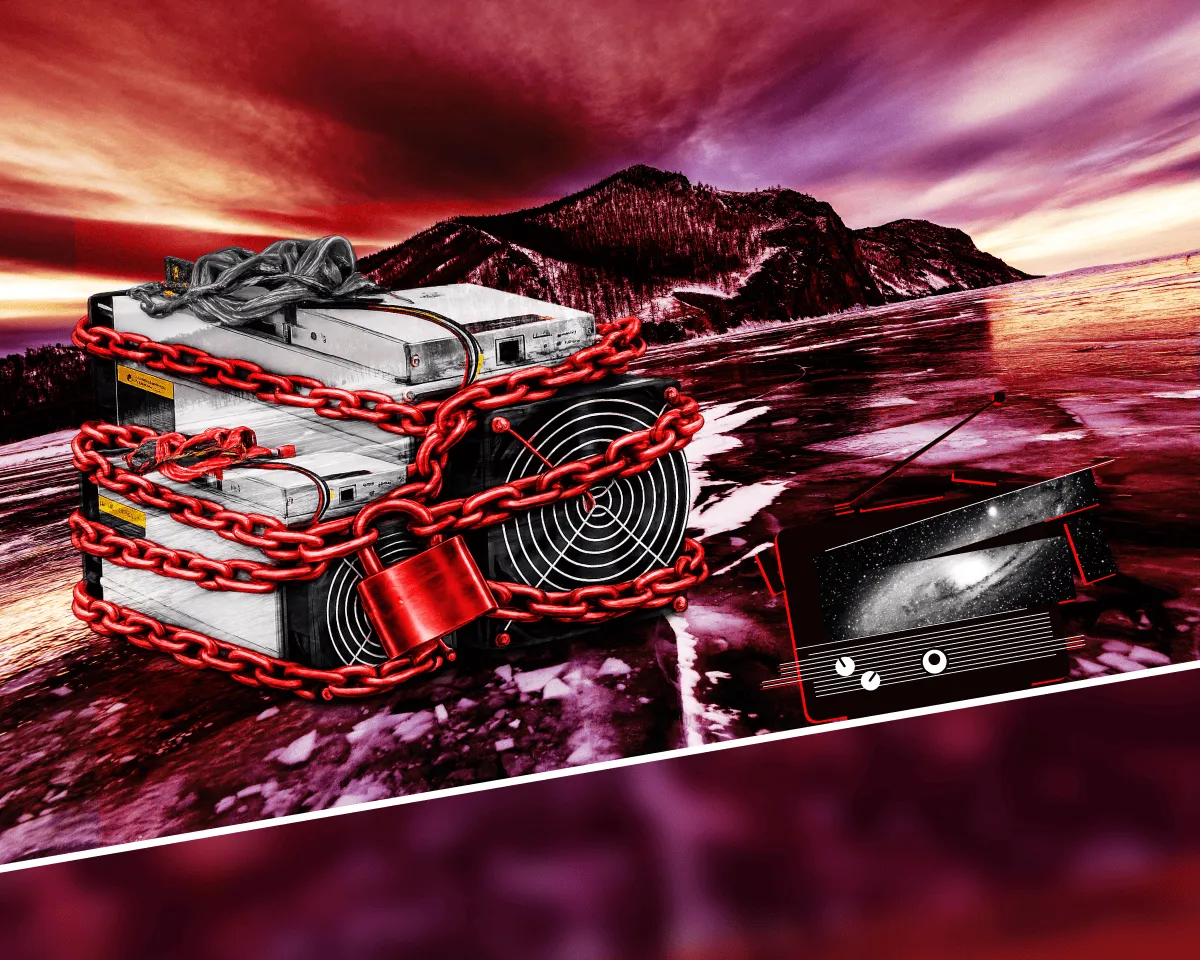
This week in “Deconstruction”: Russia’s mining ban, Google’s quantum calculations, Iranian strikes on Amazon servers, a historic lunar flight and the grim truth about brain–computer interfaces.
A five-year mining ban
Russia’s government has banned cryptocurrency mining in Buryatia and Zabaikalsky for five years — until spring 2031. Officials cite energy shortages and a bid to stop illegal operators burning subsidised electricity by the hundreds of millions of kilowatt-hours.
Matters are compounded by a draft law introducing criminal liability for illegal mining, which could take effect as soon as 1 July. Offenders face fines of up to two million roubles and jail terms of up to five years. Grounds for criminal charges would include major damage to power grids or extracting windfall profits from cryptocurrencies.
The rationale for such severity is dire legalisation statistics: of 50,000 miners, only about 3% have entered the tax register. The industry fears registering equipment imported via “grey” channels, as the amnesty promised by the state has yet to be designed.
Against this backdrop, the recently approved bill to legalise cryptocurrencies is seen by the community more as a punitive tool.
A 10-minute quantum break-in
Google researchers said that breaking Bitcoin and Ethereum with a quantum computer would require fewer than 500,000 qubits, 20 times less than earlier forecasts. At that scale, key recovery would take around ten minutes, neatly within the time to produce a Bitcoin block. Industry experts now put at least a 10% chance on such a machine appearing by 2032, urging a swift change of algorithms.
Ethereum is even more exposed because of its architecture and data-handling. Once a wallet sends a transaction, its public key remains on-chain forever, making it an ideal target. By Google’s calculations, the thousand largest Ethereum wallets, holding millions of dollars, could be cracked in under nine days.
The main advice for Bitcoin holders right now is not to move coins from old wallets unless strictly necessary. The network’s design reveals your vulnerable public key only when you spend; until then only its safe hash is stored. If you simply keep coins at an address without sending, quantum hackers will not reach you.
War hits Amazon
Escalation in the Middle East has morphed into a global economic shock owing to disrupted logistics in the Strait of Hormuz, through which a fifth of the world’s oil flows. Markets are pricing in a real physical shortfall, lifting Brent above $110 and sending war-risk insurance for tankers up by tens of times. A chain reaction follows: costlier petrol in the US, logistics, European gas and all energy‑intensive industries.
More alarming is that the war has spilled beyond oil into the world’s digital infrastructure. A strike on Amazon’s computing centre in Bahrain, a key cloud node for the region, has been recorded. That poses a direct risk of large‑scale outages in banking services, air travel and AI operations.
For the first time in modern history, physical computing has come under attack as foundational infrastructure on a par with factories. Investors are bracing for a protracted spell of expensive energy and high inflation, complicating life for central banks.
A new lunar race begins
NASA has successfully launched the historic Artemis II mission, sending the crewed Orion spacecraft to the Moon. It is the first crewed fly-by of Earth’s satellite this decade, using a safe free‑return trajectory powered by lunar gravity. The main goal is to test life-support systems ahead of a full landing, absent for more than half a century.
The launch has jolted a renewed global race beyond Earth orbit. China, India and the European Space Agency are now rushing to advance their lunar ambitions.
The Moon is seen as a vast industrial site and a staging post for Mars. Beyond mining, proposals include placing gigantic data centres there to exploit space’s cold for natural cooling. That could be a breakthrough for the IT industry, whose servers on Earth are overheating amid the rise of neural networks.
Chips boiled a human brain
The brain–computer interface industry has moved from fiction to a multibillion-dollar technology race. Elon Musk’s Neuralink is only one player, while dozens of companies such as Synchron and Chinese developers are actively dividing up the market. The technology already works in practice: paralysed people control computers by thought, move prostheses and even compose music.
Mass deployment has, however, run into an unexpected biological wall: brain overheating. For fast, powerful interfaces, energy demands are high, and there are no coolers inside a skull. Warming brain tissue by just one degree Celsius locally kills neurons, leaving engineers stumped.
A second, global problem is the near-total loss of privacy, even within one’s own head. Algorithms are learning to decode inner speech and visual imagery, creating the risk of direct mind‑reading. To sidestep the hazards of surgery and implant rejection, researchers are now focusing on advanced non‑invasive headsets and wearables.
This is a shortened version of the podcast. Watch the full video:

Subscribe to the podcast: