




On March 18, shareholders filed a class action lawsuit against the cryptocurrency exchange Gemini. The plaintiffs accuse the platform, its founders Tyler and Cameron Winklevoss, and top executives of misleading investors during and after the IPO.
The complaint states that in November, the platform’s management publicly reported progress in international expansion and plans to enter “key global markets.” The prospectus described the exchange as the company’s main product.
However, the Winklevosses soon reduced the workforce by 25% and announced their withdrawal from the EU, UK, and Australia. Simultaneously, the exchange radically shifted its business model, focusing on prediction markets. In December, Gemini launched the Gemini Predictions platform, receiving approval from the CFTC.
This change in direction was accompanied by an internal crisis: the firm lost its CFO, COO, and chief legal officer. Amidst this, operating expenses rose by approximately 40%, and the stock price plummeted by more than 75% over the past six months.
The plaintiffs claim that these management actions resulted in significant financial losses for them.


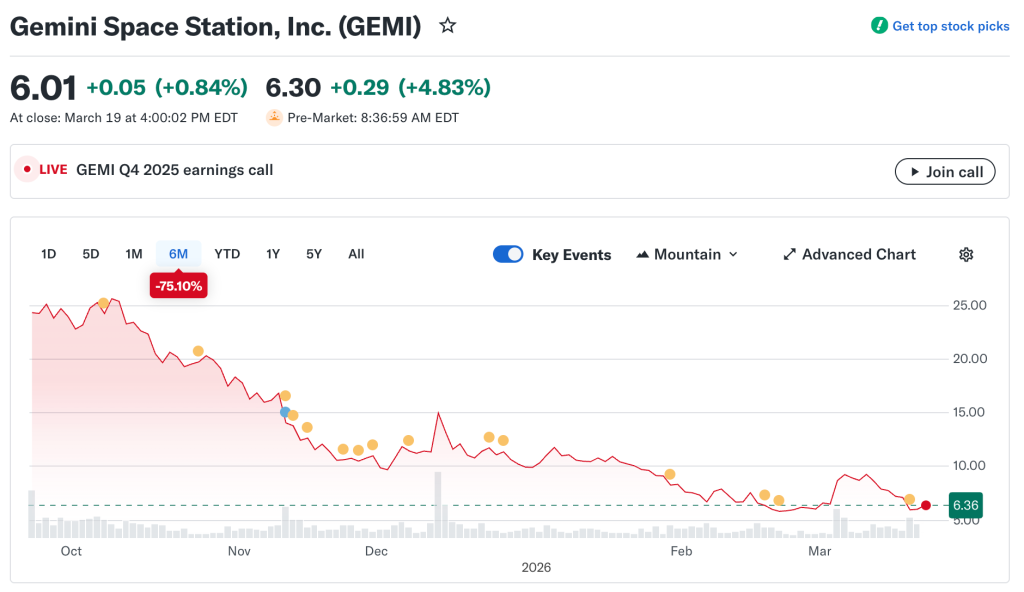
Investors have demanded a jury trial and compensation. They emphasized that they purchased Gemini shares at “artificially inflated prices.”
The platform went public on Nasdaq in September 2025. The company issued 15.18 million Class A shares at $28 each, above the planned range of $24-26. The total raised amounted to $425 million.
Financial Status
On March 18, Gemini also shared its financial results for the fourth quarter of 2025. Revenue increased by 39% compared to the same period last year, reaching $60.3 million, surpassing analysts’ forecasts of $51.7 million.
The net loss amounted to $140.8 million, compared to $27 million a year earlier. For the entire year, losses reached $585 million (in 2024 — $156.6 million).
In a letter to shareholders, Cameron and Tyler Winklevoss noted that the quarter was the strongest in terms of profit in three years, despite a decline in trading volumes. They attributed the revenue growth to “focused work on the fee structure in the second half of the year.”
The exchange’s co-founders also commented on the workforce reduction, citing the active implementation of artificial intelligence:
“Today, AI is involved in more than 40% of changes to our production code. In the near future, this figure will reach 100%. Not using neural networks at Gemini will soon be as odd as coming to the office with a typewriter instead of a laptop.”
The Winklevosses added that they are “encouraged by the crypto-friendly policies of American regulators.” Therefore, this year, the company will strengthen its presence in the United States.
Earlier in March, Crypto․com CEO Kris Marszalek announced a 12% workforce reduction — about 180 employees. The main reason was the integration of artificial intelligence into all processes.