




Capital flows indicate that stocks and cryptocurrencies are becoming ‘risk-reducing interchangeable assets,’ according to analysts at Wintermute.


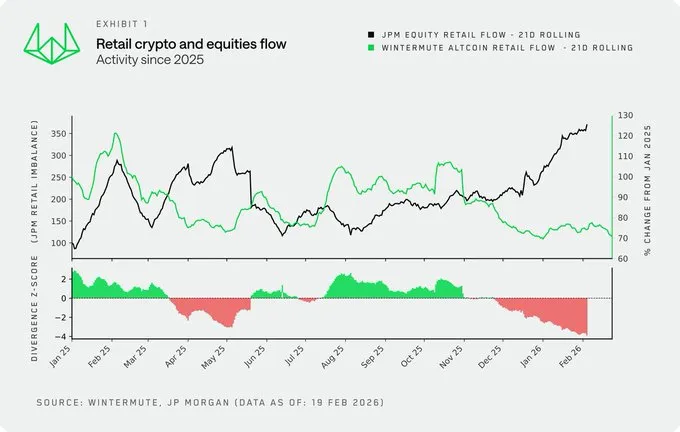
“By comparing our own data on crypto investors with JPMorgan’s information on retail stock inflows, we gain a new perspective on the relationship between participant activity in the stock and cryptocurrency markets,” the company noted.
Until the end of 2024, both sectors moved in tandem: a positive sentiment among traditional players meant purchases of digital assets. However, in 2025 the trend shifted—retail investors are now investing in stocks at a record pace while staying away from cryptocurrencies.
According to analysts, the fluctuating correlation between retail activity and the market capitalization of altcoins confirms this shift. Investors are now distributing funds between segments rather than investing in both simultaneously.
Wintermute highlighted several key factors that have shaped the current situation:
- Meme coins and AI agents ‘had their moment’—when stock market activity stalled, investors shifted to these areas;
- Retail continued to actively buy stocks during downturns, both during the announcement of US tariffs in April 2025 and in recent times;
- After October 10, there was an almost complete shift to the stock market, which continues to this day.
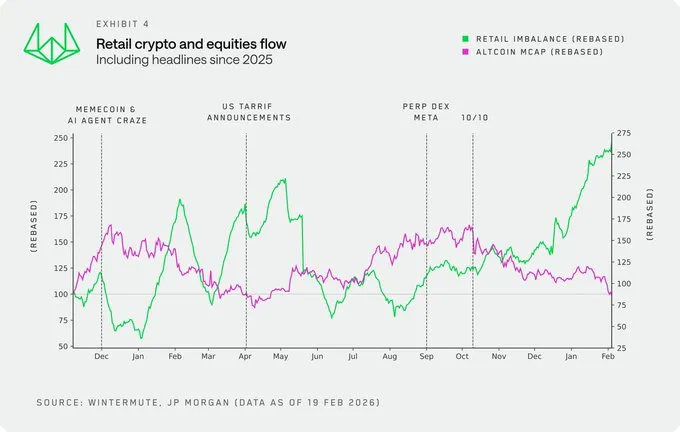
“It is important to note: we do not consider retail investor activity in cryptocurrency high enough to divert attention from stocks. We are saying that increased engagement in the stock market is displacing cryptocurrency,” the experts clarified.
According to analysts, retail activity in traditional products is a new factor that crypto investors should closely monitor to identify favorable moments for more sustainable demand for digital assets.
Market Maturation
The growing presence of experienced investors alongside new liquidity tools such as ETFs and DAT has mitigated the ‘reflexive volatility spikes’ characteristic of previous cycles.
However, with the overall market capitalization of the crypto market at $2.3 trillion, a much larger capital inflow is required for positive movement than five years ago, Wintermute noted.
“As volatility decreases, the key advantage of cryptocurrencies for investors also weakens. The extreme fluctuations that defined the 2021-2022 cycle and attracted a whole generation of new participants have simply disappeared in their usual form. For retail investors seeking volatility, stocks are becoming increasingly attractive,” the analysts added.
While cryptocurrencies still play a significant role in portfolios, digital assets have now become just one of many tools rather than the main product for speculation, the company concluded.
As reported by River, a record growth in bitcoin adoption by institutional banks, public companies, and governments was recorded.