


Worldcoin: digital dystopia, empty hype or innovation?
In the past few months, shiny metallic spheres, called orbs, have appeared around the world—from New York to Tokyo. The developers describe the Worldcoin technology and the new devices as revolutionary, heralding the dawn of a “more humane economic system.”
The project, led by the well‑known head of OpenAI, Sam Altman, has been criticised as dystopian and exploitative. Experts warn about biometric data collection practices and many aspects of their storage and protection.
ForkLog examined the core features of the high‑profile Worldcoin project, uncovering regulators’ concerns in many countries.
- Worldcoin aims to create the world’s largest identity and financial network.
- The native crypto asset WLD officially launched on July 24.
- The project has drawn close scrutiny from regulators in many countries around the world.
What is Worldcoin for?
Worldcoin is a protocol for identity verification and financial operations. It comprises three components:
- World ID;
- the World App;
- the Worldcoin token (WLD).
The protocol identifies users by scanning the iris of the eye with a biometric device called the “orb” (orb; sphere). Data privacy is ensured by zero-knowledge cryptography.
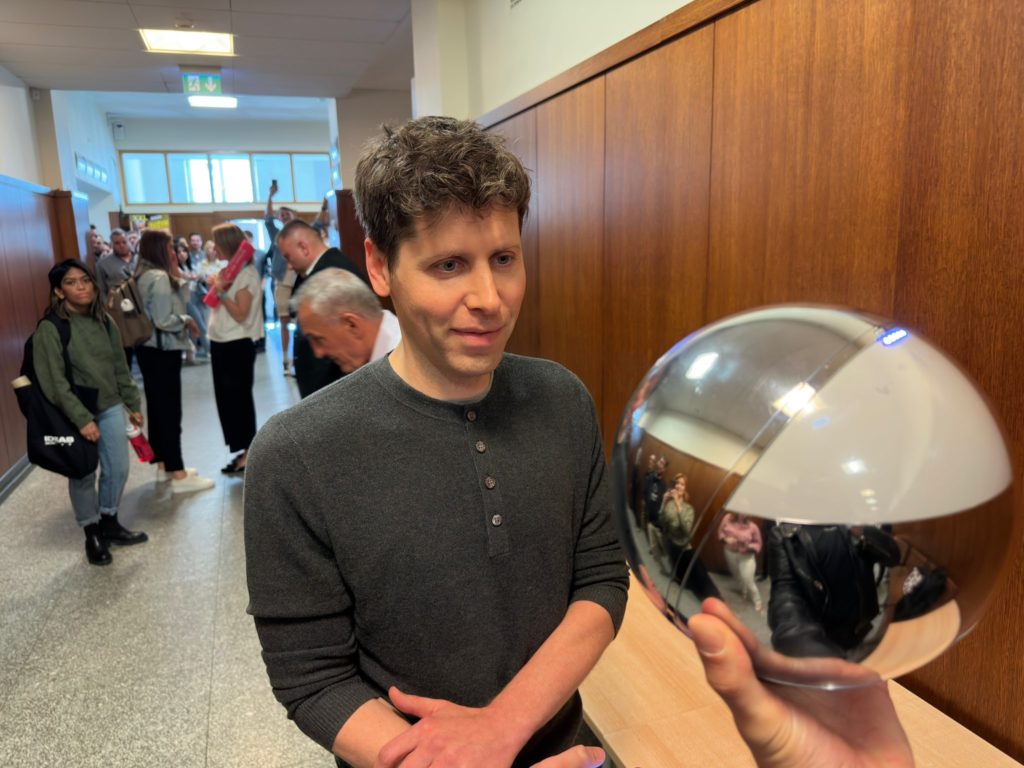
For verification with the orb, the protocol issues 25 WLD to the user. Holders can pay for services in World App, make payments, participate in votes on the protocol’s development, and use the coins as a store of value.
Tools for Humanity (TFH) develops the protocol and the orbs. Its founders are the well-known OpenAI chief executive Sam Altman and TFH head Alex Blania.
World ID is an identifier that lets the owner prove their existence and uniqueness (Proof‑of‑Personhood, PoP), while remaining anonymous.
To obtain World ID, one must install World App on a smartphone and scan the iris with the orb. The orb will generate its identifier (IrisCode) as a random number sequence not linked to the user’s personal information.
The iris features hundreds of ridges, grooves, rings and other traits. These qualities confer a very high entropy.
World ID can be used:
- to guard against bots and verify identity on social networks;
- for voting in DAOs or online polls;
- to protect against fraudsters and fake reviews on marketplaces;
- in the distribution of benefits, scholarships, government aid or airdrops.
Users can choose one of two verification types:
- without biometric storage. The orb processes biometric data and deletes it after verification. On Worldcoin’s servers only the IrisCode is stored, which will not allow re-registration;
- with biometric storage. The orb encrypts biometric data, sends them to Worldcoin’s servers together with IrisCode, and then deletes the corresponding information on its SSD. This approach allows restoring access to World App without re-verification.
Worldcoin Foundation and Tools for Humanity commit not to share user data with third parties.
Representatives say their work will help distinguish humans from AI clones and bots, reducing fraud and purifying the digital landscape.
Having World ID, users could theoretically use it to verify themselves on websites in a manner similar to Google login. The difference, Altman argues, is that login via Worldcoin is more secure and not tied to other information such as a name, email, or photo.
“If zero-knowledge proofs for this technology work correctly, the system would allow logging into a site invisibly to other people or any government,” — as stated in Time article.
In June, identity software provider Okta became the first among large companies to offer login with World ID.
The Worldcoin hype: a chronology
The OpenAI chief Sam Altman (best known for developing ChatGPT) announced the Worldcoin project in June 2021.
In an interview with Bloomberg he said he had been nurturing the idea since 2019. The head of OpenAI is one of the earliest investors in the startup, but does not participate in day‑to‑day operations, serving as an adviser. The company is led by Alex Blania.
The San Francisco–based startup raised $25 million in autumn 2021 in a financing round led by the prominent venture firm Andreessen Horowitz.
Investors valued the project at $1 billion. The round also included Coinbase Ventures, Digital Currency Group and a group of angel investors, including LinkedIn co‑founder Reid Hoffman and the founder of the bankrupt exchange FTX FTX (SBF).
In December 2022 the US Department of Justice brought eight counts against him. He was arrested in the Bahamas and extradited to the United States, where he was released on bail of $250 million. A later decision by a federal judge revoked the release and remanded him in custody ahead of an October hearing.
In October 2021 Worldcoin formally unveiled its cryptocurrency, designed as a Layer-2 solution for the Ethereum blockchain. The supply is capped at 10 billion coins (8 billion to be distributed among ordinary participants in the ecosystem, 2 billion reserved for investors and the Worldcoin Foundation).
Blania said the size of the biometrics reward depends on when a user joined the initiative—the more participants, the smaller the reward. He estimated a rough figure between $10 and $200.
The cryptocurrency is disbursed in several tranches over two years. Ten percent of the payout is available immediately in the project’s digital wallet.
In May 2023, Tools for Humanity raised $115 million in a Series C round led by Blockchain Capital. among other investors: Andreessen Horowitz, Bain Capital Crypto and Distributed Global.
In the same month, users in China without access to the app began buying biometric data from third parties in Africa to obtain signup bonuses. The company pledged to take action to combat the black market.
Commenting on the situation, in an interview with Bloomberg Blania said:
“Sure, there will be fraud. This won’t be a perfect system, especially in the early days.”
In June the project launched the identity and financial operations protocol in Germany. German citizens gained access to World ID and the Sign in with Worldcoin tool.
“Sign in with Worldcoin is designed to provide secure and privacy-preserving access to services and applications, preventing fraud and bot participation,” explained Tiago Sada, head of product at Tools for Humanity.
By mid‑July the number of World ID registrations reached 2 million.

Company representatives noted that the platform reached the second million in half the time it took to reach the first. World ID remains in beta testing.
Worldcoin believes this surge was achieved thanks to a “worldwide tour.”
On July 24 the project announced the official launch and release of the native token WLD.
According to the whitepaper, the initial token supply will be limited to 10 billion over 15 years. Subsequently, the community may approve an inflation rate of 1.5% and establish mechanisms for distributing newly issued tokens.
“Worldcoin (WLD) is an ERC-20 token on the Ethereum mainnet. Users will receive grants on the mainnet via Optimism. Most WLD transactions are therefore likely to occur on the layer‑2 network. If needed, the token can be moved back to Ethereum via the Optimism bridge,” as stated in the documentation.
News of the listing was shared by many major crypto exchanges, including Binance, Bybit and OKX. Worldcoin noted that the asset would not be available in the United States due to regulatory uncertainty.
As part of the launch the project team published World ID developer tools for public access. Representatives also outlined plans to expand verification operations through the Orb system in more than 20 countries.
In early August, Europe head of the project, Ricardo Masiera, said that Worldcoin’s verification technology would be available to large organisations and world governments.
“We are on a mission to build as large a financial and identity community as we can,” he said.
He said Worldcoin would continue to roll out in Europe, Latin America, Africa and “in all parts of the world where we are welcomed.”
Yet most people surveyed on project sites in the UK, India and Japan said they were registering for the 25 WLD tokens.
“I don’t think we can generate a universal basic income. But if we build infrastructure that would allow governments or other organisations to do so, we’d be very happy,” Masiera said.
He also said that as the protocol evolves its functionality will become more accessible. In the future the technology behind the Orb eye-scanning device would be open source, the project representative added.
Also in early August Blania noted that production and operation of Worldcoin’s Orbs could become decentralised.
According to him, manufacturing incentives will be woven into the project’s tokenomics. However, the executive acknowledged the risk that third parties could illicitly collect data under such an open model.
Earlier, Worldcoin published details of the design of the verification devices. This could theoretically enable other organisations to create their own versions.
“This will be like Bitcoin mining, which is performed to protect the network, where manufacturers will also earn WLD for each Orb they produce and put to work,” Blania explained.
He said Worldcoin will devote next year to decentralisation and mass production of retina-scanning machines. The project leader added that a range of manufacturers—from small firms to technology giants—could participate in device creation.
In August the startup opened the possibility for users who have not yet undergone biometric verification to reserve their grant in WLD tokens.
At the end of July Altman shared a video from Japan showing a long queue of people willing to have their retinas scanned in exchange for Worldcoin tokens.
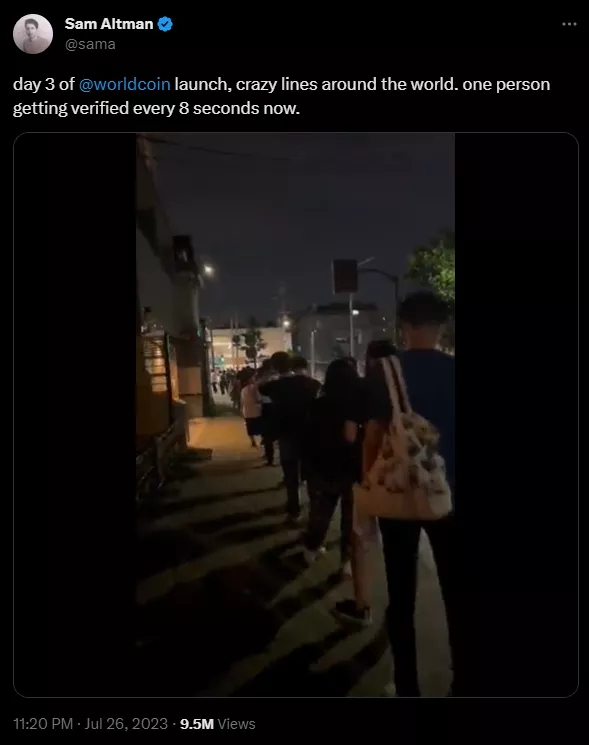
One person is verified
Is universal basic income needed for humanity?
Sam Altman is a long-standing advocate of universal basic income (UBI). In 2016, under his leadership, Y Combinator launched a research project to test the idea. It aimed to fund 100 Oakland families with $1,500 per month. But execution lagged and the programme had to be scaled back.
“I’m very interested in things like universal basic income, what will happen with global wealth redistribution, and how we can improve this process. Is there a way to leverage technology for this at a global scale?”
In early 2021 Altman stated that in the coming decade artificial intelligence would create such wealth that every adult in the United States could receive $13,500 a year.
Santiago Siri, a member of Proof of Humanity’s board, predicted that Worldcoin’s earnings, like OpenAI’s, would be distributed within the UBID framework.
“AI can undoubtedly deliver on the promise of universal basic income — the technology can generate such wealth over time. And as AI displaces jobs, there is an ethical obligation to support UBID initiatives,”
Thus far it remains unclear how Worldcoin will implement this controversial concept, rooted in the writings of the utopian socialist Thomas More.
“The hope lies in people’s willingness to buy the token because they believe in its future. So there will be inflows of funds into this economy,” Altman told CoinDesk.
UBI has many critics. Their arguments rest on economic and legal grounds:
- The system entails substantial costs;
- The implementation of the concept would lead to a large influx of migrants (as proponents of the Swiss People’s Party often say);
- A guaranteed income would significantly reduce labour productivity and employment levels.
Why has Worldcoin run into problems?
Many critics call WLD a dystopian reward for providing biometric data. Some even draw parallels with bribery.
A significant portion of people are reluctant to hand over sensitive data to a commercial project with somewhat vague aims. Even Altman acknowledged that the Worldcoin model would provoke “a certain degree of disdain” among many.
Proponents say that the biometric data collected by the orbs is deleted after processing, converted to cryptographic codes. Yet many remain distrustful, presuming the data could be used for surveillance and sold to third parties.
“Don’t use biometrics to fight fraud. In fact, don’t use biometrics at all,” wrote former NSA and CIA employee Edward Snowden in response to Altman’s Worldcoin post.
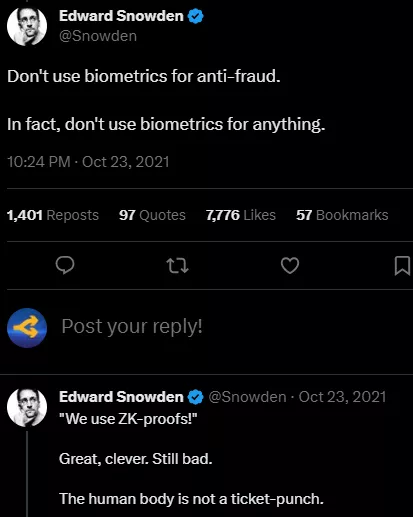
He stressed that the human body is not a “ticket compost.”
The project rollout has been shadowed by troubling reports from across the globe. MIT Technology Review published in 2022 an article describing controversial recruitment methods in Kenya, Indonesia and Chile. For instance, Spanish-speaking users received terms of service notices in English, while Sudanese residents were lured with AirPods.
This year hackers stole registration data from Worldcoin operators. BlockBeats reported that residents of Cambodia and Kenya sold their data on the black market for about $30.
“We observed orbs appearing in developing third‑world countries whose identity and privacy norms aren’t as stringent as those in the European Union and the United States,”
Privacy concerns around the iris‑scanning feature were raised by Ethereum co‑founder Vitalik Buterin. He argues there is a real risk of data leakage even though the system stores only hashed biometric data and uses zk-SNARK.
“If someone scans your iris, they could compare it to a database to determine whether you have World ID. Potentially, this system could reveal more information about the user,”
Buterin also highlighted the risk of centralisation. In his view, the integrity of the Orb’s construction cannot be verified, leaving open the possibility of backdoors by its creators.
“To Worldcoin’s credit, they have committed to decentralisation over time,”
He also pointed to the security risk of users’ mobile devices. If a World ID‑enabled phone is compromised, there is a chance of “fake people” being created and misused for malicious purposes.
Nevertheless, Buterin described the project’s concept as “truly valuable.” In his view the world needs such privacy-preserving identity applications. Yet he noted there is no perfect form of identity verification yet.
Worldcoin’s rapid growth has drawn regulators’ scrutiny across many countries. Britain’s Information Commissioner’s Office is examining the user verification process for the Sam Altman project, raising questions about data protection.
France’s CNIL called the biometrics collection by Worldcoin “questionable” in legality, as well as the conditions for storing sensitive information. CNIL opened an inquiry with German authorities, who have jurisdiction over the startup.
Bavaria’s data protection authority BayLDA has been scrutinising Worldcoin since late 2022. The regulator worries that the company handles “confidential data on a very large scale” using new technologies.
BayLDA chair Michael Will says the situation creates significant risks, including regarding the user agreement which must be “comprehensive and clear.” Several other European supervisory authorities have also expressed interest and are requesting information about the company.
Kenya’s Ministry of Interior temporarily restricted local operations as authorities assess public-safety risks. The minister, Kiture Kiniki, said the government is concerned about how the company intends to use the collected information.
Local media reported that by early August more than 350,000 Kenyan citizens had completed verification in the app in exchange for 25 WLD tokens (~$44 at the time of publication).
Soon after, searches were conducted at Worldcoin’s premises. On 5 August Kenyan police officers, acting with an interagency team, seized documents and devices reportedly containing the data collected. The equipment was handed to the headquarters of the Directorate of Criminal Investigations for analysis. The raid involved the data commissioner Immaculate Kassait. She said Tools for Humanity, Worldcoin’s parent company, did not disclose its true intentions at registration.
The company explained that it chose Kenya to start the platform in Africa due to a booming tech sector and the presence of more than 4 million crypto traders.
Argentina’s regulator also opened an investigation into Altman’s project. The Agency for Access to Public Information notes safety measures implemented to protect user privacy.
The regulator noted that the matter has recently attracted wide coverage due to facial scanning and iris scans in exchange for “economic compensation” in Buenos Aires and some provinces.
“Such cases show the need to strengthen the existing legal framework for data protection,”
Regulatory issues in several countries have weighed on the project’s utility token’s price.
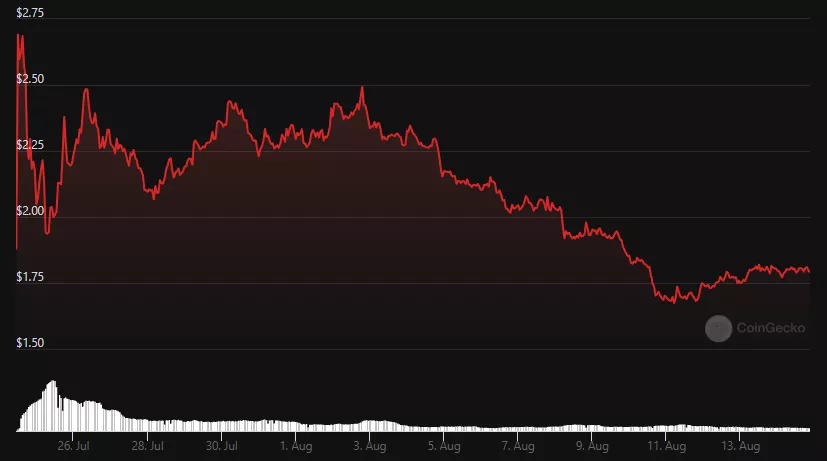
At the end of July and the start of August, the asset traded mostly above $2, occasionally testing $2.5. At the time of writing, the price hovered around $1.79.
“One person is verified every eight seconds,” said the head of OpenAI.
Conclusion
Worldcoin is a high‑tech and ambitious project with far‑reaching aims.
Many people are genuinely intrigued by yet another of Sam Altman’s ventures. Others are sceptical, criticising the company and its biometric data collection methods. Regulators worry about potential risks to public safety.
World ID is pitched as a cornerstone of infrastructure for the fair distribution of a universal basic income. But is UBI desirable for society? Will the project survive regulatory pressure in many countries? Will WLD serve as a store of value?
Time will tell.
Рассылки ForkLog: держите руку на пульсе биткоин-индустрии!