



How to pay down America’s national debt with crypto—and why
The International Monetary Fund (IMF) has published a report stating that global public debt will exceed $100 trillion by 2030, or about 93% of world GDP. Roughly a third of that ($35 trillion) is accounted for by the United States.
Parts of the community are debating whether crypto-market tools could help solve America’s debt problem. Oleg Cash Coin examines what such a process might look like.
Paying down the debt
The United States is the world’s largest economy; its debts inevitably ripple through to anyone using fiat currencies. Wherever you are, America’s obligations indirectly affect your country—whether people like it or not.
Bitcoin, as an alternative to a debt-based system, once promised if not the end of traditional finance then at least a separate path to a fairer world. Yet recent years show legacy institutions willing to use any means to escape the debt spiral—including those of the crypto market.
In 2024, US federal debt will increase by roughly 5.5%, or about $2 trillion. Interest payments alone have reached around $1 trillion a year. Washington plugs budget holes by constantly issuing bonds, which it sells to commercial banks that create new money on the back of these securities.
By buying $10,000 of government debt with real money, a bank can, quite literally, create $100,000 of new money. That is a normal mechanism of modern finance and broadly how most money supply is created—subject, of course, to various constraints.
Since the gold standard was scrapped in 1971, the US budget has been in deficit for most years. During the pandemic, debt growth accelerated thanks to massive injections over a short period and compounding interest that had built up for years.
With a presidential election looming, the topic has taken on fresh colour. The Republican nominee Donald Trump, who has declared himself a “crypto-president”, in his inimitable fashion proposed selling “a little bitcoin” to wipe out the entire national debt. It is hard not to recall the words of Satoshi:
“When someone tries to buy up all the world’s supply of a scarce asset, the more he buys, the higher the price goes.”
Crypto commentators quickly calculated what a single BTC would have to be worth for such a stunt. Even the roughest estimates push the price to $2 million—a pleasant prospect, but one that does not withstand scrutiny.
The problem is compounded by geopolitical tensions that have reduced the number of countries willing to hold Treasuries in their reserves. It is therefore unsurprising that a crypto company, Tether—the issuer of USDT—is among the top 18 holders of US government debt.
A realistic scenario
Speculation about paying down debt via crypto often boils down to the government pumping prices, selling into the rally and clearing its books. Economics does not work that way.
There are, however, more grounded ideas. Paul Mueller, a senior research fellow at the American Institute for Economic Research, suggested that friendlier crypto policy could lift GDP and improve household balance-sheets. That might help reduce the debt burden, though the timeline is anyone’s guess.
Enter the world’s largest asset managers, busy with the tokenisation of real-world assets (RWA). BlackRock’s CEO, Larry Fink, is gently championing the trend in crypto, where, in his view, BTC and ETH ETFs are “mere stepping stones on the path to tokenization.”
In October 2024, a subcommittee of the Commodity Futures Trading Commission (CFTC) sent recommendations allowing firms to use tokenised shares as collateral. That opens qualitatively new room for manoeuvre.
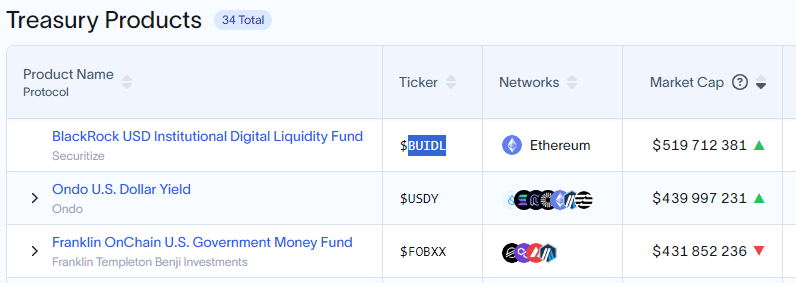
BlackRock and Franklin Templeton have already tokenised nearly $1 billion of US government debt on the Ethereum and Stellar blockchains.
Stablecoins, debt and RWA
Imagine a world where a speculative scheme that mints money out of the RWA sector becomes reality. The idea is a simple and workable crypto version of a debt-based economy, transplanted to blockchains.
Banks and the government cannot create money indefinitely at will—and doing so has obvious consequences, including inflation.
Therefore a mechanism is needed to create value without swamping the economy with “fat” liquidity injections from the the Fed and others involved. The mechanism may be somewhat more complex, but overall it looks promising.
It could resemble a looped system of collateral, loans, bonds and RWA. Tether has conducted a kind of experiment, creating nearly $120 billion of USDT backed by the world’s most liquid asset (Treasuries), while also generating a stable stream of income.
While the company mints “crypto-dollars” against bonds, BlackRock is paving a path to mint, quite literally, new dollars from old debt.
Allowing such cryptoassets to be pledged as collateral would open the way to gradual tokenisation of all, or most, of the national debt through a series of speculative chains.
What it might look like
BlackRock’s BUILD fund buys Treasuries onto its balance-sheet and then issues a token. If the CFTC approves the use of such assets as collateral, it becomes possible to create money through credit. The organisation that owns BUILD transfers the token to a bank, which creates new money against that collateral.
Thus the bank holds a liquid asset on which it can keep extending credit. The organisation receives cash and a low-volatility collateral asset. If the chain is looped, additional capital can be attracted to buy more debt via long, hedged sequences.
Such a scheme could expand the money supply without endangering the banking system in its current form.
What is happening in crypto now is the construction of a new layer for producing derivatives based on traditional financial instruments—ones that will enter the banking system as fresh liquid assets.
Perhaps America’s route out of debt lies in creating yet another derivative atop the existing problem. And it just might work.
Рассылки ForkLog: держите руку на пульсе биткоин-индустрии!