



DeFi + AI equals DeFAI: the market’s new equation
Decentralised finance lacks simplicity. For people outside Web3, engaging with DeFi protocols—and grappling with liquidity, staking yields and complex trading strategies—remains difficult.
To ease newcomers in and enhance the experience for crypto financiers, developers have turned to AI. Thus the DeFAI narrative emerged.
ForkLog explores the symbiosis of today’s AI and DeFi trends, unpacks new features in financial apps and assesses their impact on users and the industry.
Why bring AI into DeFi?
In their current form, decentralised finance could credibly rival the existing financial system and take a place in the global economy. One barrier to mass adoption of crypto and DeFi is technological complexity.
Many users, accustomed to intuitive modern apps, do not wish to delve into the intricacies of blockchain protocols or the workings of decentralised finance. How can they still benefit from DeFi? Developers have responded by introducing network abstraction (NA), including the more widespread account abstraction (AA).
Enlisting AI, builders of financial dapps are rolling out simplifications to minimise the user-experience (UX) hurdle. This approach has become part of a new narrative—DeFAI (DeFi + AI). The symbiosis is meant to remove frictions by offering simple, customised interfaces for decentralised applications.
For advanced crypto financiers, DeFAI promises a better user interface (UI) and higher returns through sophisticated trading strategies and on-chain analytics.
Coupling with AI has brought several functions to dapps:
- risk management—identifying potential threats to profit or capital and mitigating the consequences;
- automated trading—algorithms analyse market patterns and execute orders on their own;
- fraud prevention via intelligent detection systems;
- yield optimisation—strategies seek higher returns by interacting with multiple protocols and selecting the most favourable.
AI agents carved out a niche—and filled it
AI agents account for the lion’s share of dapps in the DeFAI category. The bot sector slowed markedly after the late-2024 boom. And although in early February 2025 Binance tried to draw attention back to them, that did not help tokens of popular projects recover from the major sell-off.
On March 18th, former platform chief Changpeng Zhao urged AI-agent developers to focus on building useful products rather than minting tokens.
On AI agents, I have an unpopular opinion:
While crypto is the currency for AI, not every agent needs its own token.
Agents can take fees in an existing crypto for providing a service.
Launch a coin only if you have scale. Focus on utility, not tokens.?
— CZ ? BNB (@cz_binance) March 17, 2025
According to CryptoRank, the DeFAI narrative has gathered momentum since January 2025. The chart below shows a 62.6% rise for the subcategory over a 30-day period. Leading the pack are tokens from adjacent niches: AI agents, portfolio managers and platforms for trading strategies.
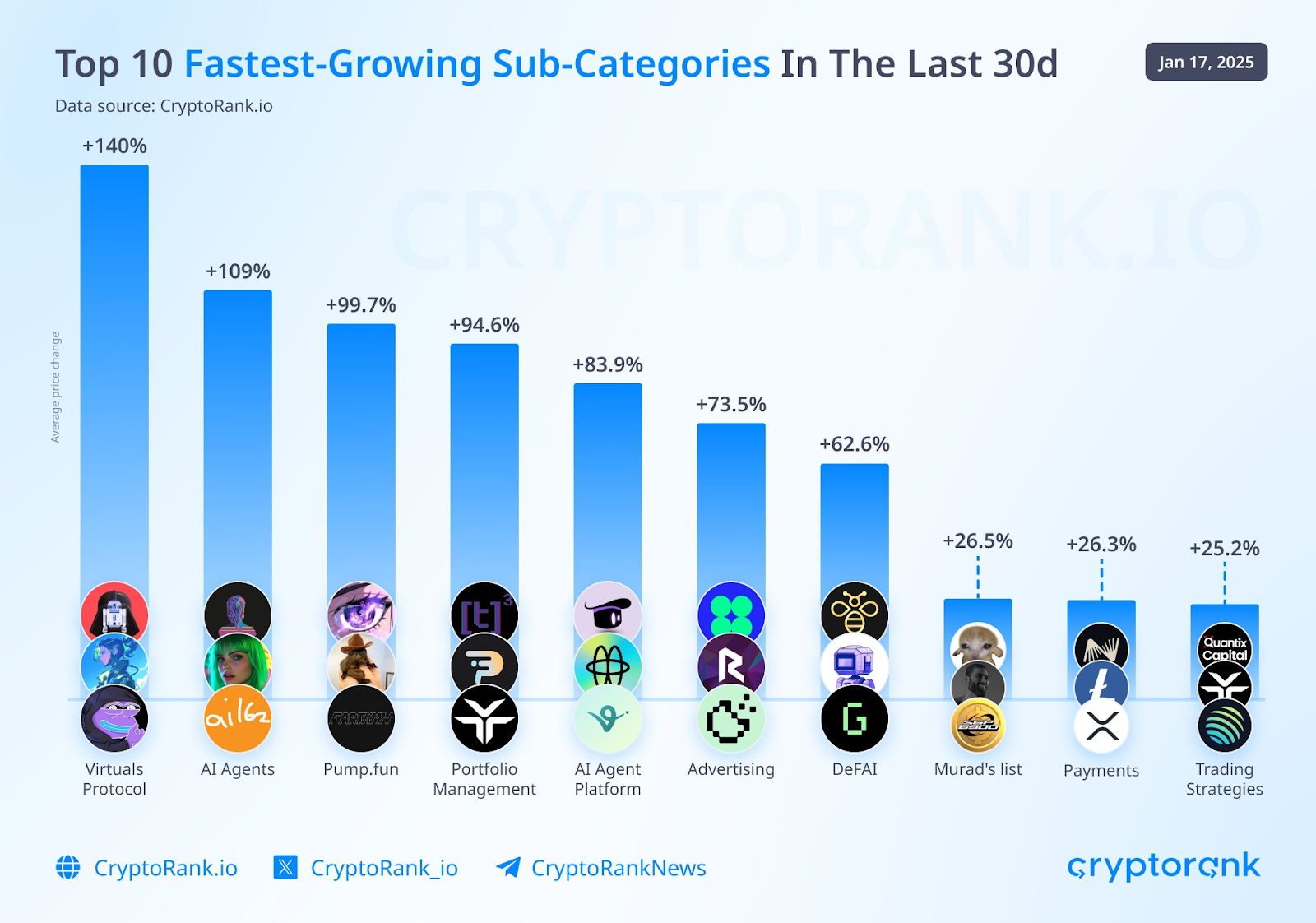
The emergence of AI agents capable of submitting transactions autonomously on-chain—such as Griffain and Orbit—helped cement the DeFAI trend.
On March 17th 2025, crypto analyst Miles Deutscher underscored DeFAI’s long-term significance. He highlighted users’ allegiance to two leading categories over the past 90 days. For investing in the theme, he chose a favourite—the ANON token from Hey Anon.
AI assistants quickly became popular thanks to automation that simplifies interactions with DeFi protocols. On Griffain, for example, users can create agents to launch tokens, stake SOL and manage liquidity.
These advances were enabled by Trusted Execution Environments (TEE). The Phala Network protocol implements the technology and allows custom AI agents to be deployed on its base. TEEs provide a secure, confidential environment, protecting sensitive data from malicious attacks while boosting efficiency and reliability.
Despite bearish sentiment in the market, experts at the crypto bank Sygnum Bank offered a positive outlook for AI-assistant tokens in 2025. At this point in the cycle, however, they remain mostly speculative assets.
How DeFAI applications work
Systems based on NA or intent-based blockchains also aim to simplify UX. In the former, users state a desired outcome and the system—often with the help of solvers—finds the optimal way to achieve it.
For example, when swapping tokens or moving assets across chains, a solver determines the best route given gas fees, slippage and liquidity, then executes the required transactions.
DeFAI uses machine-learning algorithms and large language models (LLMs) to smooth interactions with the blockchain. Rather than focusing on the infrastructure needed to execute intents, AI makes better-informed decisions ahead of execution.
AI agents analyse on-chain data, forecast market trends and recommend actions aligned with a user’s goals—for instance, selecting the optimal pool for providing liquidity or optimising asset allocation for yield farming.
AI is upgrading DeFi tools. Among available dapps, notable additions include:
- personalised financial strategies—AI derives insights from a user’s transaction history, investment patterns and risk profile; DeFAI apps then propose tailored strategies. Example: analysing on-chain activity to spot frequent stablecoin usage and recommending high-yield platforms for staking them;
- goal-based trading—short-term price swings often trigger impulsive decisions. DeFAI apps help automate strategies and reduce emotion. Users can set clear objectives, for example: “Sell 30% of ETH if the price drops below $1800 to limit losses, or sell at $2500 to lock in profit”;
- validator selection for staking—choosing poorly among many validators can cut rewards or even incur penalties. DeFAI apps evaluate candidates by uptime and reputation;
- text-based portfolio control—via chatbot-style interfaces, DeFAI apps let users manage portfolios conversationally. Some dapps integrate with Telegram and Discord.
DeFAI in practice
As of March 20th 2025, the DeFAI category on CoinGecko was nearing a $900,000 market capitalisation.
Projects on the list include market-analytics agents, assistants for trading decisions, infrastructure for programming strategies and automated investment systems.
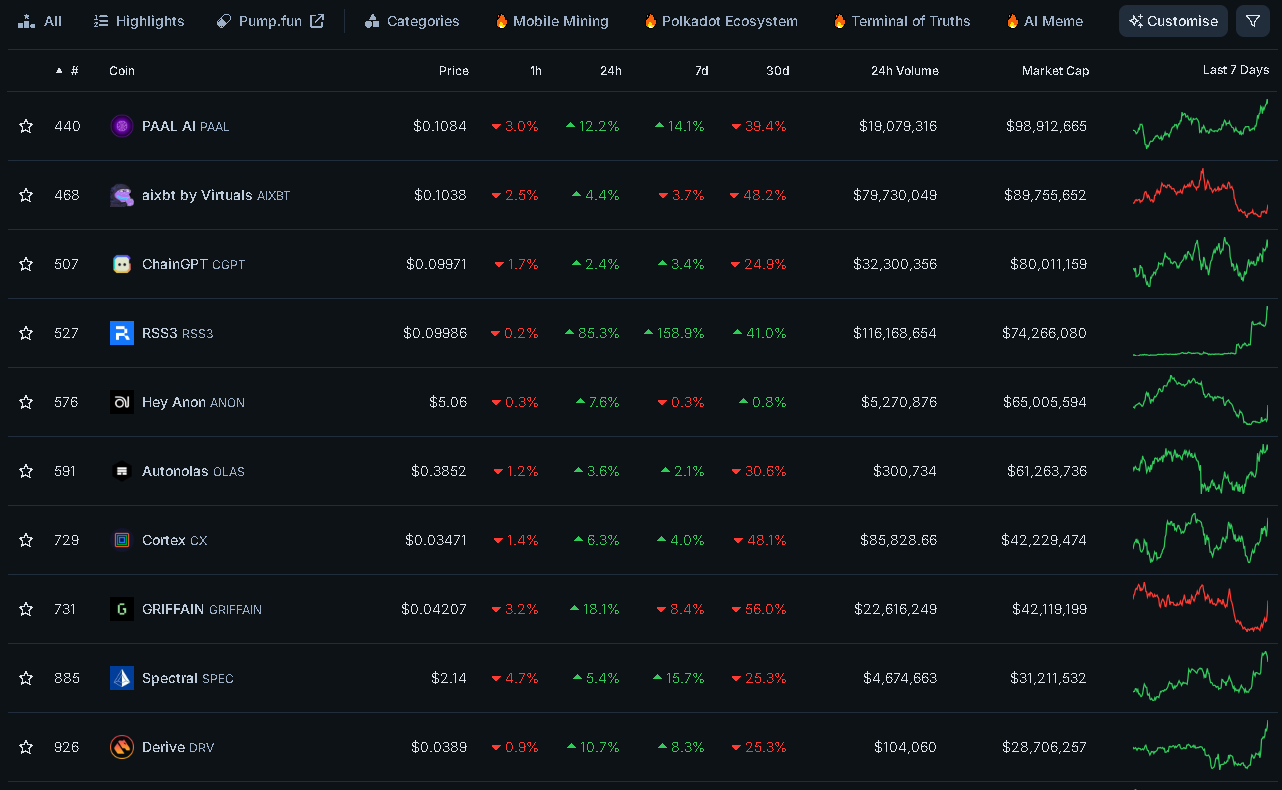
First place goes to PAAL AI, a multipurpose AI platform presented as a chat bot.
Next is the popular AI agent Aixbt, an autonomous assistant released on the Virtuals Protocol in the Base network. It supports fundamental analysis of cryptocurrencies, tracks social sentiment and builds a dynamic view of the market.
In third place is ChainGPT, a startup focused on automated trading, smart-contract generation and NFTs.
Infrastructure is represented by RSS3, a project for information aggregation and a launchpad for AI agents.
Fifth by market cap is Hey Anon, the brainchild of seasoned DeFi developer Daniele Sesta. The dapp gathers information about projects across blockchains and “talks” to users through a dialogue window. It helps users make informed decisions and fine-tune trading algorithms with stop-losses of varying sophistication.
Nerding out on this a bit more here is a practical example:
Example Setup:
Entry price: $0.0010
Initial ATR (10-period, 1-minute candles): $0.0001
Initial stop-loss: Aggressive at 5× ATRBelow you can see the different stop losses at different volatility as the coin goes up. https://t.co/bsgQeRNVEI pic.twitter.com/J3qsbD1kVE
— Daniele ? ( Revenge Arc ) (@danielesesta) March 17, 2025
DeFAI systems for investment management aim to help with portfolio control:
- Aspis. The AIDAO framework can configure AI agents to service vaults and the dynamic parameters of funds;
- Mozaic Finance. An AI platform for managed yield farming with interoperability that optimises yield strategies and auto-reinvests;
- Almanak. Uses DeFi analytics and forecasting to optimise trading strategies and automatically rebalance portfolio assets.
Hallucinations, not insight
It is worth remembering that AI agents are prone to “hallucinations”, when LLMs produce nonsensical or incorrect answers. Imagine such a “fit” during a token swap: an agent inflates a fee or sends assets to a wrong contract address, causing financial losses.
AI models are also potentially vulnerable to hacking. In DeFi, that could lead to user funds being lost. Widespread use of AI agents in decentralised finance raises the risk of systemic failure across the crypto market.
The synthesis of “DeFi + AI” invites a rethink of the balance between autonomy and automation. Unlike intent-based network-abstraction protocols, DeFAI keeps humans in the loop, acting as an adviser rather than an executor.
The potential of AI agents in DeFi is only beginning to unfold. The very fact that they are always on and can execute limitless transactions in milliseconds gives them an edge. Yet, as with any new technology, the consequences are not always predictable, and users should always weigh the associated risks.
Рассылки ForkLog: держите руку на пульсе биткоин-индустрии!