



Week in review: bitcoin tests $112,000; Trustee Plus halts sign-ups from Ukraine
The leading cryptocurrency set a fresh high near $112,000; Russia advanced digital-asset legislation; the Trustee Plus wallet stopped registering residents of Ukraine; and other highlights of the week.
Bitcoin sets new ATH near $112,000
Bitcoin began the week with a pullback to around $102,000, but on May 21 the asset attempted a push to $109,000. In the evening it cleared the level, printing a high at $109,565 (CoinGecko).
The advance continued the following day with a new ATH at $111,814. On Binance, the price reached $111,980.
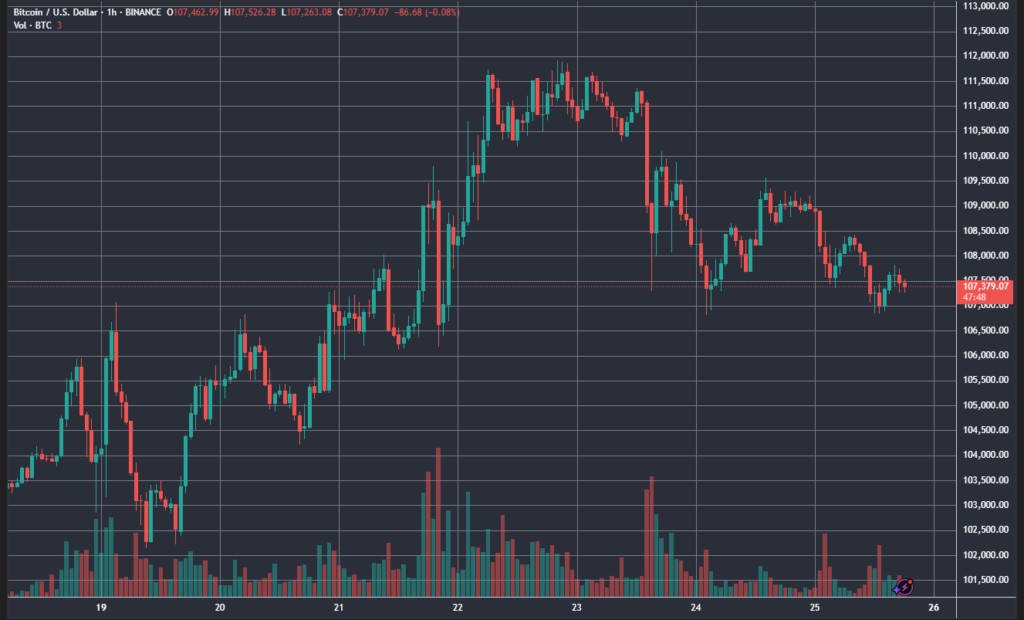
The main driver was steady institutional inflows, reflected in demand for exchange-traded funds and rising bitcoin reserves.
The cryptocurrency failed to hold the record level — on May 23 the price slumped 3% within an hour after threats by US President Donald Trump to impose 50% tariffs on EU products from 1 June.
Bitcoin is ending the week up 3%, trading around $107,500. Large-cap altcoins tracked a similar trajectory over seven days, but only BNB finished in the green — up 2.8%.
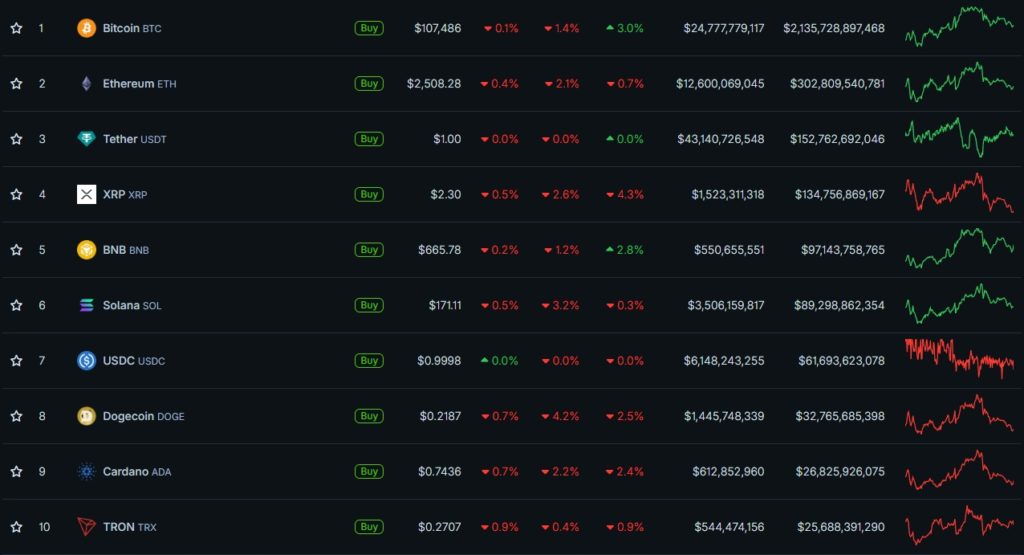
Privacy-focused Monero outperformed over the period. XMR gained more than 19% and trades at roughly 25% of its all-time high.
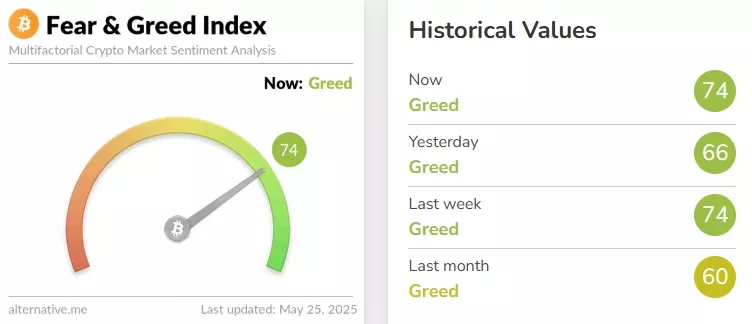
The Crypto Fear & Greed Index stayed in positive territory throughout the week.
Total crypto market capitalisation reached $3.5 trillion; bitcoin’s dominance stands at 61.1%.
Trustee Plus stops registering Ukraine residents and pivots to the EU
From May 20 the Trustee Plus crypto wallet halted registration of new users residing in Ukraine.
“There are many reasons, but the lack of legal certainty matters most. Officially, we have decided to postpone expansion plans for the Ukrainian market and to stop researching this market,” the project team said.
The change did not affect already registered users and Ukrainians permanently residing in the EU and being its residents. They still enjoy uninterrupted access to the wallet’s services.
The team did not specify when the situation for residents of Ukraine might change.
Confiscation and tokenisation: Russia readies bills on digital assets
Russia’s Justice Ministry drafted a bill recognising cryptocurrencies as property for their arrest and confiscation, deputy justice minister Vadim Fedorov said.
“At the same time, it is proposed to establish special requirements aimed at ensuring its preservation, taking into account the specifics of a particular [digital] currency: an investigator will be able to seize the physical carrier with access codes to it or ask a court to prohibit transactions,” the official noted.
He added that the document is being prepared for a first reading in the State Duma.
Maria Agranovskaya, managing partner at Agranovskaya & Partners, told ForkLog the bill will expand the scope of current legislation, which already recognises digital currencies as property. Given the practical difficulties of seizing cryptocurrency, the document focuses on the “physical carrier subject to seizure” and on requirements for intermediaries to provide information upon request.
The Finance Ministry said it is preparing a bill on tokenising real-economy assets within an experimental legal regime. The head of government tasked the drafting in 2024.
“This will be a government bill undergoing interagency approval, enabling the launch of tokenisation within the experimental legal regime,” clarified Alexey Yakovlev, director of the ministry’s financial policy department.
What to discuss with friends?
- Opinions: what consequences the US-approved stablecoin law will bring.
- The Bancor team filed a lawsuit against Uniswap over the use of AMM.
- Standard Chartered confirmed a $500,000 bitcoin target amid rising interest from sovereign wealth funds.
- An economist said bitcoin undermines the dollar’s hegemony.
Hoskinson to audit Cardano Foundation after claims of $600m in ADA misappropriation
Cardano Foundation is preparing to publish an audit report on the state of its treasury following allegations of $600 million in ADA misappropriation.
NFT artist Masato Alexander claimed that Cardano founder Charles Hoskinson used a genesis key to alter the ledger and transfer 318 million ADA during the Allegra hard fork in 2021.
As evidence, the expert cited a transaction that launched the protocol update and a commit on GitHub.
The coins generated 25 million ADA in staking rewards, Alexander added.
Hoskinson said an audit report related to the hard fork is being prepared. He stressed he is “deeply wounded” by the community’s distrust.
Also on ForkLog:
- Coinbase disclosed the number of users affected by a data leak.
- Strategy was accused of concealing bitcoin risks.
- In Kazakhstan, licensing is under way for crypto exchanges.
- Argentina’s president disbanded the investigative group in the LIBRA case.
Vitalik Buterin proposes shrinking node state size
Ethereum’s scaling should boost performance without compromising the usability of personal nodes, believes network co-founder Vitalik Buterin.
In a new essay he proposed relevant recommendations.
They include implementing:
- EIP-4444;
- distributed history storage;
- synchronisation without storing state (stateless verification);
- light nodes “with partial state” (partially stateless nodes).
According to Buterin, full deployment of EIP-4444 will reduce disk-space requirements — the main hurdle keeping most people from running nodes. Each node would store data for the last 36 days, the state, and Merkle tree state.
For distributed history storage, the cryptographer proposed that each node store a small percentage of information older than the set horizon. To increase reliability, erasure coding is suggested.
In the medium term, the Ethereum co-founder deems it necessary to move to synchronisation without storing state. This would allow running a node with RPC support without storing Merkle tree state, roughly halving data-storage needs.
A new concept could be the introduction of light nodes “with partial state”.
What else to read?
We explained the features of Ethereum’s next major upgrade, Fusaka, slated for year-end.
We concluded a series on tokenomics prepared by Web3 researcher Vladimir Menaskop.
We published an adapted text version of a debate between ForkLog founder Anatolii Kaplan and DAO Builders co-founder Denis Smirnov about digital consciousness.
We outlined in educational cards what a token generation event (TGE) is. In the regular digest we compiled the week’s key cybersecurity events.
Рассылки ForkLog: держите руку на пульсе биткоин-индустрии!