


How crypto fared in the first half of 2025 — Binance Research
- The crypto market eked out a modest 1.99% gain in the first half.
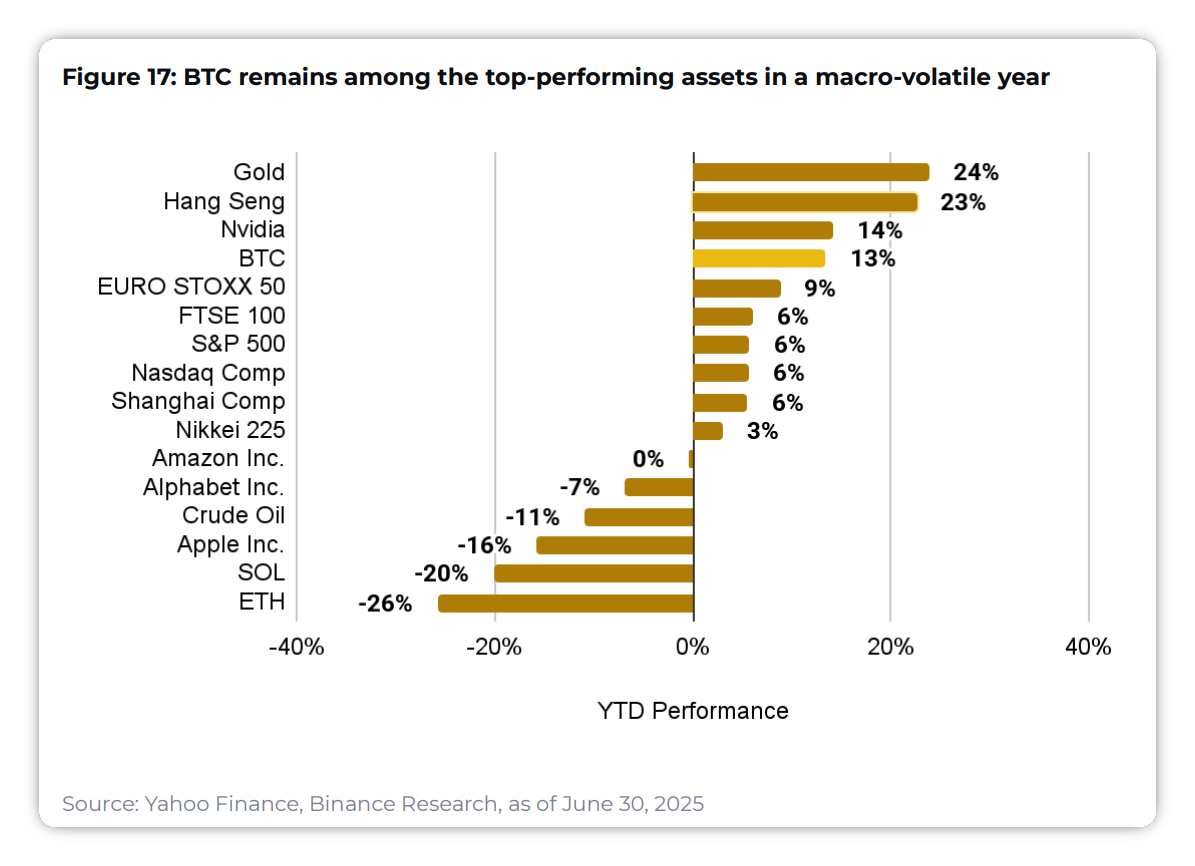
- Bitcoin burnished its macro-asset credentials: up 13% year to date and overtaking Google and Meta by market value.
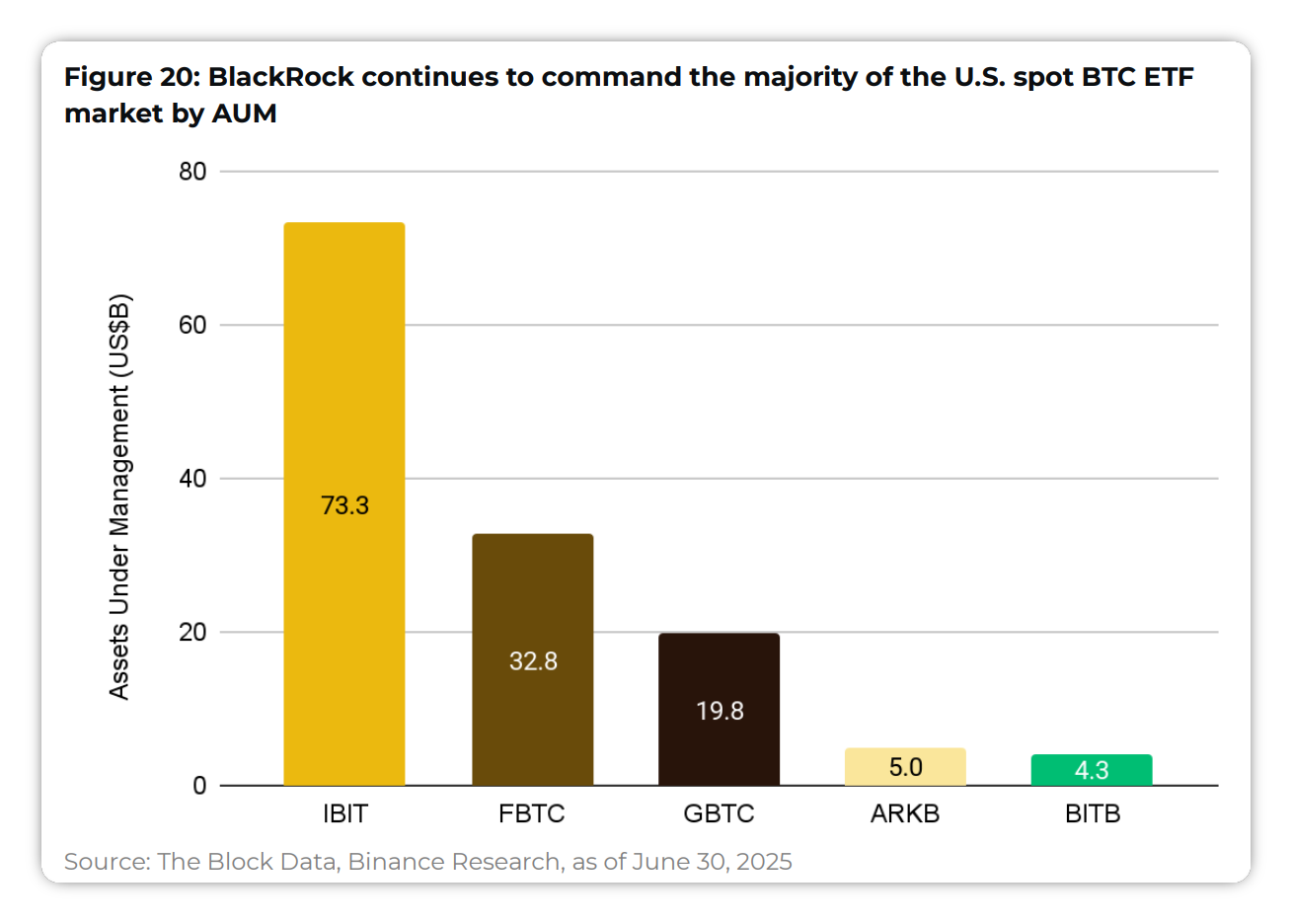
- Spot bitcoin ETFs were the key driver, with cumulative net inflows of $13.7bn. BlackRock led.
- The regulatory backdrop shifted markedly: the US passed the GENIUS Act, the EU implemented MiCA, and Asia took divergent paths.
- DeFi’s TVL held steady even as user activity climbed.
Binance’s research arm published a 145-page report on digital-asset markets in the first six months of 2025. The document dissects macroeconomic forces, the evolution of key ecosystems and the industry’s main trends.
After a 96.2% surge in 2024, the crypto market posted a modest 1.99% gain in the first half of 2025. The subdued print reflects a first-quarter correction (-18.61%) followed by a second-quarter rebound (+25.32%).
Macroeconomics set a tricky backdrop
The global economy in the first half was marked by a “great divergence”. Major players pursued different monetary paths, creating a volatile setting for crypto assets.
The US showed a gradual slowdown in the first quarter and an unexpected easing of inflation. China beat expectations with GDP growth of 5.4% year on year in the first quarter, reflecting the positive impact of stimulus.
A brief but intense US–China trade war raised tariff rates to 145% in April before they fell. On April 2nd the US announced comprehensive reciprocal tariffs of up to 34% on Chinese goods. Between April 4th and 11th the sides pushed rates to record levels through rapid tit-for-tat moves.
The euro area accelerated GDP growth for a third consecutive quarter on the back of consumption and investment. Japan rebounded after a prior contraction but faced weak domestic demand.
Global liquidity first tightened, then loosened. The the Fed halted balance-sheet run-off, supporting risk assets. Aggregate money supply across the US, China, the EU and Japan increased by $5.5trn — the biggest six-month rise in four years.
Bitcoin strengthened its macro-asset status
The first cryptocurrency proved resilient amid global volatility. With a year-to-date return of +13%, bitcoin outperformed most traditional assets.
Binance’s analysts view bitcoin’s price cycle as a leading indicator of the global manufacturing cycle by 8–12 months, implying further opportunities in the second half of 2025.
Bitcoin’s market value stayed above $2trn for most of the half, making it the sixth-largest asset globally — just behind Amazon and ahead of Google, Meta and silver.
The coin’s dominance rose to 65.1% in June, a more-than-four-year high.
«Capital is flowing into bitcoin faster than into the rest of the crypto market, reflecting accumulation by long-term investors and growing integration with traditional finance,» the report says.
Bitcoin ETFs were a key structural driver. Cumulative net inflows topped $13.7bn year to date. BlackRock’s IBIT dominated, absorbing most new investment, while Grayscale’s GBTC continued to shed assets owing to high fees.
Corporates are accumulating bitcoin
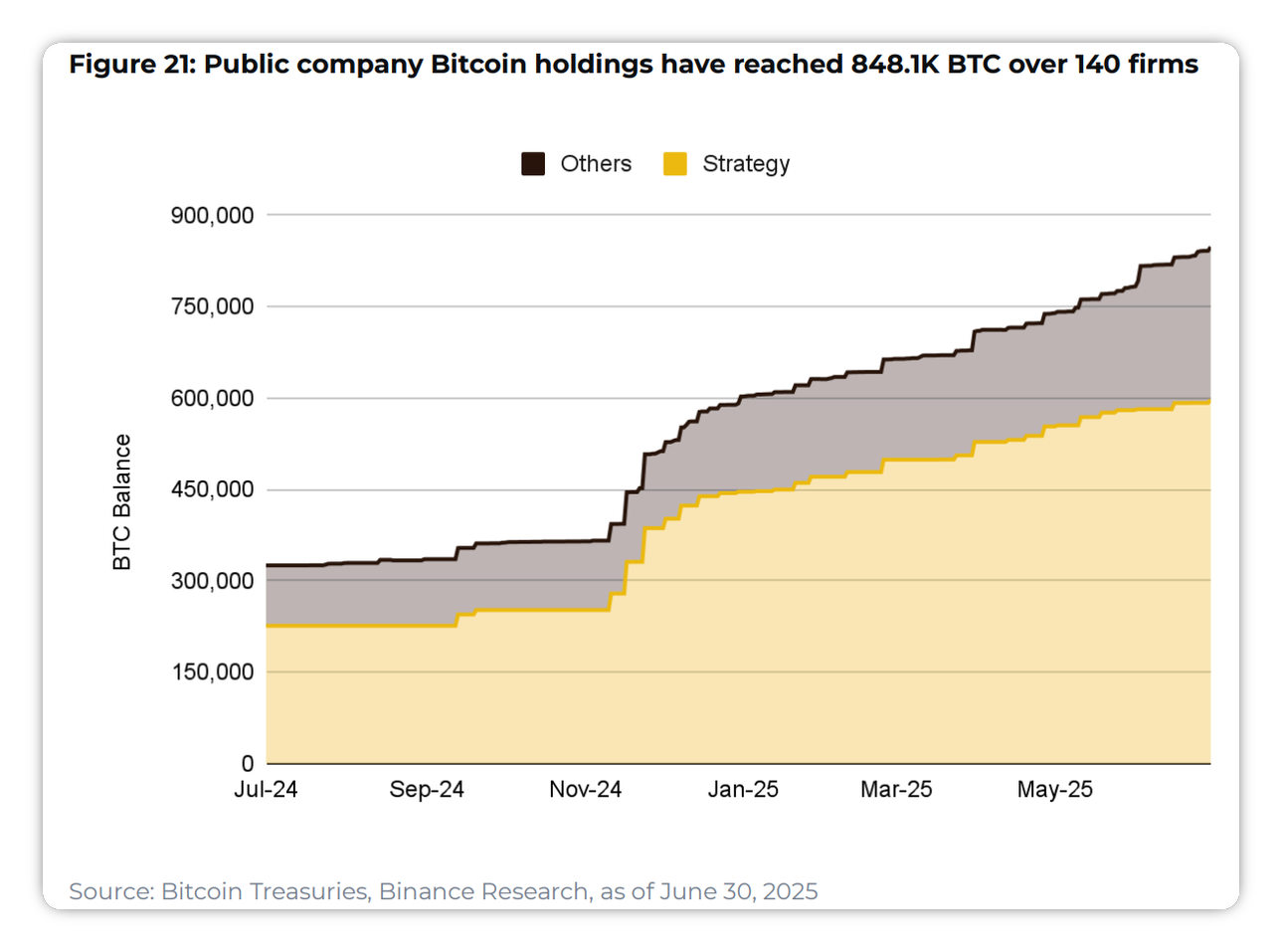
More than 140 public companies hold 848,100 BTC versus 325,400 a year ago. Strategy retains the lead with over 70.4% of aggregate reserves. Since the start of the year more than 50 new firms have disclosed bitcoin allocations, adding 245,300 BTC.
Record highs rekindled corporate interest in bitcoin. Amid inflationary pressure and geopolitical tension it is seen as a hedge and a tool to improve capital efficiency.
Regulatory clarity is also improving. US politicians are signalling a softer stance, making bitcoin reserves more appealing from a reporting perspective.
Bitcoin’s ecosystem is developing
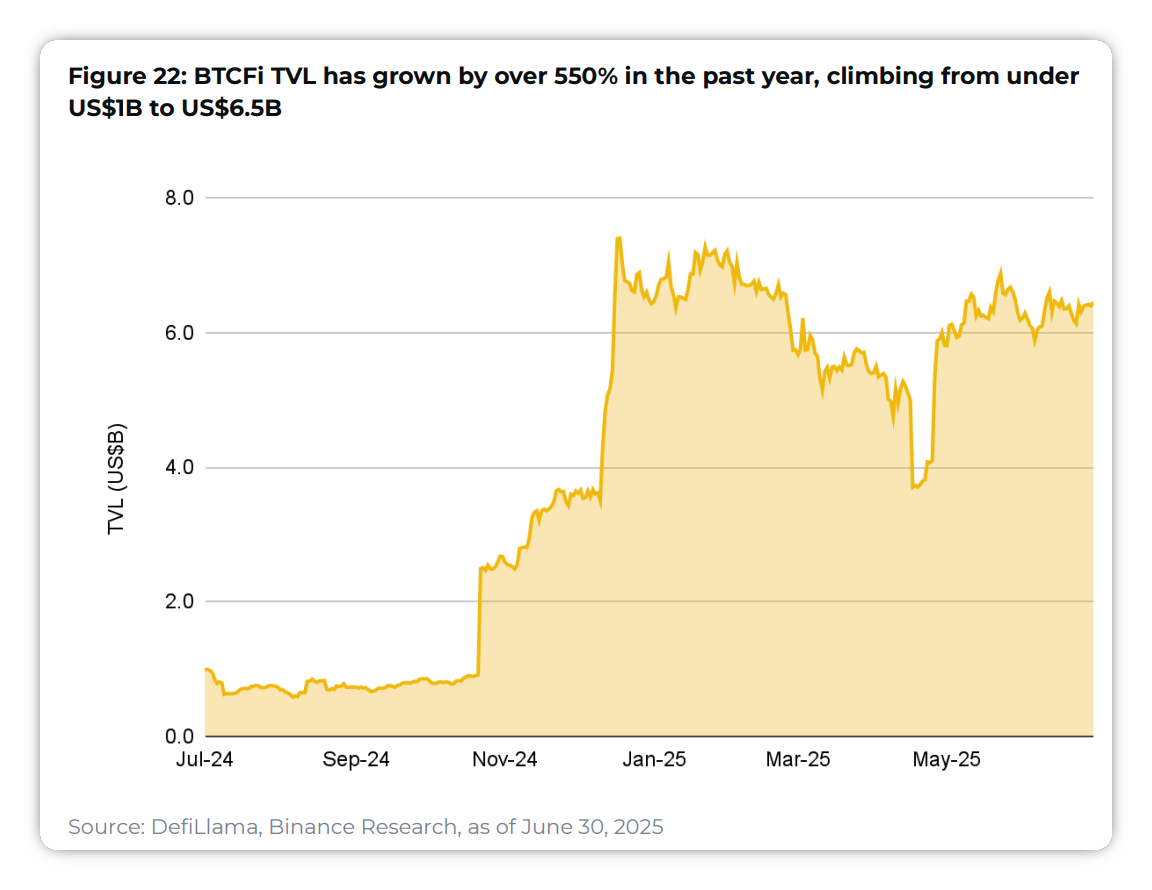
Scaling solutions for the original cryptocurrency made notable progress. TVL in bitcoin DeFi (BTCFi) rose by more than 550% year on year to $6.5bn.
Ordinals and BRC-20 tokens saw a pullback in speculative activity. Daily transactions fell to 300,000–375,000 — an 18-month low, less than half the 700,000-plus peak during last summer’s “Ordinals mania”.
Ethereum ran into headwinds
The second-largest crypto asset delivered mixed results. ETH’s price fell 26% year to date, lagging other digital assets and the broader market. The ETH/BTC ratio sank to multi-year lows around 0.023.
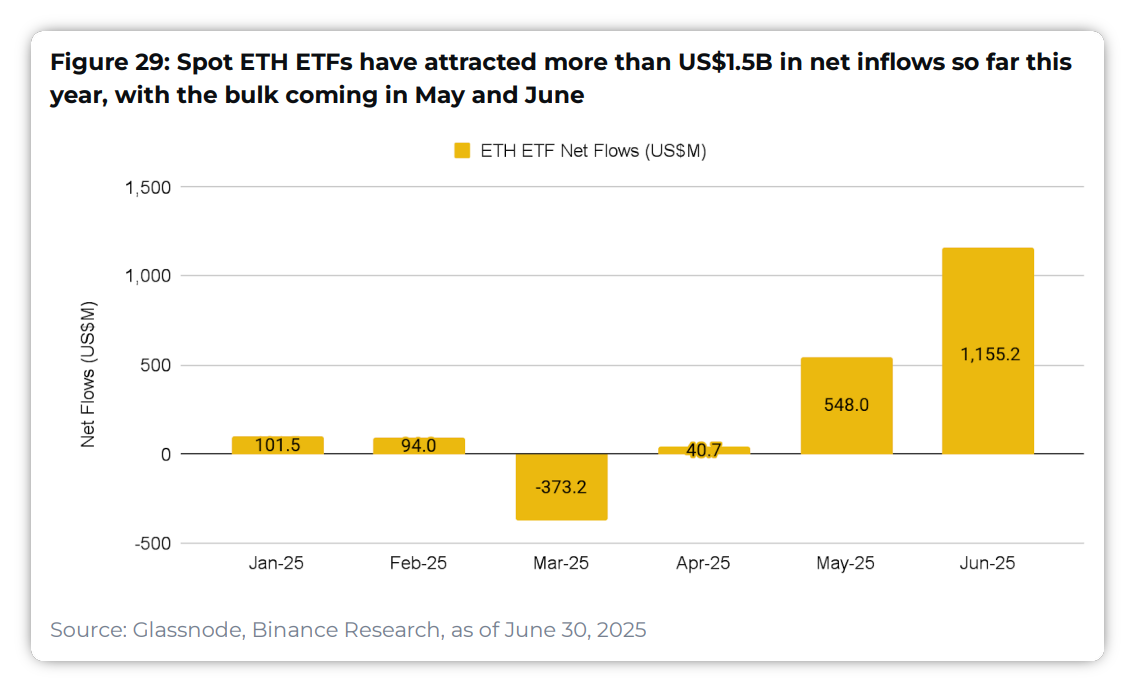
Even so, Ethereum’s institutional profile shifted notably. Spot ETH ETFs recorded a 19-day streak of inflows between May and June — a record, with more than $1.3bn added over the period. Net inflows over the year exceeded $1.5bn, most of it going to BlackRock.
The L2 ecosystem for Ethereum showed signs of market saturation and divergent growth paths. Optimistic rollups retained the lead in liquidity and user share. Base and Arbitrum stood out for steady fee generation. ZK-rollups achieved real technical gains in reducing proof costs, yet still lag in TVL and user retention.
Fragmentation and mixed progress towards Stage 2 keep the long-term prospects of Ethereum’s rollup-centric roadmap in limbo.
L1 blockchains and DeFi show maturity
Despite price pressure, Ethereum retained dominance. The protocol attracted institutional capital, successfully executed Pectra and leads on developer activity.
Solana sustained high throughput and improved network reliability ahead of Firedancer. Institutional interest in the protocol rose.
BNB Chain posted record activity on decentralised exchanges. The ecosystem expanded into memecoins, real-world-asset tokenisation (RWA) and AI applications. The protocol shipped the Pascal and Maxwell upgrades.
Avalanche accelerated adoption of enterprise subnets, and Sui more than doubled DeFi TVL. TRON cemented its position as a major network for stablecoins, while TON deepened its integration with the Telegram messenger.
DeFi’s TVL held steady at $151.5bn — down just 5.8% year to date. User engagement surged: monthly active addresses in decentralised protocols topped 340m, up 240% year on year.
According to the analysts, rapid user growth amid a cooling altcoin market suggests DeFi is moving beyond a speculative bubble. The market showed specialisation across three leading blockchains:
- Ethereum cemented its role as the network for institutional capital with $89.4bn in TVL (58.44% of the market);
- Solana became the leader for retail activity, thanks to high speed and low fees;
- BNB Chain attracted users via PancakeSwap, capturing a sizable share of DEX volumes.
Restaking became an important segment of the ecosystem. The EigenLayer protocol, with TVL above $11bn by period end, created a Security-as-a-Service market, significantly boosting Ethereum’s capital efficiency.
Stablecoins reached a $250bn market cap
Total stablecoin capitalisation surpassed the previous $174bn peak before Terra’s 2022 collapse. Growth of roughly 22% in the first half to more than $250bn reflects renewed confidence and accelerating mainstream adoption.
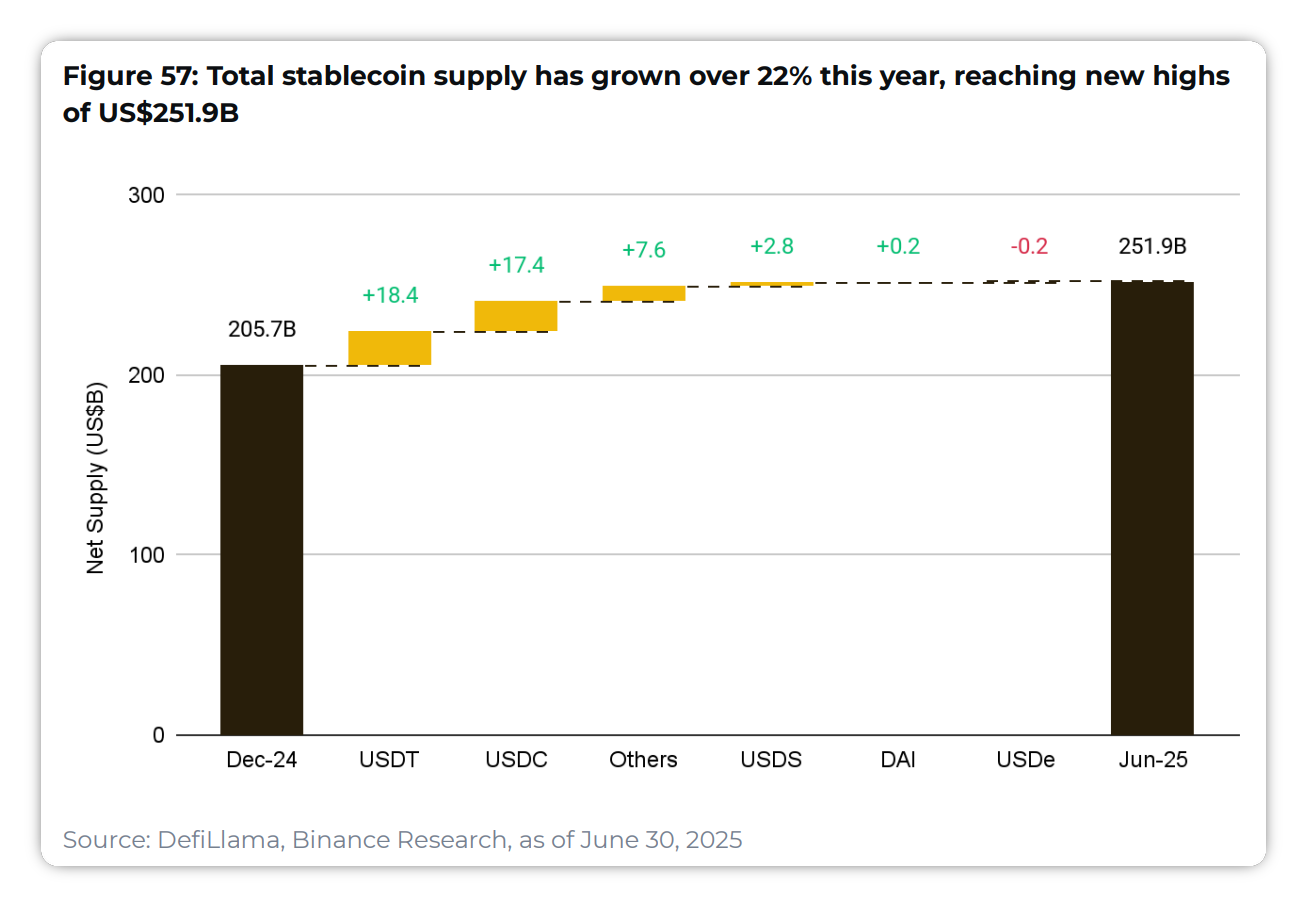
Tether (USDT) retained dominance with a market cap of $153–156bn, helped by first-mover advantage and deep integration into trading venues. USDT remains the quote currency on many exchanges, particularly in Asia.
USDC’s float grew from about $42bn at end-2024 to $61–62bn in June. That lifted USDC’s market share from roughly 20% to about 25.5%, making it the fastest-growing large stablecoin in the first half.
Circle — the USDC issuer — became the first stablecoin company with a US listing via an IPO on June 5th on the NYSE. The shares jumped from $31 to $200 on the first day — one of the best fintech IPOs in recent years.
The regulatory landscape changed dramatically
On July 19th US President Donald Trump signed the GENIUS Act, establishing a federal framework for stablecoin oversight. The law requires full backing of stablecoins with liquid assets and annual audits for issuers with market capitalisations above $50bn.
«We will preserve the dollar’s status as the world’s dominant reserve currency — and we will use stablecoins to do it,» Binance Research quotes US Treasury Secretary Scott Bessent as saying.
The EU fully implemented MiCA. Asia showed divergent approaches: Hong Kong actively positions itself as an innovation hub with the launch of stablecoin-issuer licences, whereas Singapore shifted to strict regulation.
The second-half outlook
Binance Research highlighted ten themes:
- A Fed pivot and fiscal expansion. With inflation easing and the labour market slowing, a return to hawkish policy looks unlikely.
- America’s policy shift. Moving from enforcement to legislation to boost institutional adoption. Key progress is expected on stablecoins, DeFi, bitcoin reserves and CBDCs.
- Faster integration of crypto into TradFi. More crypto-company IPOs and strategic acquisitions by traditional financial players, and diversification of corporate treasuries into crypto assets.
- Stablecoins in payments. Major players will expand integrations; retail giants will issue their own dollar stablecoins.
- RWA move to secondary markets. An evolution from static issuance to active secondary trading of institutional products.
- BTCFi moves towards using bitcoin as collateral at scale. The next phase will show whether digital gold becomes collateral via conservative lending and stablecoin issuance.
- Rollup development. The sector is making progress towards “real” decentralisation and Ethereum’s chosen development model.
- AI integrations in crypto. Since January 2025 AI-related on-chain activity is up 131%. Some 4.42m daily users interact with AI dapps.
- Prediction markets as a global information layer on forthcoming events. Platforms are positioning as “News 2.0”, with the potential to become an infrastructure layer for real-time event intelligence.
- Altcoin rotation has yet to materialise. Bitcoin dominance remains high; structural factors may restrain momentum (a glut of new tokens and a lack of a convincing new catalyst).
The report is available to download free of charge and contains detailed analysis of the trends mentioned, with charts and additional data.
In July, Binance reached 280m registered users on its eighth anniversary. Over its lifetime, aggregate spot and derivatives trading volume on the platform exceeded $125trn.
Рассылки ForkLog: держите руку на пульсе биткоин-индустрии!