



Week in Review: Binance imposes restrictions on Russian clients, and the NBU bans crypto purchases from hryvnia accounts
Binance imposed restrictions on users from Russia; the National Bank of Ukraine set a limit on quasi-cash operations that affect cryptocurrency purchases; Justin Sun announced the launch of the algorithmic stablecoin USDD; and other events of the past week.
Bitcoin hits a local low
On Monday, 18 April, the price of the first cryptocurrency updated its local minimum from mid-March at a level below $38,500. However, by evening the price had returned to around $41,000, and on Thursday, 21 April, it nearly touched $43,000.
At the time of writing, bitcoin was trading near $39,640.
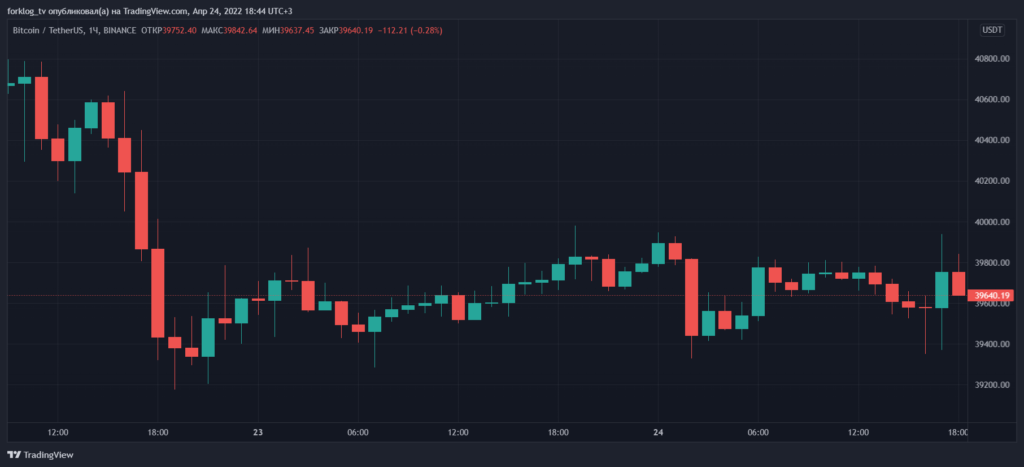
Arcane Research analysts noted that the correlation between bitcoin and tech stocks had reached its highest level since July 2020, and predicted a drop in bitcoin mining profitability. In Glassnode they allowed that Bitcoin could have bottomed, noting a redistribution of coins among investors in the $35,000-$42,000 range.
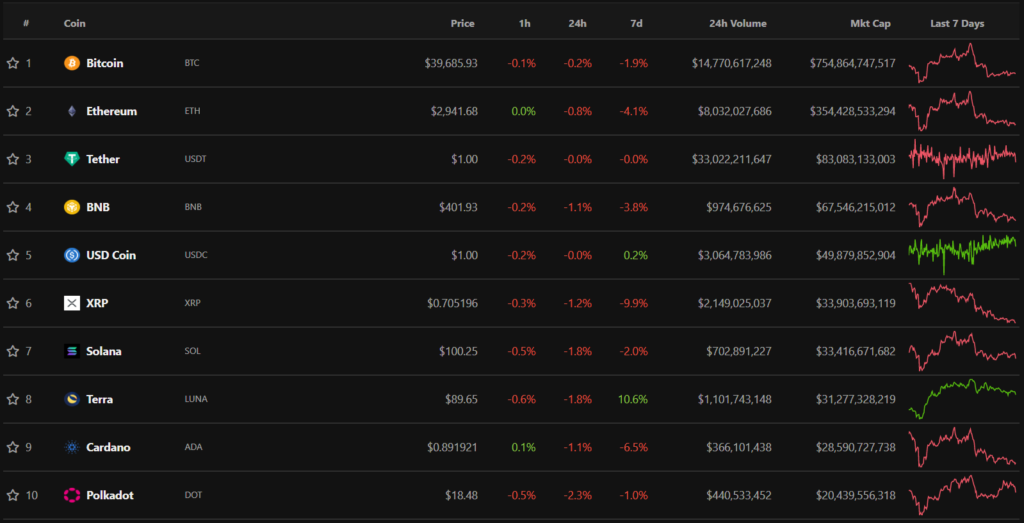
The flagship pulled the rest of the market. Almost all top-10 digital assets by market capitalisation closed the week in the red. The exception was Terra (LUNA), whose prices rose by more than 10% over the past seven days.
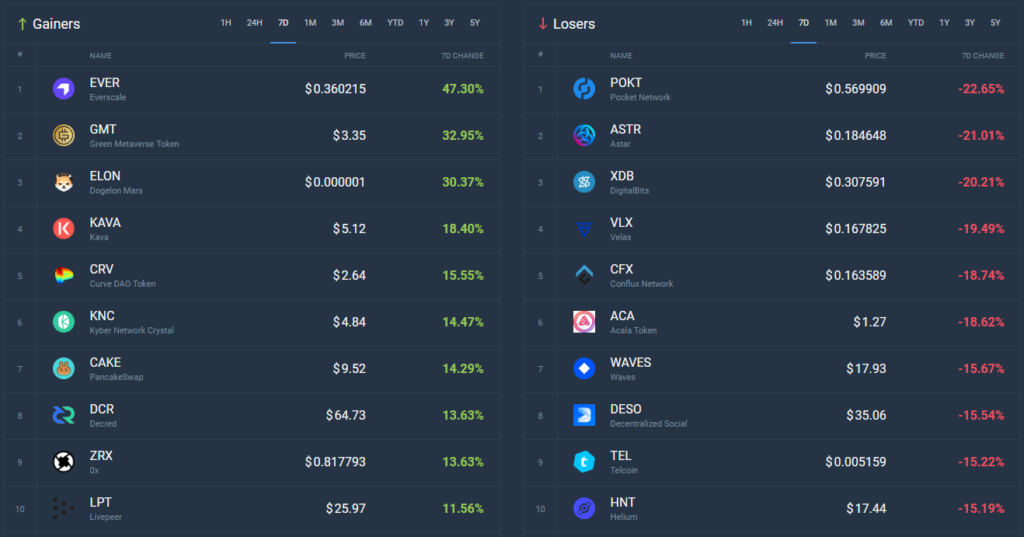
According to CoinCodex, among mid-cap digital assets the biggest gainer over the week was the Everscale blockchain token (EVER). Against the backdrop of the growing popularity of the decentralized exchange FatQube, its price rose 47%.
The token of the Pocket Network (POKT) fell, by 22%.
The aggregate crypto market capitalisation stood at $1.9 trillion. Bitcoin’s dominance index rose to 38.9%.
Binance imposes restrictions for users from Russia. Media reports ties between the exchange and Rosfinmonitory
The cryptocurrency exchange Binance announced restrictions for accounts held by Russian residents whose total crypto assets exceed €10,000.
They will have access only to withdrawals. The company does not plan to cease services in Russia for now. However, Binance noted that it is monitoring the political situation and that, should international sanctions against the country widen, they will apply them as well. The measures followed the EU’s fifth package of restrictive measures against Russia.
Reuters reported that the regional Binance office had links with Rosfinmonitoring and the FSB. The deal allegedly included assistance in doing business in the region in exchange for handing over customer data (names and addresses) to law enforcement under the pretext of countering terrorist threats and illicit activity.
The events unfolded amid Rosfinmonitoring’s bid to identify crypto assets of opposition figure Alexei Navalny.
The exchange denied Reuters’ account, publishing correspondence with journalists from the agency and denying accusations of collaboration with Russian state bodies.
The company said Russian authorities never approached the platform about Navalny. Binance also rejected claims that it shares any user data with Russian regulators and with FSB-linked agencies.
BitRiver mining group placed under US sanctions
The US Treasury imposed sanctions on BitRiver, a group of companies operating mining data-centres in Russia. The agency notes that the 2017-founded operator currently has three offices in Russia. Ten subsidiary entities were also included in the sanctions list.
NBU bans cryptocurrency purchases from hryvnia accounts
The National Bank of Ukraine introduced additional restrictions on cross-border transactions by citizens, which also affect cryptocurrency transfers, in an effort to prevent capital flight amid martial law.
Under the order, individuals are temporarily prohibited from conducting quasi-cash operations from hryvnia bank accounts and in foreign currency above 100,000 hryvnias per month. Such operations include cryptocurrency purchases, topping up brokerage or forex accounts, topping up electronic wallets, buying gift certificates, transfers to bookmakers, payment of traveler’s checks and other.
Trend toward algorithmic stablecoins gains momentum
The market capitalisation of the algorithmic stablecoin TerraUSD (UST) neared $18 billion, enabling the asset to surpass Binance USD (BUSD) and take third place in the stablecoins ranking. Against the backdrop of UST’s success, the ecosystem token LUNA rose 17.5% on 19 April.
Tron founder Justin Sun announced plans to launch his own algorithmic stablecoin USDD on 5 May. Tron DAO will manage the stablecoin. According to Sun, the organisation will provide an annual yield of about 30%.
In contrast to the apparent trend, Tether’s chief technology officer Paolo Ardoino criticised algorithmic stablecoins, arguing that their approach to collateralisation makes such assets a risk to the crypto market:
“If you experience a liquidation of an algorithmic stablecoin on the scale of UST, the market may cope with it. But imagine if you had a stablecoin like Tether with a market capitalization of $80 billion or $100 billion, which is mainly backed by digital assets. It’s hard to imagine what would happen and to be confident in sufficient liquidity to stop a cascading effect”, — he said.
MetaMask warns Apple users of loss risk; Phantom launches Android wallet
The MetaMask team warned non-custodial wallet users about the risks of storing data in Apple iCloud due to possible phishing attacks, and advised disabling MetaMask backups in device settings.
Meanwhile, the Solana-based wallet Phantom launched a mobile version of its app for Android devices.
U.S. authorities warn North Korea-linked hackers targeting the crypto industry
The Cybersecurity and Infrastructure Security Agency, the FBI and the U.S. Treasury issued a joint warning about threats from North Korean hackers aimed at stealing cryptocurrencies. It lists Lazarus Group, APT38, BlueNoroff and Stardust Chollima.
Earlier this week, Binance chief Changpeng Zhao said that the exchange had successfully confiscated assets from 82 wallets belonging to North Korean hackers, totaling $5.8 million. They were linked to the Ronin sidechain hack (Axie Infinity), whose damage was estimated at $625 million.
Beanstalk Farms DeFi protocol lost $181 million in a hack
The Ethereum-based Beanstalk Farms stablecoin protocol lost more than $181 million in crypto as a result of a hack. The hacker obtained about $76 million. The attack was carried out using a $1 billion loan, enabling the attacker to execute a fraudulent withdrawal vote.
This week also saw a curious incident involving Zeed on the BNB Chain, where an unknown actor destroyed a smart contract containing assets worth about $1 million.
On Saturday, due to a bug by the AkuDreams team, the Dutch NFT auction project ended with users’ funds lost. More than 11,539 ETH (~$33.93 million) were permanently locked in a smart contract.
Nike and RTFKT unveil first NFT collection; BAYC creators reveal the Otherside metaverse launch date
Nike and RTFKT unveiled the first NFT collection on the Ethereum blockchain. The digital sneakers are inspired by the Nike Dunk silhouette.
Yuga Labs will launch the Otherside metaverse on 30 April. Over the past 24 hours, sales of BAYC and MAYC NFTs rose by 18% and 108%, respectively.
U.S. will settle Ross Ulbricht’s debt with seized Bitcoin worth $2.7 billion
The U.S. authorities will utilise the seized 69,370 BTC (about $2.75 billion) to satisfy the state’s claim against Ross Ulbricht, founder of the Silk Road, amounting to $183 million.
In April 2013, the hacker stole 69,370 BTC during the operation of the illegal marketplace. In November 2020, law enforcement seized the bitcoins. Ulbricht declined to claim them.
A date for the sale of the seized crypto assets has not been announced.
Uniswap Labs announces frontend-level blocking of sanctioned addresses
Uniswap Labs, the developers behind the leading Ethereum exchange Uniswap, began blocking at the frontend level addresses associated with illicit activity.
Blockchain-data monitoring is implemented in collaboration with TRM Labs. The latter flags crypto wallets that may be linked to hacker activity, fraud, financing of terrorism, ransomware, human trafficking, as well as sanctioned addresses.
Russian bankers propose criminal liability for holding crypto on non-custodial wallets
In the Association of Banks of Russia, they developed a concept for the recovery of crypto held on non-custodial wallets. It envisages criminal liability for their owners.
The concept provides for criminal liability simply for the possession of assets on such wallets if the cryptocurrency has not been declared.
Also on ForkLog:
- Hollywood will adapt a book about Ethereum and Vitalik Buterin.
- Snoop Dogg will present NFT-based cannabis farms.
- Bloomberg reported that Blockchain.com is preparing for an IPO this year.
- Coinbase launched a beta version of its NFT marketplace.
What else to read and watch
Move-to-Earn gained traction in 2022. One of the most notable players in the segment is STEPN. ForkLog has looked into how the app works, what pitfalls exist, and whether daily exercise can boost financial well-being.
In ForkLog’s educational cards, we explain what the blockchain trilemma is and how the Everscale project works.
ForkLog AI has compiled the most important AI news from the past week.
The DeFi sector continues to draw heightened attention from crypto investors. ForkLog has compiled the week’s key events and news in a digest.
On Monday, 18 April, ForkLog LIVE broadcast discussed Bitcoin’s price, the race among L1 protocols and other news. Guests were Tone Vays — a trader and ForkLog contributor — and Nikita Inshakov and Vladimir Maslyakov from HyperFlex.
Рассылки ForkLog: держите руку на пульсе биткоин-индустрии!